

Key takeaways
- Partner training needs access, branding, and workflows built for external users.
- Field agents need short, role-specific mobile learning that works under real constraints.
- Certification should control readiness for products, campaigns, and compliance-sensitive tasks.
- App-Learning fits partner networks where consistent knowledge directly affects activation and sales...
External enablement needs its own operating model
There is no universally best partner training platform. The right choice depends on who the partners are, how they work, and what failure costs the business money. A reseller academy can tolerate a browser-first portal. A telecom or prepaid field network cannot. Agents need help between customer conversations, on low-end Android devices, with changing tariffs, stock rules, and compliance requirements.
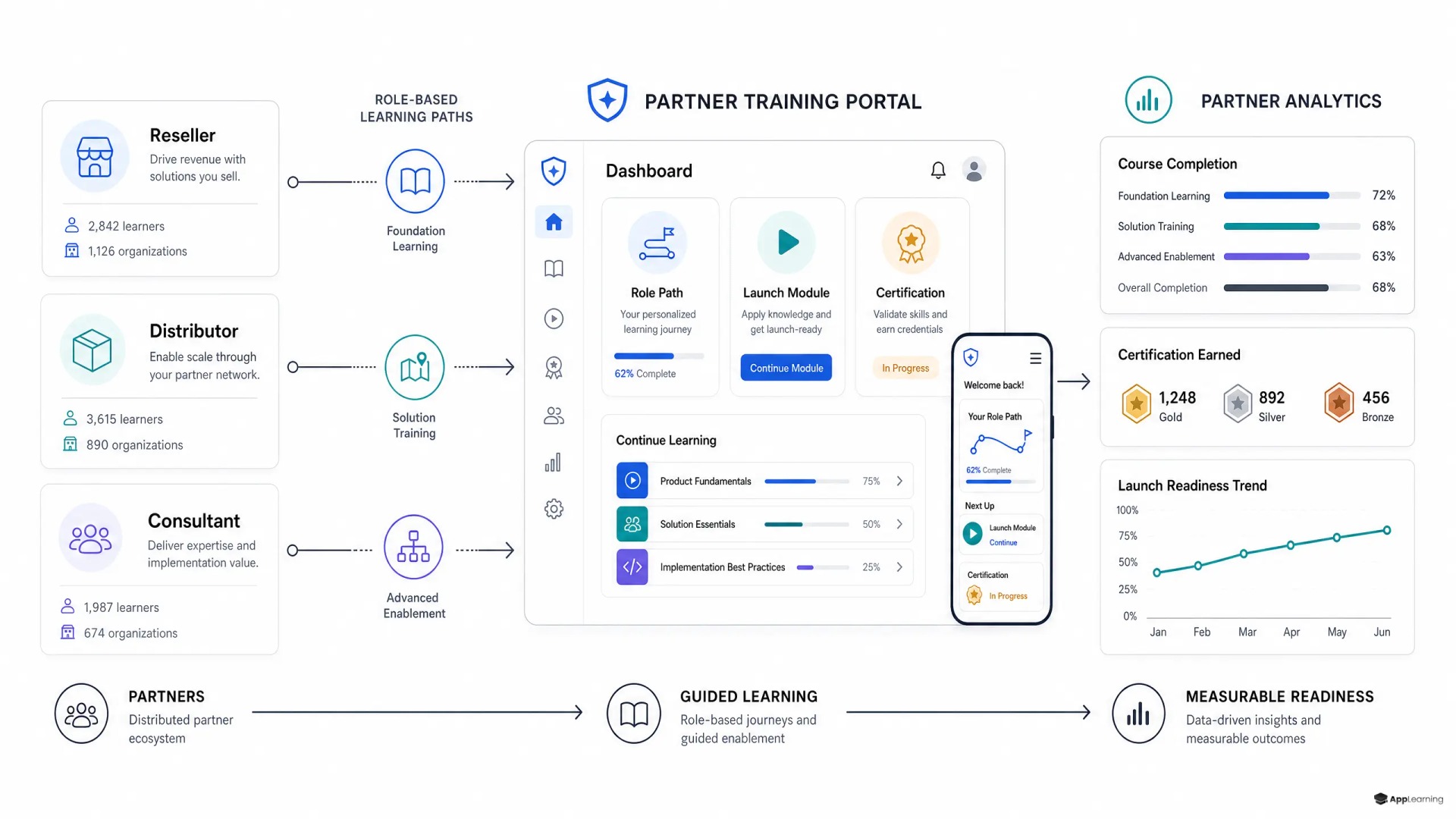
A capable external training platform makes access simple without exposing the internal employee environment. It supports role, region, language, and campaign paths. It gives each partner a credible branded experience. It checks readiness before a new offer reaches the market. Most importantly, it connects learning data to activation, support demand, and sales performance rather than treating completion as the finish line.
Internal portals create friction at the field edge
Internal LMS portals are usually built around employee identities, HR structures, desktop use, and long-form courses. Partners sit outside that model. They may be independent, temporary, distributed across regions, and active in several operating systems at once. If they need corporate credentials, a VPN, a large download, or a long video to learn a new promotion, the business has made training optional in practice.
Static PDFs fail for the same reason. They publish information but do not sequence action, test understanding, or show where agents are stuck. Partner enablement training should guide a new user from registration and setup to the first sale, then repeat that pattern for every product launch and process change.
Platform fit follows the partner model
The comparison should start with the partner workflow, not a generic feature checklist. These platforms address different versions of the problem.
- Docebo suits complex extended-enterprise programs that need distinct partner domains, separate authentication, certification renewal, and broad system integrations. It fits central teams with the capacity to run enterprise governance.
- LearnUpon is strong when distributors, resellers, customers, or regional groups need separate branded portals managed from one environment.
- TalentLMS is a practical option for teams that value a branded portal, multilingual delivery, and app-based access without starting with a large enterprise rollout.
- Skilljar is purpose-built for external education and suits partner programs that need a brandable academy, certification, integrations, and a conventional responsive learning experience.
- WorkRamp fits customer and partner education teams that need branded domains, SSO, certifications, and engagement tracking alongside sales and HR integrations.
- App-Learning has the clearest fit for broad field-agent networks where onboarding, product updates, short quizzes, certificates, gamified mechanics, and readiness analytics must sit close to the sales workflow.
Mobile readiness separates field systems from content portals
For field sales, mobile access is not a checkbox. It is the delivery constraint that shapes every other decision. Short, localised modules, clear visuals, optional audio, low-data formats, and resumable learning matter more than a large course catalogue. The World Bank identifies downloadable content and compressed, bite-sized lessons as useful patterns for low-bandwidth learning environments in its guidance on online skills training.
Do not accept “mobile responsive” as proof of field readiness. Test the platform on the weakest common device and connection. Ask whether critical onboarding content can be cached, whether progress survives a dropped signal, whether quizzes sync reliably later, and whether agents can open a lesson from the existing field app without searching for another portal.
Good to know
Which partner training platform is best for field sales agents?
Choose the platform that works on the devices agents actually use and can connect learning to onboarding, campaign readiness, and sales activity. For large field networks, this usually matters more than a large content catalogue.
Should partners use the same LMS as employees?
They can share a core platform, but partners need separate access, branding, content paths, and reporting. Reusing an employee portal without adapting the experience usually creates friction.
Which metrics show whether partner training is working?
Start with activation and readiness. Track time to first sale, pass rates, campaign certification, support requests, early sales quality, and drop-off by region or agent cohort.
Certification must control real permissions
Certificates are useful only when they represent a business control. In a field-agent business, a pass should unlock or confirm readiness for a new campaign, tariff, registration flow, payment process, or compliance-sensitive product. A badge that changes nothing is decoration. A readiness gate gives operations a clear record of who received the update, passed the check, and is eligible to sell.
This changes analytics as well. Track pass rates, failed questions, repeat attempts, campaign reach, and certification expiry by region, supervisor, language, and product. Then connect those signals to time to first sale, support tickets, reversals, and early sales quality. That is the performance visibility a CEO or COO needs from a partner training platform.
Build a mobile partner academy that agents can use in the field.
TalkThe selection process should expose operational gaps
Run every shortlisted platform through one live use case: launch a new prepaid offer to a mixed-literacy agent network across several regions. The platform should prove that it can handle the whole loop, from targeted notification to learning, assessment, certification, supervisor visibility, and update into the systems that run the field.
- Create external access without employee-style login friction.
- Segment paths by partner type, region, language, and campaign.
- Deliver one practical field action per short module.
- Make certification a gate before commercial or compliance-critical activity.
- Test weak connectivity, low storage, interrupted sessions, and delayed sync.
- Connect readiness data to CRM, agent onboarding, support, rewards, and performance reporting.
- Give commercial, operations, and compliance teams clear ownership of content approval and expiry.
The strongest partner academies do not win by storing more content. They remove ambiguity at the point of work. When every agent receives the right update, proves they understand it, and can act without calling support, training becomes part of the operating system for activation, sales quality, and consistent execution.