

Key takeaways
- Multiple learning paths are a distribution problem before they are a navigation problem.
- Product learning should not become an unrelated extension of core onboarding.
- Stable routes connect cohort-specific curricula to existing operational channels.
- A shared academy preserves one foundation for identity, progress, branding and maintenance.
- Explicit routing rules make overlapping assignments and curriculum access auditable.
Cohort-Specific Learning Paths Should Not Require Separate Academy Builds
The second path tests the academy architecture
The first curriculum looks simple when everyone follows it. A second audience exposes the design decision underneath.
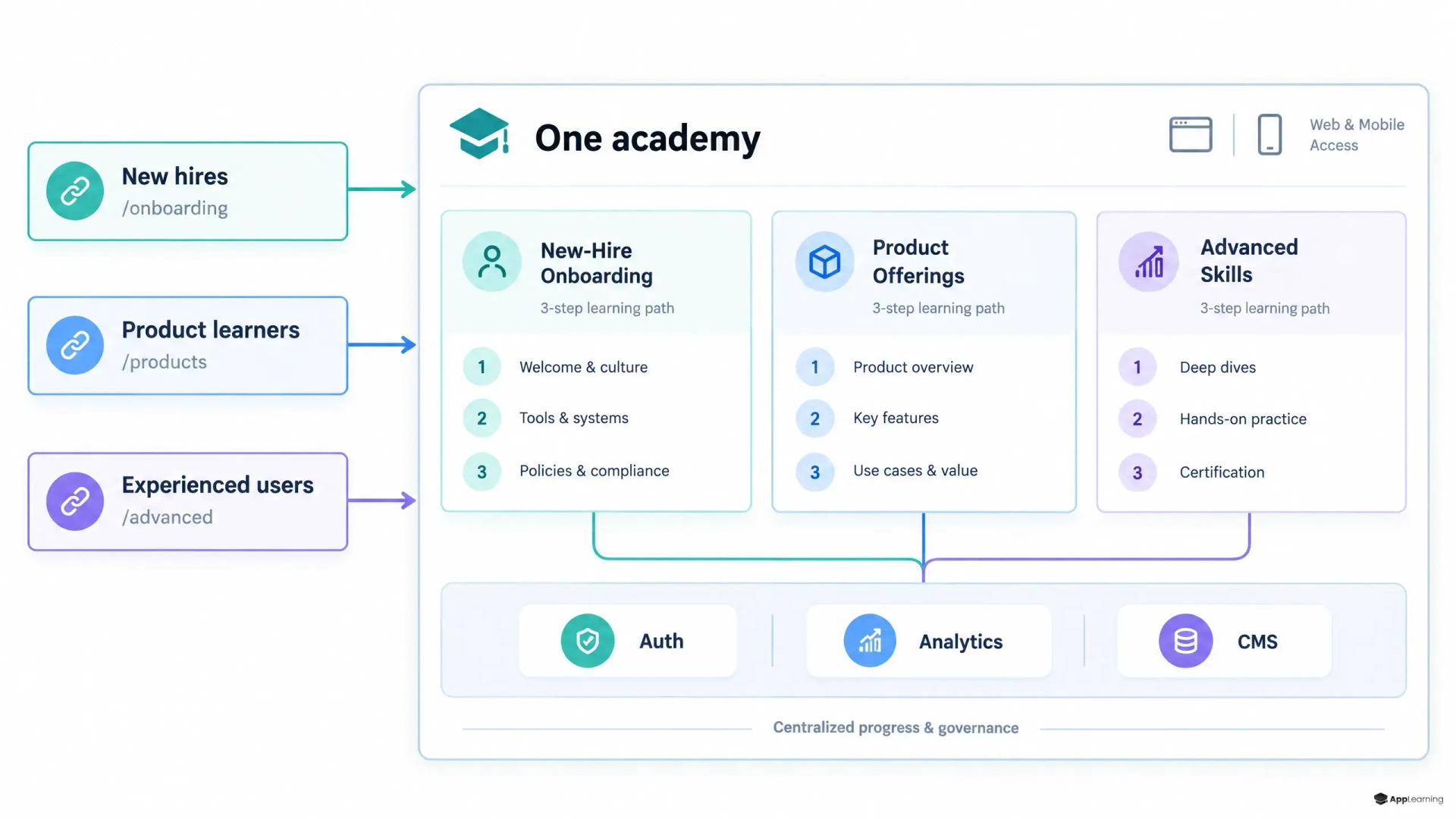
In an anonymized field-learning use case, new agents already had structured onboarding. The organization needed a separate product-knowledge path alongside it. App-Learning’s architecture supported exposing that curriculum through a dedicated route within the same application and CMS. The requirement was parallel learning, not another academy deployment.
Curriculum boundaries should not become application boundaries
Onboarding should remain focused on becoming operational. A product path should address a separate readiness requirement. Adding every topic to onboarding turns a defined journey into an expanding container. For an LMS supporting multiple learning paths, curriculum routing should select the journey while the academy application provides the shared environment.
Stable routes turn curricula into distribution destinations
W3C’s web architecture guidance treats address persistence as an ongoing commitment, not something a URL format guarantees. (w3.org) For a multi-course academy, each curriculum should therefore have a durable destination that survives menu changes and content edits.
Operations can distribute those destinations through CRM messages, email, field apps or internal portals. A product campaign should open its curriculum, not a catalogue that agents must search. Login should preserve the intended destination.
The shared foundation still needs access boundaries
OWASP recommends checking permissions on every request. (cheatsheetseries.owasp.org) A shareable route must therefore remain separate from permission to access its curriculum. Forwarding a campaign link should not bypass eligibility.
The proposed design keeps authentication, branding, content management and analytics shared. Progress belongs to the learner and the relevant curriculum version, not the message channel used to enter. A second path should not create a second learner record.
Overlapping cohorts need explicit precedence
An agent may need onboarding and product training simultaneously. Cohort-based learning paths should make both assignments visible while marking required work and prerequisites. A campaign route should open the campaign without silently replacing onboarding.
OWASP’s logging guidance calls for recording when, where, who and what for events. (cheatsheetseries.owasp.org) Applied here, the audit record should capture the learner identifier, cohort, curriculum version, assignment rule and timestamp.
Good to know
Does each cohort need a separate curriculum?
Only when its learning requirements differ. Several cohorts can share one curriculum while retaining distinct assignment records.
Does a dedicated route require offline support?
No. Offline access needs separate decisions about caching, synchronization and content expiry.
Failure states belong in the routing design
An unpublished curriculum needs an unavailable message. An expired campaign needs an approved successor or an explanation. Neither should silently send agents into unrelated onboarding.
W3C’s language guidance explains that identifying page language helps assistive technology render content correctly. (w3.org) Curriculum routing should also define translation fallback explicitly. Missing translations should not silently change the language, and entry on low-end phones should not require loading the entire catalogue.
Plan your parallel learning paths with App-Learning.
DiscussPath-level measurement should preserve one operational picture
The ADL xAPI specification supports parent and grouping relationships between learning activities. (github.com) Whether using xAPI or another event model, field agent training should distinguish assignment, route opening, first activity, completion and readiness-check results by curriculum.
Learning activation should mean a defined learning action, not a link click. Sales activation remains a separate outcome. The scalable academy gives each curriculum its own destination while keeping learner records and governance together. Another topic should require a publishing and distribution decision—not another academy build.