

Key takeaways
- Future earning and previously earned benefits need separate cutoff policies.
- Course completion remains independent of reward issuance and redemption.
- Auditable reward states make reconciliation and error recovery possible.
- Learner messages and support guidance need alignment before earning stops.
- Outstanding claims and disputes need monitoring beyond the feature release.
When Learning Rewards End, the Obligation to Learners Remains
Consider a learner who completes a course, earns a benefit and encounters an error during redemption. Meanwhile, the product team plans to stop future earning. These are separate problems. Removing the rewards screen resolves neither.
A feature switch cannot close an entitlement
A learning rewards sunset needs more than a release date. GOV.UK’s service retirement guidance (gov.uk) frames retirement around continuing user needs. Applied to a learn and earn app, that means separating the decision to stop issuing new promises from the work of resolving existing ones.
For a fintech growth team, the distinction is strategic. Education should still explain the product after the incentive disappears. App-Learning’s design principle is to keep that learning journey independent of its reward layer.
Four clocks govern the transition
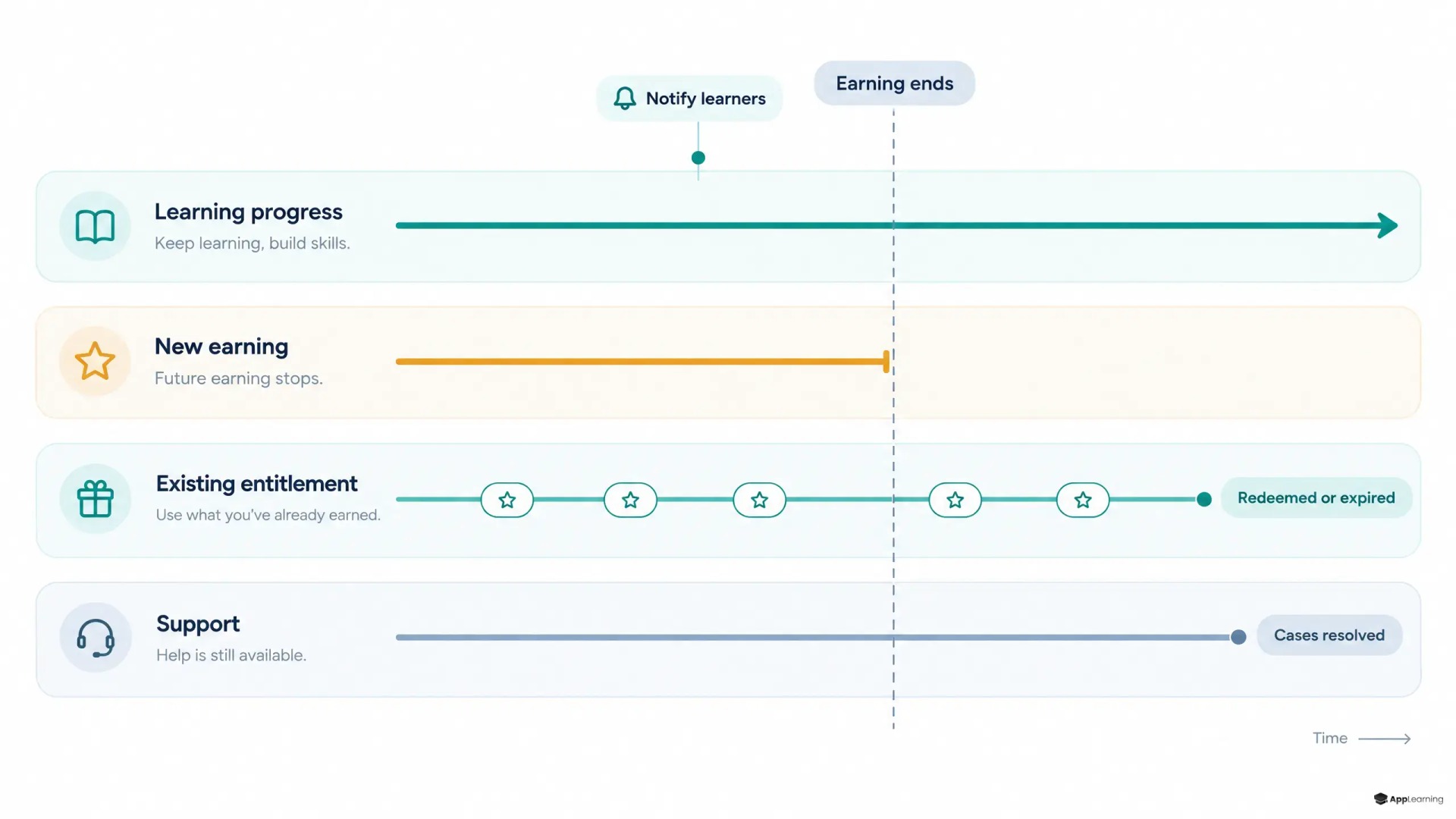
The LMS rewards lifecycle needs four explicit timelines, each with an owner and a transition rule.
- Earning ends at a defined timestamp and timezone, with rules for activity already in progress.
- Issuance processes eligible pre-cutoff activity, including delayed validation, without enabling new earning.
- Redemption continues for valid earned benefits under the agreed policy, independently of the earning cutoff.
- Support remains available for failed redemptions, disputed eligibility and unresolved cases.
Course progress follows a separate lifecycle. ADL’s xAPI specification (github.com) treats learning statements as immutable records with an explicit voiding mechanism. The architectural lesson is separation, not compulsory adoption of xAPI. A redemption failure should not reverse course completion.
A balance needs an explainable history
Incentive entitlement management should distinguish earned, pending validation, available, redemption pending, redeemed and disputed states. Expiry or cancellation needs its own reason and policy basis, not a generic zero balance.
OWASP’s logging guidance (cheatsheetseries.owasp.org) recommends recording when, where, who and what for events. A reward ledger should connect the qualifying activity, rule version, entitlement identifier, redemption attempt and outcome. Reconciliation should compare that ledger with fulfilment records. Manual corrections need an actor and reason, not silent overwrites.
Communication must describe the learner’s actual state
GOV.UK’s retirement guidance (gov.uk) recommends explaining what changes and how users can meet their needs afterwards. For rewards, one announcement is insufficient. Messages should distinguish learners with no balance, available benefits, pending issuance and open disputes.
Before cutoff, acquisition pages, onboarding, reward screens and support scripts should agree on dates and eligibility. An error message should explain whether a claim remains pending and provide a case reference. “Rewards have ended” is not an adequate response to an earlier valid claim.
Older app versions belong in the sunset test
The test matrix should cover old and new clients before and after cutoff, including offline completions, delayed issuance, cached configuration and provider timeouts. Server-side rules should govern eligibility; separate controls should govern earning, redemption and interface visibility.
RFC 9110’s retry guidance (rfc-editor.org) distinguishes operations that can safely repeat from those that cannot. Redemption needs application-level duplicate protection and status lookup. A timeout should trigger reconciliation before another fulfilment attempt, not an instruction to keep tapping.
Plan a rewards transition that preserves learner progress and resolves earned benefits.
DiscussClosure depends on resolved states
For gamified learning operations, aftercare should track outstanding entitlements, pending-case age, redemption failures and disputes separately from course completion and continued learning. Closure needs reconciled records, resolved or explicitly transferred cases, a retention plan and a named escalation owner.
A technology partner’s job is to make these transitions operable and explainable. The reward may have helped someone start learning. Its retirement should not erase their achievement, obscure an earned benefit or leave support guessing what happened.