
Key takeaways
- Technical release, visible availability and active promotion are separate launch milestones.
- Readiness criteria cover login, lessons, saved progress, quizzes and support.
- A pre-promotion activation baseline describes the early cohort, not the whole workforce.
- Initial activity reveals reach and friction, not learning impact.
- Wider promotion needs release monitoring and clear ownership of unresolved fixes.
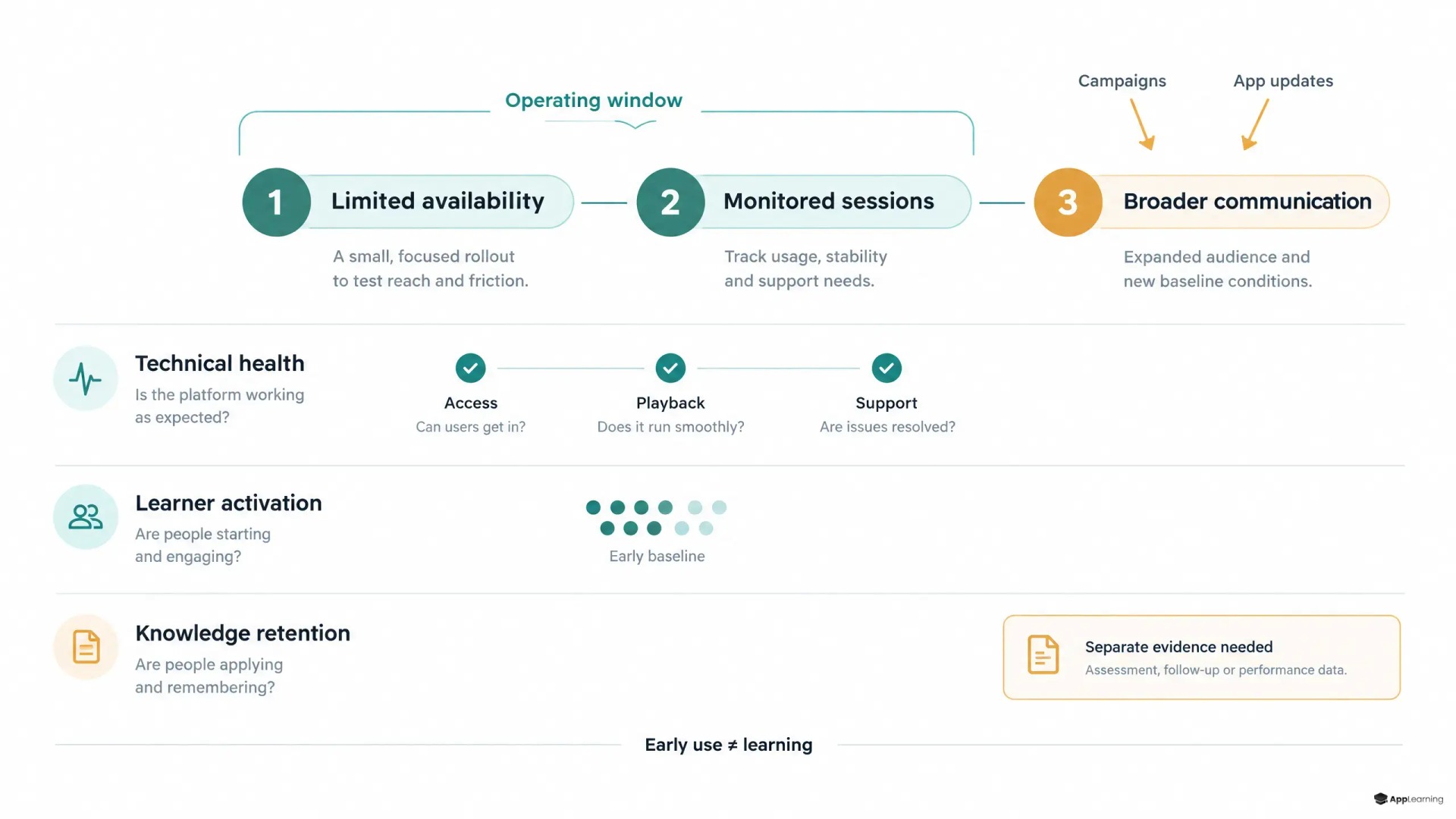
In one mobile-academy rollout, learners gained access before the formal announcement. The operating team reserved a short observation period to catch major regressions, with workforce promotion and a later release push still ahead. The useful lesson lies in that sequence, not in any claimed participation or learning result.
One launch contains three milestones
Technical release means the academy is deployed. Visible availability means eligible agents can find and enter it. Active promotion means communication channels deliberately send people there. These milestones deserve separate timestamps in an employee training app launch.
The GOV.UK Service Manual describes private beta as limited access for real users before wider availability. (gov.uk) A phased learning platform rollout can use the same principle without confusing a quiet release with a completed launch.
Early activity needs a stable denominator
GOV.UK’s completion-rate guidance distinguishes starts from completions and excludes test users. (gov.uk) For an academy, a useful first-session learner activation measure is the share of unique entrants who finish their first lesson during that session.
Eligible agents, academy entrants and lesson starters belong in separate counts. The baseline should retain app version, region and entry channel. Campaigns and mandatory updates can change both who has access and who arrives. Comparing raw totals across those changes would mix distribution with usability. The early cohort is a starting reference, not a workforce benchmark.
The learner path must be observable
Academy launch monitoring should connect login, academy entry, lesson start, lesson completion, saved progress, quiz submission and support requests. A completion event should mean the result was saved, not merely that someone tapped a button.
For field agents, readiness checks should include low-end Android devices, interrupted connections and supported languages. Where offline use is supported, the checks must distinguish locally saved progress from confirmed synchronisation. Content errors need lesson and version references so the team can reproduce them.
Release checks need an escalation owner
GOV.UK’s assisted-digital guidance includes support design and performance measurement during private beta. (gov.uk) An LMS rollout checklist should therefore test the support route alongside the learning path, with acceptance criteria agreed before promotion.
- Verify that an eligible agent can sign in and reach the first assigned lesson.
- Complete a lesson and quiz, reopen the app and confirm progress persists.
- Report a content error and test the support route through to resolution.
- Review session failures and support requests daily, recording severity, owner and retest status.
One release lead should own escalation and the expansion decision. Login failures, lost progress or blocked required assessments should hold promotion until corrected and retested. Other issues need an explicit acceptance decision, owner and deadline.
Promotion and mobile updates are separate decisions
Google Play supports percentage-based staged rollouts for app updates, not first-time app publication. (support.google.com) Academy access, campaign timing and update requirements should therefore remain separate release controls.
Expansion should follow evidence that the agreed journeys work and monitoring remains active. At App-Learning, the technology-partner role extends beyond deployment to readiness checks, learner-event instrumentation and feedback loops with the operator.
Plan an observable academy rollout with App-Learning.
DiscussLearning evidence comes after release evidence
CDC guidance separates learning assessment from workplace transfer and recommends follow-up after learners have had time to apply their training. (cdc.gov) For field sales, that suggests separate measures for product knowledge, demonstrated sales readiness and later performance. First-sale timing is a useful operational measure, but not proof that training caused the sale.
A quiet launch earns its value by making the next decision clearer. It should leave the operator with an observable learner journey, a bounded list of defects and named owners—not a premature claim that agents have learned.