

Key takeaways
- One generic certificate hides critical differences between selling, implementing, and supporting a product.
- Sales, technical, and delivery tracks need distinct evidence, assessment methods, and renewal rules.
- Readiness gates should unlock tangible rights such as co-selling, implementation access, and support tiers.
- Partner dashboards must expose company-level coverage gaps, not just individual course completions.
- Academy data can become an operational signal for channel quality and revenue readiness.
Certification collapses under channel complexity
A single partner certificate works when a channel is small and the product is simple. It stops working when partners take on distinct commercial, technical, and delivery work. A seller who can qualify a use case is not automatically able to scope an integration. A consultant who can configure the product is not automatically equipped to lead adoption or support a regulated customer.
This matters sharply in fintech. Product complexity raises the cost of poor explanation, poor implementation, and weak post-launch support. A partner academy strategy should therefore define the evidence required for each activity that affects pipeline, deployment quality, and retention. Completion is a useful event. It is not proof of readiness.
Glean’s new network is a useful market signal. It separates Referral, Commercial, Services and Solutions, and Technology pathways while establishing sales, technical, and delivery accreditations. The important lesson is structural: a partner may contribute in several ways, but each contribution needs its own proof standard.
Three tracks for three forms of risk
A mature partner certification program starts with the work partners perform, not the content a vendor has available. In practice, most B2B platforms need at least three tracks.
- Commercial readiness proves that a partner can identify the right customer, diagnose the problem, position the product accurately, and run a qualified co-sell motion.
- Technical readiness proves that a partner can configure, integrate, secure, and troubleshoot the product within defined technical boundaries.
- Delivery readiness proves that a partner can plan implementation, manage stakeholders, drive adoption, and hand over a stable customer operation.
These tracks may share product foundations, but they should diverge fast. Shared onboarding creates a common language. Role-specific learning and evidence prevent false confidence. This is the difference between channel partner training as a content catalogue and a system that controls operational access.
Privileges turn learning into a readiness gate
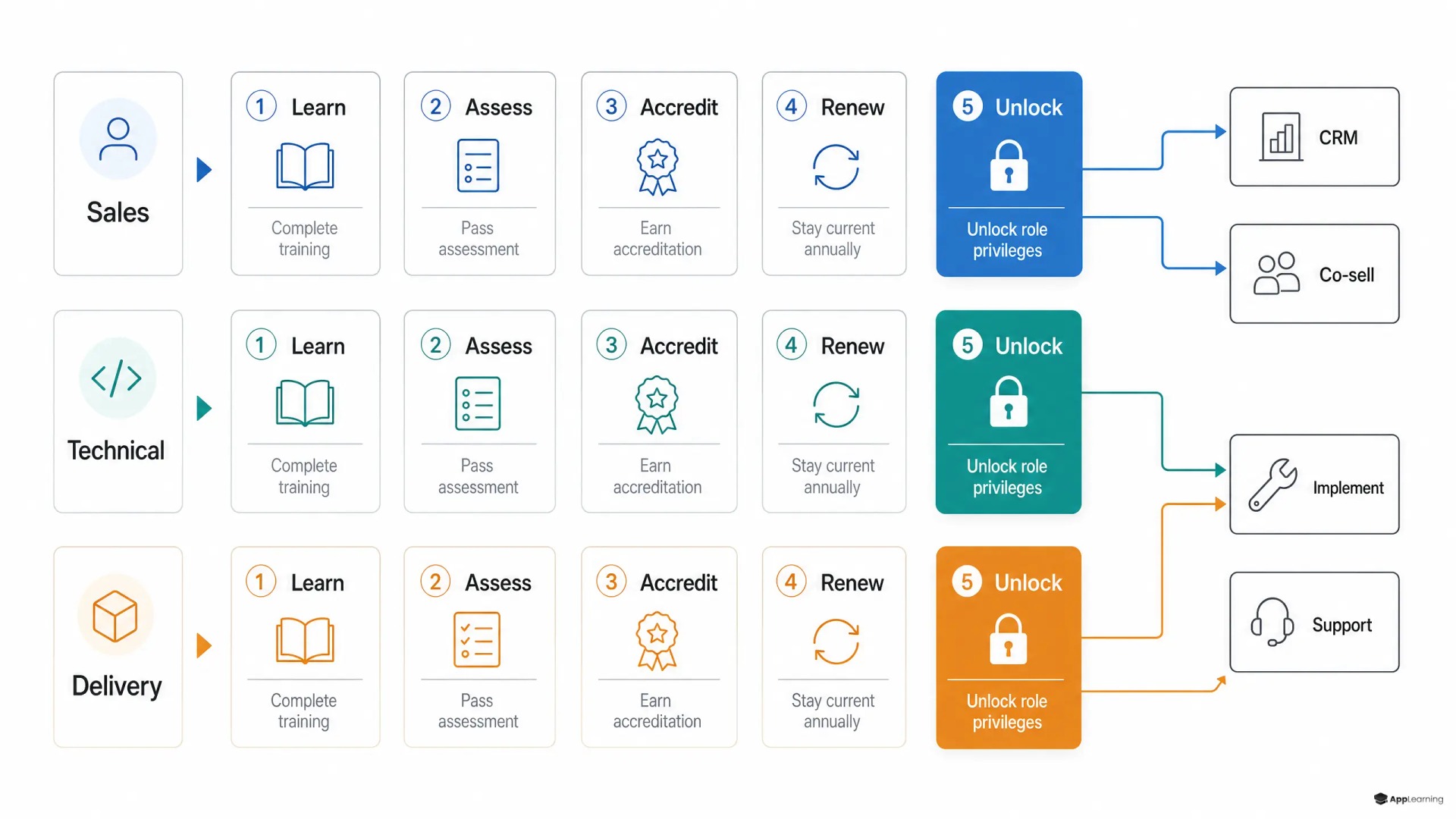
Readiness only changes behaviour when it unlocks something valuable. Connect each verified status to a specific right, benefit, or workflow. Commercial readiness can unlock deal registration, referral fees, lead sharing, or access to co-selling support. Technical readiness can unlock sandbox access, advanced documentation, integration support, or solution validation. Delivery readiness can unlock implementation rights, customer-facing services listings, escalated support, or higher service tiers.
The gate must also work in reverse. If a required accreditation expires, the relevant privilege should pause or route to an exception process. That is not punitive. It protects customers, protects the brand, and gives partner managers a clear basis for action.
Evidence must match the job
Different roles need different assessments. Sales teams need scenario-based discovery, positioning, and deal qualification checks. Technical teams need configuration tasks, integration exercises, and security or architecture decisions in a safe environment. Delivery teams need implementation plans, adoption plays, stakeholder decisions, and handover artefacts.
Renewal logic should follow product and risk change, not an arbitrary annual calendar alone. A major API revision, a new compliance obligation, or a material change to implementation practice should trigger targeted recertification. A partner enablement LMS can automate prerequisites, role pathways, scored assessments, expiry dates, and renewal assignments without making the experience feel bureaucratic.
Company coverage reveals the actual channel risk
Individual completion rates are a weak management metric. A partner company may have ten certified sellers but no qualified delivery lead in a target region. Another may have strong technical coverage but no commercial owner able to create pipeline. Both gaps limit growth, even if the academy dashboard shows high overall completion.
Measure coverage against the partner’s agreed business model. Track the number of active commercial, technical, and delivery-ready people by market, segment, product line, and strategic account. Add expiring certifications, open prerequisites, and opportunities that lack the right assigned capability. This turns partner readiness into a visible operating condition rather than an annual enablement report.
Good to know
Should every partner complete all three certification tracks?
No. Assign tracks according to the partner’s commercial model and intended activities. A referral partner may need only commercial foundations, while an implementation partner needs technical and delivery evidence.
How should certification renewal rules be set?
Base renewal on product risk and change. Use targeted recertification for material product, security, regulatory, or delivery-method changes, with a regular validity period as a backstop.
Which systems should receive partner readiness data?
Send verified role status, expiry dates, and competency tags to the CRM and partner operations platform. Use them to govern deal registration, staffing, access, support routing, and partner-tier decisions.
Academy status belongs in partner operations
The academy should hold verified learning evidence, while CRM and partner-management workflows use the resulting status. Match each learner to a partner-company record, pass role and expiry data into the operational systems, and surface readiness directly where teams register deals, assign implementation work, or request support.
This is especially useful for growth leaders in fintech. Education-led acquisition does not end when a partner completes a module. The same data can show which partners can credibly explain a complex offer, which markets have implementation capacity, and where a promising channel motion will fail without capability investment. Mastercard’s fintech programme similarly places an e-learning platform alongside physical training, mentoring, and ecosystem connections, showing how learning can sit inside a wider opportunity system rather than beside it.
Build a partner academy that proves who is ready to represent your product.
PlanThe academy becomes a channel control plane
The goal is not to issue more badges. It is to make a reliable decision about who may represent, implement, and support the product. When role-specific evidence triggers real privileges, the academy becomes infrastructure for channel quality. It gives partner teams a way to scale access without lowering standards, and it gives growth teams a clearer view of where ecosystem capacity can create qualified demand, successful delivery, and durable customer value.