

Key takeaways
- Product adoption tools and education platforms solve different parts of activation.
- Guidance drives the next action while education builds decision confidence.
- Complex fintech workflows often need both layers working together.
- App-Learning fits when adoption depends on understanding, trust, or compliance.
The product adoption platform is not the academy
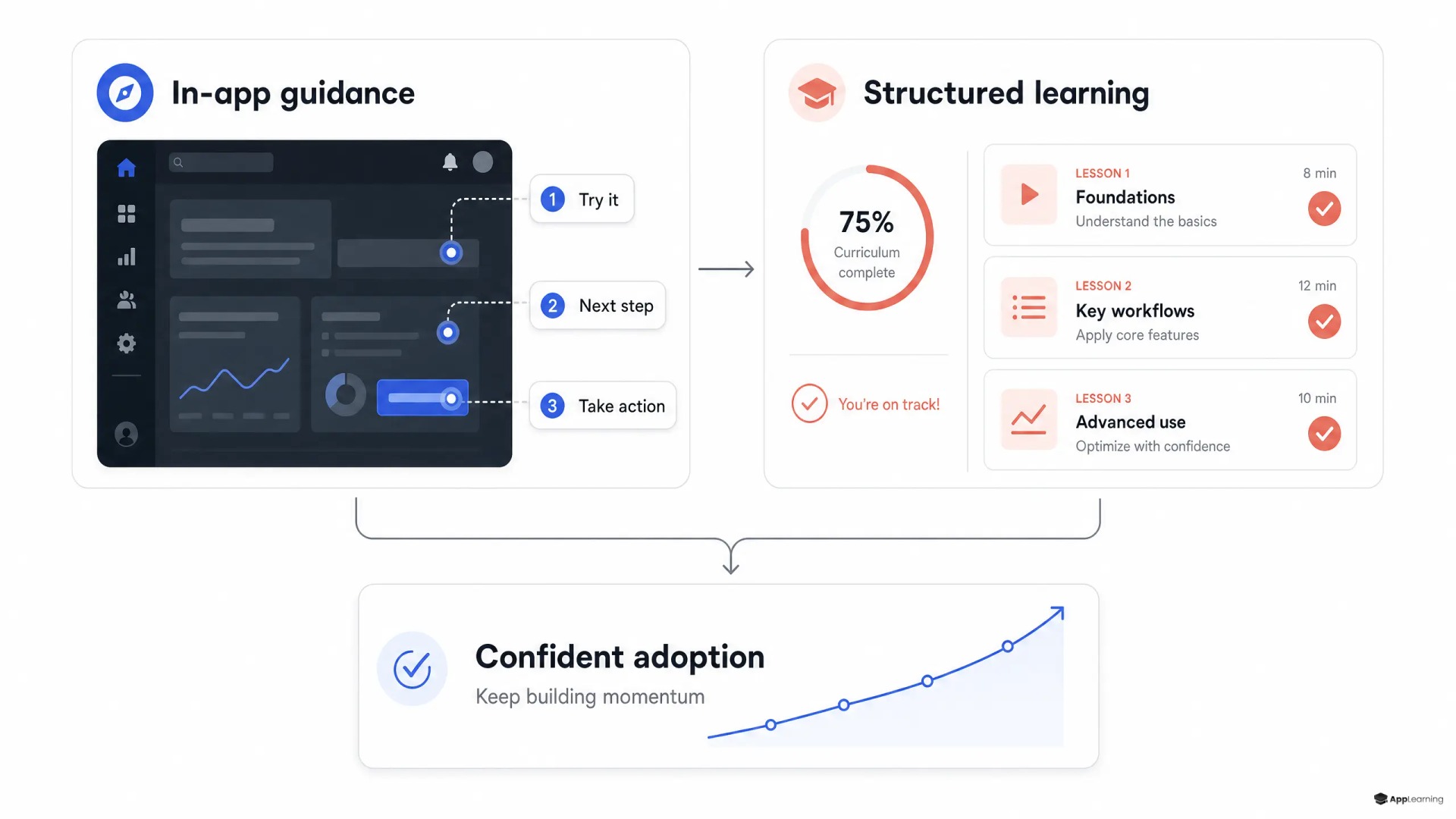
A product adoption platform helps users complete the next action inside a product. It uses prompts, walkthroughs, checklists, and contextual help to reduce friction at the point of use. Customer education software solves a different problem. It builds the knowledge, judgment, and confidence a user needs before an action makes sense.
The distinction matters most in fintech. A tooltip can show a user where to complete identity verification, create a recurring investment, or configure wallet security. It cannot reliably explain why the step exists, what trade-offs it creates, or when a different workflow is safer. That is the central test for product adoption platforms for customer education.
Guidance works best when the task is already understood
In-app guidance is strong when the user knows the goal and only needs help with execution. Think of a new dashboard, an unfamiliar setting, or a feature that is hard to discover. The best guidance is short, timely, and tied to one observable behavior.
Education becomes necessary when the user must form a mental model before acting. Financial products regularly create this condition. Users may need to understand custody, fees, market orders, tax records, account permissions, lending risk, or fraud controls before they can use a feature with confidence. Pushing them through a flow without that understanding can create abandonment, support demand, and poor decisions.
The market divides into action layers and learning layers
These scores are an operational fit assessment rather than an absolute vendor ranking. Guidance reflects contextual help in the product. Learning depth reflects structured curriculum, practice, and progression. Analytics reflects the layer’s ability to show behavioral or learning progress.
- With Pendo, teams get high guidance and high behavioral analytics, but low structured learning depth. It is a strong fit for targeted walkthroughs, feature discovery, and measurement of the actions that follow a guide.
- An Appcues Flow offers high guidance, low learning depth, and medium engagement analytics. It fits teams that need fast, no-code onboarding flows, tooltips, and lifecycle prompts.
- The Userpilot Resource Center adds high guidance and medium self-service depth through tutorials, checklists, search, and segmented content. It remains a support and activation layer rather than a full academy.
- Chameleon provides high guidance with a focus on in-product UX patterns, targeting, and integrations. Learning depth is low unless it connects to a separate education system.
- WalkMe is strongest where users move through complex processes across several business applications. Its guidance and workflow analytics are high, while structured customer learning is not its core job.
- Skilljar provides high learning depth, academy operations, certifications, and education reporting. It is built for a broader customer education program and can connect learning data to the customer systems around it.
- App-Learning provides high learning depth for complex products, with bite-sized lessons, quizzes, gamified progression, and branded academies. Deep links, embeds, and SSO let product teams connect that learning to product moments without turning the interface into a classroom.
Structured learning carries the trust burden
For a fintech product team, the useful split is simple. Use guidance to help a customer do the work. Use education to help them understand the work. The education layer should explain concepts in plain language, use realistic scenarios, test recall where errors carry risk, and give users a clear route back into the product.
App-Learning is designed for this structured layer. It turns existing decks, product documentation, expert input, and videos into short learning modules with quizzes, review, and analytics in a branded academy. The aim is not to replace the product experience. It is to prepare users for the moments where a product interface alone cannot establish understanding or trust.
Good to know
When is an in-app guide enough?
Use an in-app guide when the user understands the goal, the action is low risk, and the product can give immediate feedback. A guide is ideal for feature discovery, setup steps, and simple workflow changes.
When does a fintech need customer education software?
Use structured learning when a user needs context before acting. This includes financial concepts, risk disclosures, security behavior, complex workflow logic, and regulated processes where completion alone does not prove understanding.
Should a customer academy replace product onboarding?
No. The academy should prepare users for complex or high-context work, while onboarding helps them take the next relevant action in the product. The two layers should share audience segments, deep links, and activation metrics.
How should teams prove that education improves activation?
Track the full path from assigned or started learning to assessment performance and downstream product behavior. Use matched cohorts or experiments, then review retention, support demand, and safe completion alongside the primary activation event.
Fintech activation has high-context moments
The combined model is especially useful for workflows where a mistaken click has consequences or where users need confidence before they commit. Common cases include:
- Identity verification that explains why documents are requested and how data is handled.
- First deposits, trades, transfers, or withdrawals that require users to understand timing, fees, limits, and risk.
- Security onboarding for passkeys, recovery methods, allowlists, and phishing prevention.
- Advanced features such as recurring investments, margin, staking, lending, tax exports, or multi-user permissions.
- Lifecycle education that prepares users for a product release before an in-app prompt asks them to use it.
Build a customer academy that makes complex product decisions easier.
ExploreA combined stack needs one measurement model
Do not treat academy completion as the outcome. Connect learning events to product behavior. Define the activation action, identify the knowledge needed to complete it safely, and then measure the path from lesson start to quiz performance to product action. Compare educated cohorts with comparable uneducated cohorts, and use controlled tests where possible. This avoids claiming causality from a completion rate alone.
A practical combined-stack checklist is short:
- Use product data to find the workflow where users stall or make repeated errors.
- Separate the immediate product action from the concepts users must understand first.
- Trigger concise in-app guidance for the action and route high-context users to a relevant learning module.
- Use scenarios and knowledge checks for risk, compliance, or decision-heavy topics.
- Send learning and product events to the same reporting model so Product, Growth, Content, and CX work from one definition of activation.
The durable system is not an endless sequence of tours or a distant academy that users never visit. It is a connected journey: education establishes confidence, in-app guidance turns that confidence into action, and shared measurement shows whether both layers move real adoption.