
Key takeaways
- A beta pilot is not a public rollout or a decision to issue the digital euro.
- Merchant onboarding needs clear acceptance, exception handling and fraud-awareness journeys.
- Offline and refund lessons must follow the documented pilot scope and implemented PSP flows.
- Embedded education belongs within PSP and checkout workflows, not a distant course catalogue.
- Learning readiness, support demand and payment performance measure different things.
The beta pilot is not a public rollout
According to the ECB’s pilot page, (ecb.europa.eu) the digital euro pilot is planned to run for 12 months from the second half of 2027. Participants include 36 selected payment service providers, selected merchants, and staff from the ECB and 19 national central banks. As of November 10, 2026, the merchant application call had closed and selection was underway. Issuance still depends on EU legislation and a subsequent ECB decision.
In the Bundesbank’s July 14, 2026 briefing, (bundesbank.de) the distinction is explicit. The pilot instrument is not legal tender and is not available to the general public.
The operational problem begins at checkout. A failed attempt is hard to interpret if staff cannot distinguish a technical defect from a misunderstood instruction. The proposal here is additional enablement, not a claim of an ECB training mandate or endorsement.
The first transaction needs a shared script
Merchant onboarding should establish who may participate, how acceptance works, which status confirms payment and where unresolved cases go. Participants need a matching explanation of the beta and their payment journey. Both sides should understand the same boundaries.
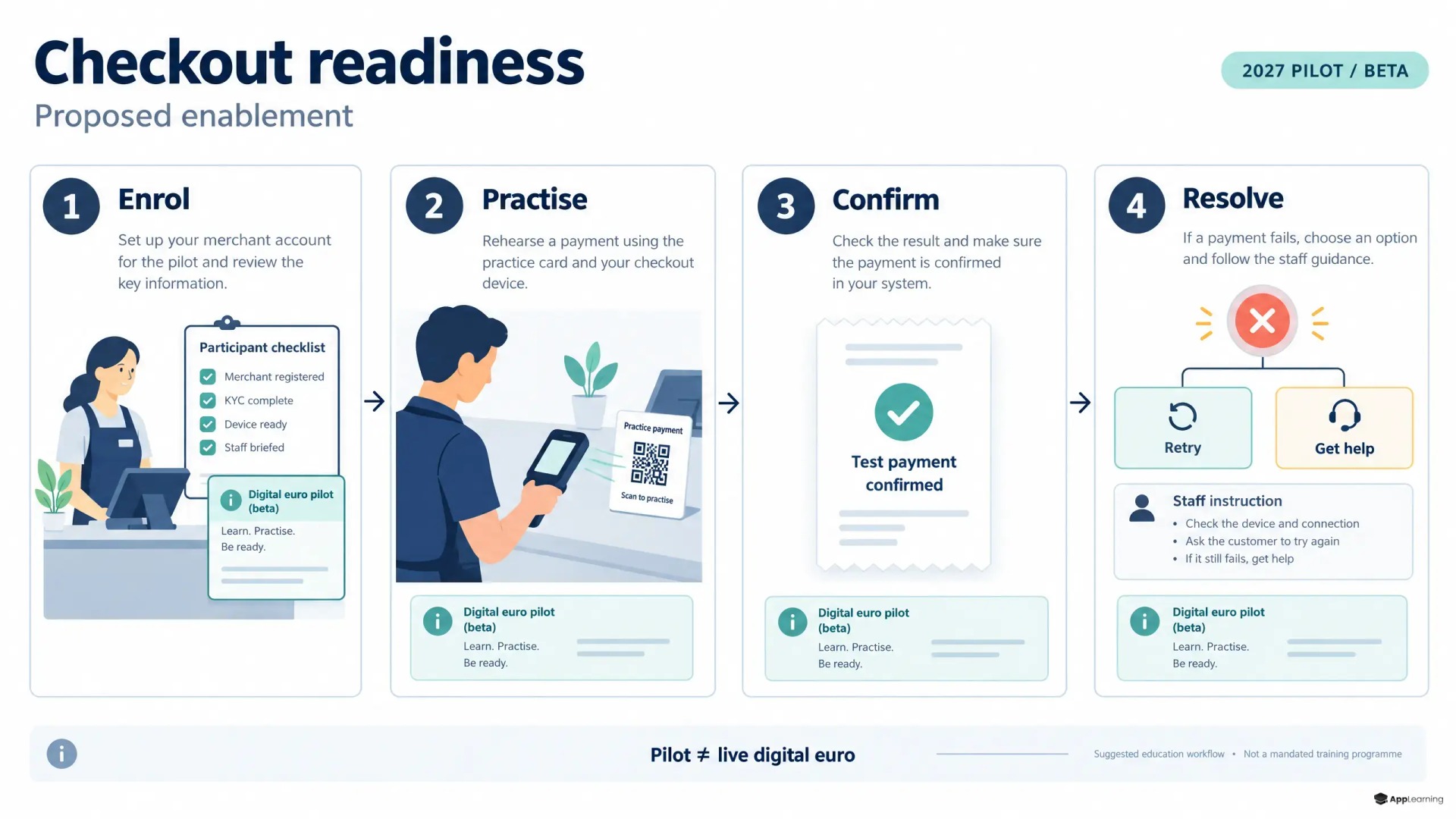
A proposed mobile journey could sit inside PSP onboarding or open through a trusted staff QR code. That QR code would launch learning, not represent a payment capability. Concrete steps could be:
- Confirm pilot eligibility and complete the approved enrolment steps.
- Practise acceptance using the relevant checkout simulation.
- Complete a first successful simulated payment.
- Resolve an exception scenario and identify the verified support route.
For App-Learning, the useful role would be a mobile, multilingual white-label academy around these approved journeys. Embedded fintech education would support the workflow rather than become another destination staff must remember.
Scenario practice must respect the pilot boundary
Under the ECB’s published pilot scope, (ecb.europa.eu) merchant payment cases are online, offline NFC payments are person-to-person, and refunds form part of the existing person-to-business flows. Digital euro merchant education should teach the implemented PSP process, not invent an offline checkout or refund interface.
Counter staff and PSP support could rehearse the same cases from different roles. A cashier encounters an unclear status; support identifies the relevant evidence and approved next step. A refund request follows the documented process. Payment service provider training should never substitute a generic retry instruction for an agreed exception procedure.
Language checks need fraud awareness
Given the ECB’s warning about fraudulent investment and pilot invitations, (ecb.europa.eu) scam recognition belongs in the proposed learning journey. A scenario quiz could test whether staff recognise an unsolicited investment request and use a verified contact route.
Each language version should preserve payment-status meanings, escalation rules and beta terminology. Local reviewers should check those distinctions against the approved source material. Completion alone would not demonstrate understanding.
Readiness and payment success need separate measures
Within the ECB’s merchant feedback requirements, (ecb.europa.eu) operational readiness and support needs sit alongside successful and failed transactions. A proposed learning dashboard should keep those dimensions distinct:
- Readiness through first successful simulated payment and exception accuracy.
- Support demand through ticket reasons and repeated instruction errors.
- Merchant confidence through brief checks before and after practice.
- Payment performance through operational transaction outcomes, measured separately.
Map your pilot’s merchant learning journey with App-Learning.
DiscussA controlled rollout needs content ownership
The B2B rollout checklist should name a PSP content owner, approved journey version, language reviewers, escalation owner and update process. A small merchant cohort could expose unclear instructions before wider deployment.
The goal is not to train participants into producing favourable results. It is to make their actions interpretable. Learning can establish readiness; operational testing must still reveal friction. Neither lesson completion nor a successful beta payment establishes eventual public adoption.