

Key takeaways
- Evaluate activation platforms by readiness outcomes, not content-library features.
- Mobile usability is a core operating requirement for distributed agent teams.
- Fast update workflows matter as much as initial onboarding.
- The right system supports first-sale readiness and ongoing field consistency.
A library does not activate a seller
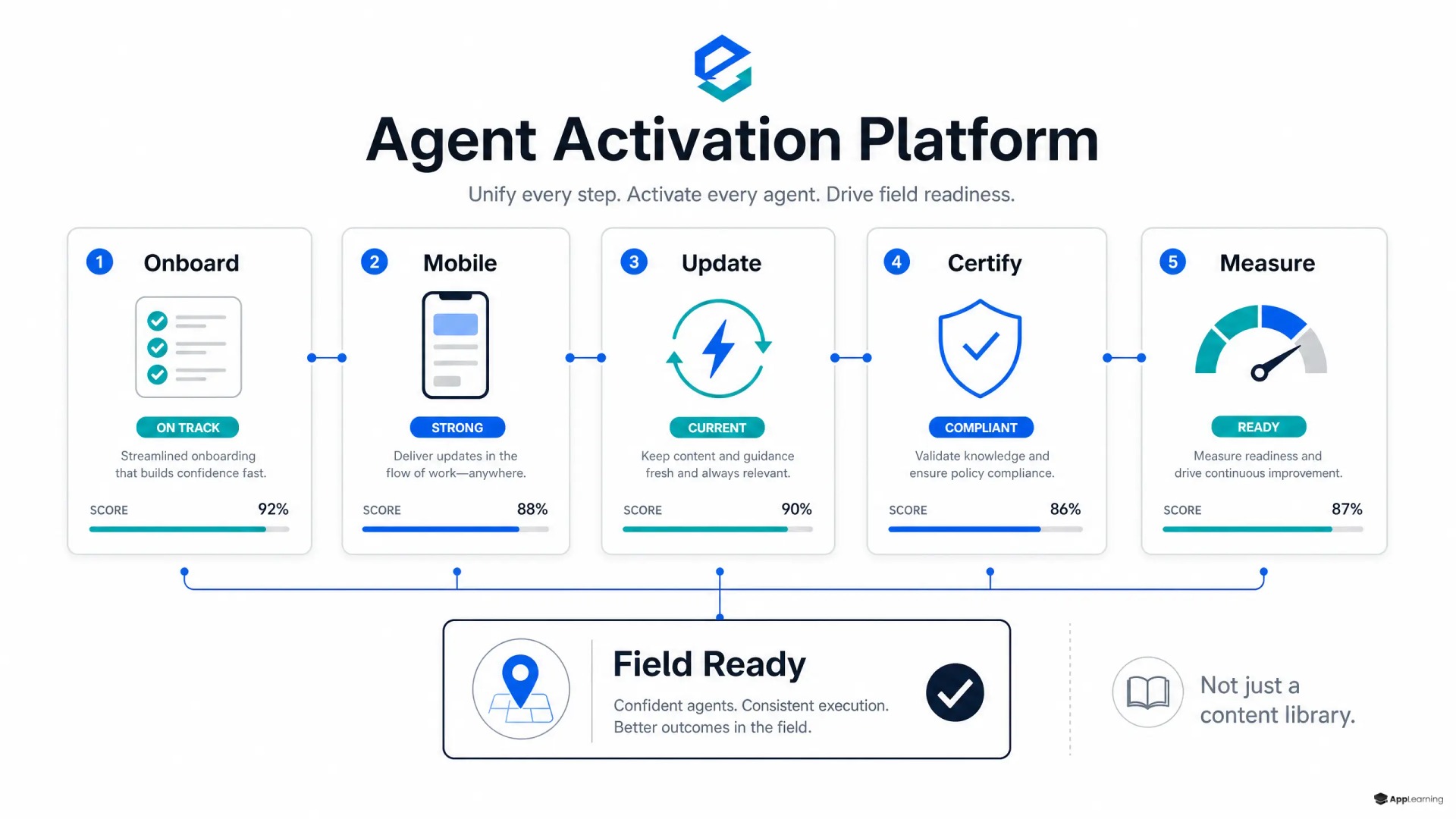
Most training platforms solve a publishing problem. They store courses, track completions, and issue certificates. An agent activation platform solves a field-execution problem. It moves a new recruit from signup through setup, product confidence, compliance checks, and the first successful sale. That difference matters when an agent must register customers, explain changing tariffs, manage stock or wallet steps, and work without a supervisor nearby.
For operators, completion is only evidence of exposure. It does not prove that the agent can perform the next task. In agent networks, weak training can also become a customer and operational-risk issue; the World Bank notes that poorly trained agents may fail to apply required controls or recognise suspicious activity. (digitalfinance.worldbank.org) A platform that sits apart from onboarding, CRM, support, and rewards leaves the hardest work to chat groups and call centres.
The activation stack behind first-sale readiness
Shortlist platforms against the full path to productive field activity. The goal is not to buy more learning features. The goal is to remove the next blocker before it becomes a drop-off point, a support call, or a failed customer interaction.
- Guided first-sale paths that combine registration, product basics, process steps, sales practice, and required checks.
- Role, region, language, and campaign logic so agents see only the actions relevant to their current work.
- Short assessments and certification gates that confirm readiness before a new product, tariff, or process goes live.
- Modular update workflows that let operations replace one lesson, price point, or script without rebuilding a full course.
- Data connections that place learning progress beside activation, support, CRM, stock, wallet, and sales signals.
This is the operating model for field agent activation. A readiness check should produce a clear next action: unlock a campaign, prompt a retry, route the agent to support, or alert a supervisor. If a pass or fail changes nothing, it is reporting theatre.
Mobile constraints set the shortlist
A mobile sales readiness platform must work under the conditions of the weakest common device, connection, and language profile. Responsive design is not enough. World Bank guidance on low-bandwidth learning highlights downloadable content, compressed lessons, and bite-sized units as practical ways to reduce data and time demands. (blogs.worldbank.org) For field teams, that means short screens, clear visuals, optional audio, plain language, reliable resume behaviour, and no mandatory long-form video for critical tasks.
Make these conditions part of the procurement test. Run a first-sale journey on a low-end Android device. Interrupt the connection during a quiz. Check whether progress survives. Measure time to open a campaign update on mobile data. Ask an inexperienced agent to find the next required task without a manager’s help. A polished desktop demo cannot answer these questions.
Readiness needs a management view
Leaders need more than an academy dashboard. They need to see where activation slows and whether the problem is knowledge, setup, access, stock, payment readiness, or field follow-up. The platform should retain enough context to drill from network level to region, cohort, language, product, campaign version, and individual agent.
- Median time from signup to first successful sale.
- Drop-off rate at each onboarding and readiness step.
- Readiness pass rate and failed questions by product, region, and campaign.
- Campaign-update reach, completion, and certification within the required window.
- Support requests per new agent before first sale.
- Sales-quality or compliance exceptions after readiness has been confirmed.
These metrics turn training into an early-warning layer. A regional sales decline is a late signal. A spike in failed tariff questions, incomplete setup steps, or repeat support requests gives operations a chance to intervene before the campaign underperforms.
Good to know
What separates an agent activation platform from an LMS?
An LMS manages learning content. An agent activation platform connects learning to onboarding steps, readiness checks, campaign access, support workflows, and first-sale performance.
Which metric best shows agent activation?
Time from signup to first successful sale is the clearest early outcome. Pair it with readiness pass rates, support demand, and early sales quality to identify the real bottleneck.
Does mobile responsive design make a platform field-ready?
No. Test low-end Android performance, data use, interrupted sessions, offline or delayed syncing, language support, and the ability to resume a task without losing progress.
Should campaign certification control field access?
For high-risk or fast-changing offers, it should. A certification gate creates a clear record of who received the update, understood it, and is eligible to sell.
Demos hide the costly failure modes
Buying teams often overvalue authoring tools, catalogue design, and generic gamification. Those features may help, but they do not prove that the platform can activate thousands of agents across varied field conditions. The common mistake is treating implementation as an IT handover instead of testing the whole operating loop.
- Choosing a desktop LMS because it has a mobile app rather than proving mobile task completion in the field.
- Measuring course completion without linking it to first sale, support dependency, or sales quality.
- Publishing updates as PDFs or broadcasts without comprehension checks and follow-up logic.
- Treating certificates as rewards instead of permissions or evidence of campaign readiness.
- Accepting closed reporting that cannot connect learning events to CRM and performance data.
See how mobile-first activation can fit your field operation.
TalkA mobile-first operating layer
App-Learning fits teams that need to turn fragmented product, process, and compliance material into a usable activation layer. Its platform supports role-based learning paths, short modules, quizzes, certificates, gamified mechanics, content updates, analytics, mobile and web delivery, plus API-based integrations where needed. (app-learning.com) The practical value is not another destination for agents to visit. It is a way to place guided learning close to the existing field app and the moment of action.
The right agent activation platform makes readiness visible and repeatable. It gives every new agent a clearer route to the first sale, gives operations control when offers change, and gives leaders evidence that field capability is keeping pace with growth. That is a stronger system than a content library, because it treats learning as part of distribution execution.