
Key takeaways
- Measure behavior after the launch spike, not only engagement during it.
- Multi-element gamification can lift early engagement without creating persistent learning behavior.
- Define a mechanic-specific half-life using return, practice, assessment, and activation data.
- Refresh mechanics when measured lift decays, not when a content calendar says so.
- Separate novelty-driven interaction from learning loops that support confident product use.
Launch Metrics Confuse Attention With Change
Most gamification metrics answer the easiest question: did people react when the feature appeared? They count badge views, leaderboard opens, streak starts, challenge clicks, and seven-day engagement. Those signals matter, but they are not proof that learning gamification changed behaviour. A new mechanic creates a visible target and a reason to explore. That can produce a launch spike even when users do not return, practise, retain knowledge, or use the product with more confidence.
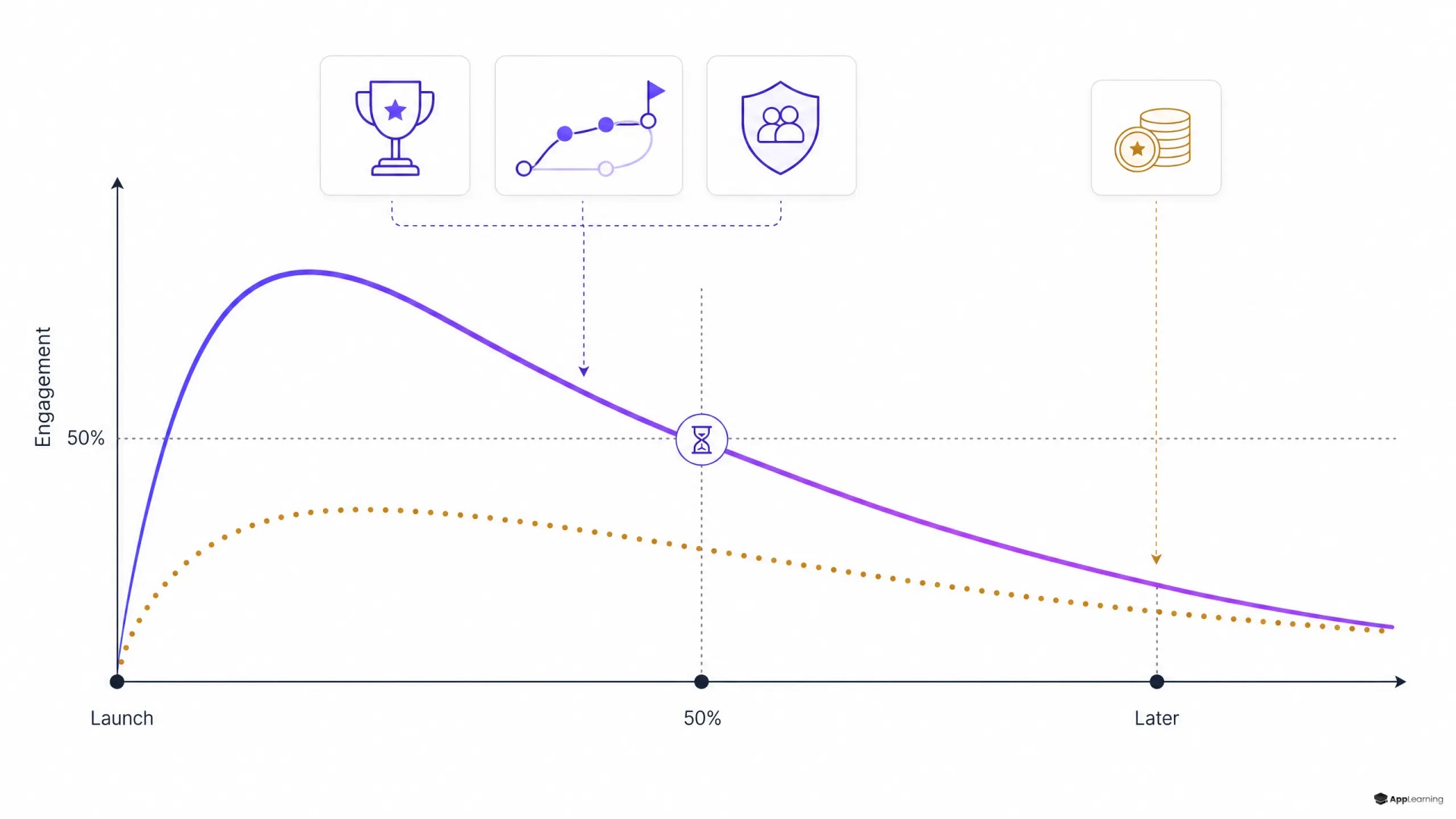
This is the gap in common gamification effectiveness reporting. Product teams need to measure the incremental lift created by a mechanic over time, then watch that lift decay. Without that view, a feature can be declared successful precisely when its effect is already disappearing.
The Early Lift Did Not Last
A 2026 quasi-experiment published in Acta Psychologica compared 35 EFL learners using points, badges, and a leaderboard with 31 learners using points alone. The multi-element group reported higher overall, cognitive, emotional, and behavioural engagement immediately after the intervention. At delayed posttest, that advantage was no longer maintained.
The study is small, focused on English vocabulary learning, and measures self-reported engagement rather than fintech activation or commercial outcomes. It should not be read as a universal verdict on badges or leaderboards. It does show the operational risk clearly: a richer design can win the immediate comparison and still fail to create a durable advantage. Delayed effects gamification needs its own measurement discipline.
A Half-Life Makes Decay Visible
A gamification half-life is the time from a mechanic’s peak incremental lift until that lift has fallen by 50%. The lift should be measured against a valid baseline, a comparable unexposed cohort, or an experiment control group. It is not the time until raw engagement falls by half. Seasonality, lifecycle changes, and shifts in acquisition can move raw totals without saying anything about the mechanic itself.
For example, a challenge may raise qualified weekly return by eight percentage points in its first week. If the incremental return lift falls to four points by week five, its return half-life is five weeks. The same mechanic may have a shorter practice half-life and a longer assessment-retention half-life. That distinction matters. It tells the team whether the mechanic is prompting empty activity or supporting a useful learning loop.
- Instrument exposure at the mechanic level, including badges earned, challenge starts, streak state, rank views, and reward claims.
- Set a comparison method before launch, using an A/B test where possible or matched cohorts where experimentation is not feasible.
- Calculate incremental lift by week for each outcome that matters.
- Record the point at which the lift halves, reaches zero, or turns negative.
- Use the result to decide whether to keep, adapt, personalize, or retire the mechanic.
Signals That Map to Learning
For a fintech product, the right signals sit beyond the game layer. A customer does not need to keep opening a leaderboard. They need to understand a financial concept, complete the next relevant learning action, and use the product correctly. That is where gamification metrics become useful to product and customer education teams.
- Qualified return rate, measured as a return to an unfinished or relevant learning journey rather than a generic app open.
- Repeated practice, such as completing another scenario, simulation, quiz, or explainer after the first session.
- Challenge completion quality, including whether users finish the learning task and not merely claim a reward.
- Delayed assessment retention, measured days or weeks after initial completion with new but equivalent questions.
- Downstream activation, such as setting up a feature, completing a first transaction, or using an advanced tool after demonstrating understanding.
- Support deflection signals, especially fewer repeat questions about concepts covered in the learning flow.
Decay Curves Beat Click Totals
Compare mechanics by their decay curves, not by lifetime click totals. A leaderboard may create a steep early lift and then fade. A progress path may produce a smaller launch response but maintain repeated practice for months. Points may work well as immediate feedback inside a task, while a time-bound challenge may be better for helping a new customer finish onboarding. These are different jobs and should not compete on one engagement number.
A useful score is persistence-adjusted learning lift: the cumulative incremental value a mechanic creates across a defined period, weighted toward repeated practice, delayed knowledge, and downstream activation. This prevents a mechanic with loud early gamification engagement from outranking one that produces fewer clicks but more durable product confidence.
Good to know
What is a gamification half-life?
It is the time it takes for a mechanic’s incremental effect on a defined outcome to fall by 50% from its peak after launch.
Which outcomes should define the half-life?
Use outcomes tied to the learning journey: qualified returns, repeated practice, delayed assessment performance, correct feature activation, and fewer repeat support needs.
Does every mechanic need its own half-life?
Yes. A streak, leaderboard, badge, and challenge can affect different behaviours at different speeds. Measuring them as one gamification layer hides that difference.
When should a team refresh a gamification mechanic?
Refresh it when its measured incremental lift decays below a defined threshold and the learning outcome no longer justifies the added product complexity.
Refresh Is an Intervention, Not a Calendar Event
Teams often rotate badges, themes, or challenges on a fixed calendar. That creates activity, but not necessarily progress. Refreshing a mechanic should be a response to evidence. If its incremental lift reaches its half-life quickly while retention remains weak, the issue may be novelty rather than learning value. Change the task design, feedback, difficulty, reward timing, or relevance to the user’s next product decision.
Retire mechanics that create shallow interaction without improving learning or activation. Personalize those that work for one segment but not another. A first-time investor may benefit from a guided confidence-building challenge, while an experienced customer may find the same mechanic distracting. The goal is not to make every screen game-like. It is to apply reinforcement where it helps users make better decisions.
Measure which learning loops actually last.
MeasureA Measurement Model for Customer Academies
App-Learning implementations can connect learning events to the product journey already happening across web and mobile. Track the customer’s exposure to a badge, leaderboard, streak, or challenge; connect it to repeated practice and assessment data; then link those learning signals to activation of the relevant feature. A multilingual customer academy can use the same model across markets while testing whether mechanic half-lives differ by audience, language, or product maturity.
The practical output is a mechanic portfolio, not a collection of decorative features. Product leads can see which interventions help customers finish onboarding, understand complex financial or Bitcoin-related concepts, and return with intent. Content teams can focus scarce production capacity on learning journeys whose effect persists.
Gamification is neither a growth trick nor a visual layer. It is a behavioural system with an effect curve. Teams that measure only the launch spike will keep rewarding novelty. Teams that measure half-life can build learning loops that remain useful after the points stop feeling new.