

Key takeaways
- Map share, token, fiat and stablecoin misconceptions before the first buy.
- Show the bank, exchange and custody roles in exact product language.
- Place short disclosures and comprehension checks beside the relevant action.
- Keep education separate from personal financial advice and performance claims.
- Measure informed activation, confusion and support demand by user cohort.
A familiar app opens a new risk surface
On October 6, 2026, Moneyweb reported that FNB had partnered with VALR to bring crypto trading into its share-investing experience. FNB’s own crypto page says customers can buy, hold and sell crypto in the FNB App through selected share-investing products, starting from R10. (moneyweb.co.za)
That is a meaningful product-design shift. A customer does not enter a separate exchange with unfamiliar branding and a separate onboarding path. They move from a known bank and brokerage journey into assets with different risks, market structure and operating constraints. That makes crypto education in banking apps an interaction problem, not a content-library problem.
Familiar navigation can hide a different product
A share-trading shell can create false equivalence. Users may assume that every investment has the same ownership model, trading timetable, settlement process, transfer options and protections. It does not. The point is not to make crypto feel more complex than it is. The point is to surface the few distinctions that change what the customer is actually buying and what they can do with it.
Stablecoins need special treatment. A token described as stable should not be presented as the same thing as cash, a bank deposit or legal tender. The South African Reserve Bank notes that crypto assets are not legal tender and are not backed or guaranteed by the SARB. (resbank.co.za)
Build learning into the trade path
Good embedded crypto onboarding uses short interventions tied to irreversible or high-consequence choices. The aim is not to force a course before access. It is to close a specific knowledge gap before the customer confirms a transaction.
- At asset selection, add a 20-second explainer that distinguishes a digital asset from a company share without comparing expected returns.
- When a stablecoin appears, explain its reference asset, the difference between a token and fiat currency, and where users can find issuer and redemption information.
- At the order screen, show the exact transaction constraints that apply to that product, including funding, execution timing, pricing, transfers and any withdrawal limits.
- Before confirmation, offer an optional short risk scenario that shows how a rapid price move or an operational restriction could affect the customer’s next action.
Crypto investing microlearning works best when each lesson has one job: explain the term on screen, show its operational consequence, then return the customer to the task. App-Learning can provide this as branded, embeddable modules across mobile and web, with contextual calls to action rather than a detached crypto academy.
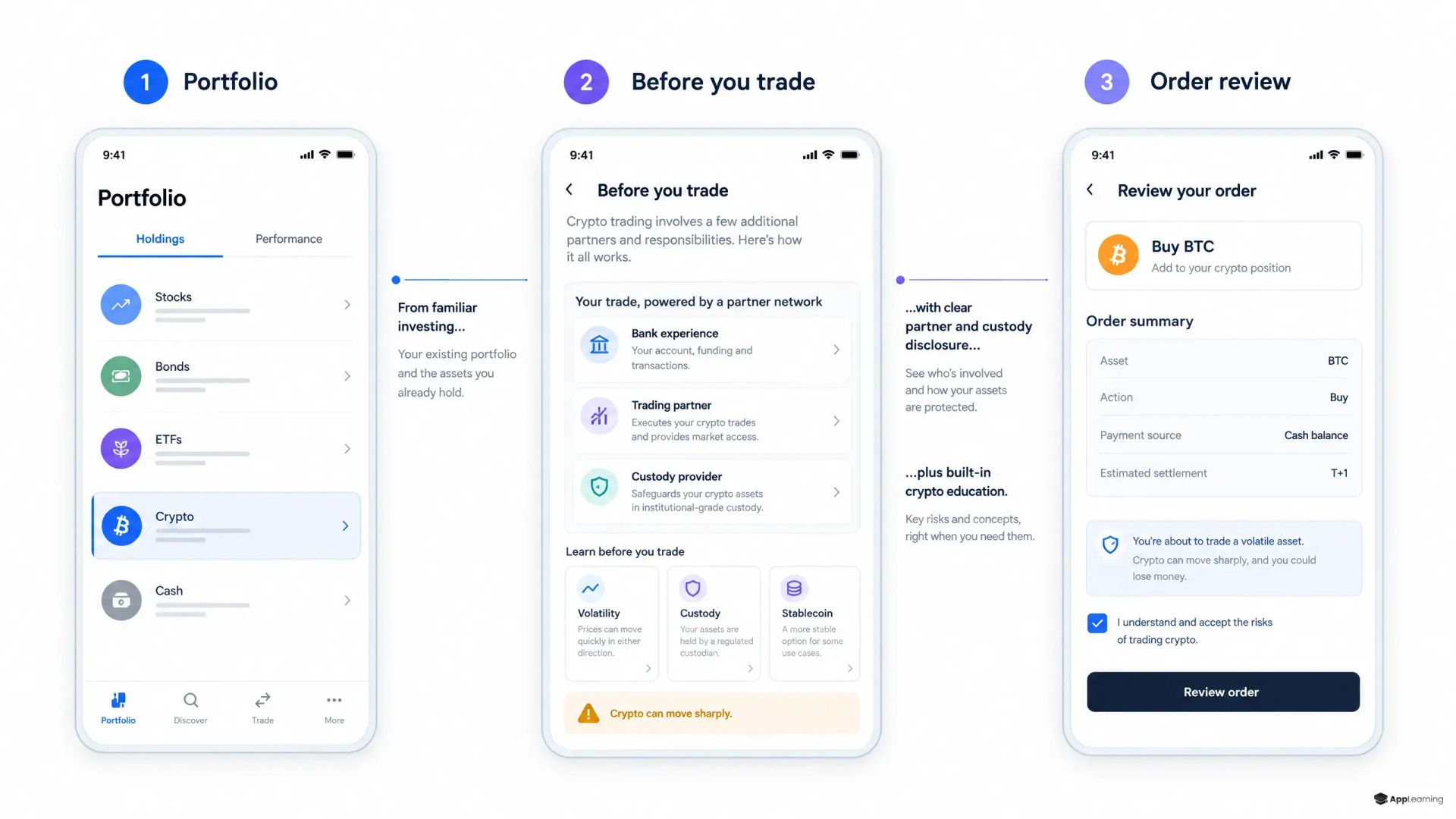
Make the operating model visible
Bank crypto product education should name the parties and functions with the same language used in the governing product terms. Do not rely on a generic diagram that implies a legal allocation of responsibility. State who provides the customer interface, who executes trades, who holds or safeguards the assets, what sits inside the product perimeter, and whether external transfers are available.
This is especially important in a partner model. The customer sees one trusted interface but may interact with several operating layers. A concise “who does what” panel beside the first trade can reduce later confusion without claiming that the bank, exchange or custodian provides a guarantee that the applicable terms do not provide.
Good to know
Where should crypto education appear in a banking app?
Place it beside the first meaningful decision: selecting an asset, choosing a stablecoin, reviewing an order and confirming a transaction. Keep deeper reference material available, but do not depend on users finding it before they need it.
Should a comprehension check block a crypto purchase?
Usually, it should clarify a critical misconception rather than become a blanket gate. Product, compliance and legal teams should define which disclosures or acknowledgements are required for the specific market and product.
Which metric best shows whether embedded learning works?
Use a balanced view. Combine informed activation, comprehension accuracy, step-level abandonment, repeat support contacts and early retention instead of treating completed purchases as the sole success measure.
Test understanding without steering the decision
A comprehension check should verify mechanics, not risk appetite or investment suitability. It must never imply that passing a quiz makes an investment appropriate, safe or likely to perform well.
- Can this asset currently be transferred to an external wallet under this product’s terms?
- Which party does the product documentation identify for trade execution, asset safeguarding and customer support?
- Does a stablecoin label mean the token is a bank deposit or a guaranteed cash balance?
Each answer should link to the relevant disclosure or product term. Wrong answers should trigger a short explanation and let the customer continue after reviewing it. This separates education from personal financial advice while creating an auditable signal that the key concept was presented and understood.
Put learning at the point of financial decision.
ExploreMeasure informed activation rather than raw conversion
A first-buy conversion rate alone can reward the wrong design. Track where customers abandon the flow, which explanations they reopen, comprehension-check accuracy, support contacts tagged to the trade journey, and repeat activity after the first transaction. Compare these signals across meaningful cohorts such as first-time investors, existing share investors and users who viewed the learning module.
Use learning analytics to find recurring misconceptions, then improve the smallest relevant intervention. A rising activation rate matters only if it does not coincide with more confusion, avoidable support demand or customers discovering product limits after they trade.
The bank interface can reduce navigation friction, but it cannot erase crypto-specific risk or turn education into a suitability decision. The durable model is precise: explain the asset, expose the operating model, test the critical mechanics and let the customer make an informed choice inside the flow they already trust.