

Key takeaways
- Familiar analogies are useful entry points, not complete product explanations.
- Teach the same-versus-different model explicitly.
- Compare ownership, execution, rights and lifecycle events before using marketing labels.
- Use misconception assessment to catch learners who extend the analogy too far.
- Precise product language supports customer and employee readiness.
Analogies create a fast path into complexity
A new financial product asks learners to build a mental model before they can decide, act or explain it to someone else. A familiar comparison reduces that initial load. Research on analogical comparison shows that aligning similar cases can help learners identify a shared principle and apply it in a new setting.
That makes the product education analogy useful in fintech. “This gives you exposure like that” can orient a customer quickly. But it is only a starting point. The comparison should earn attention, then make the learner inspect the mechanics.
Similarity turns dangerous when it becomes equivalence
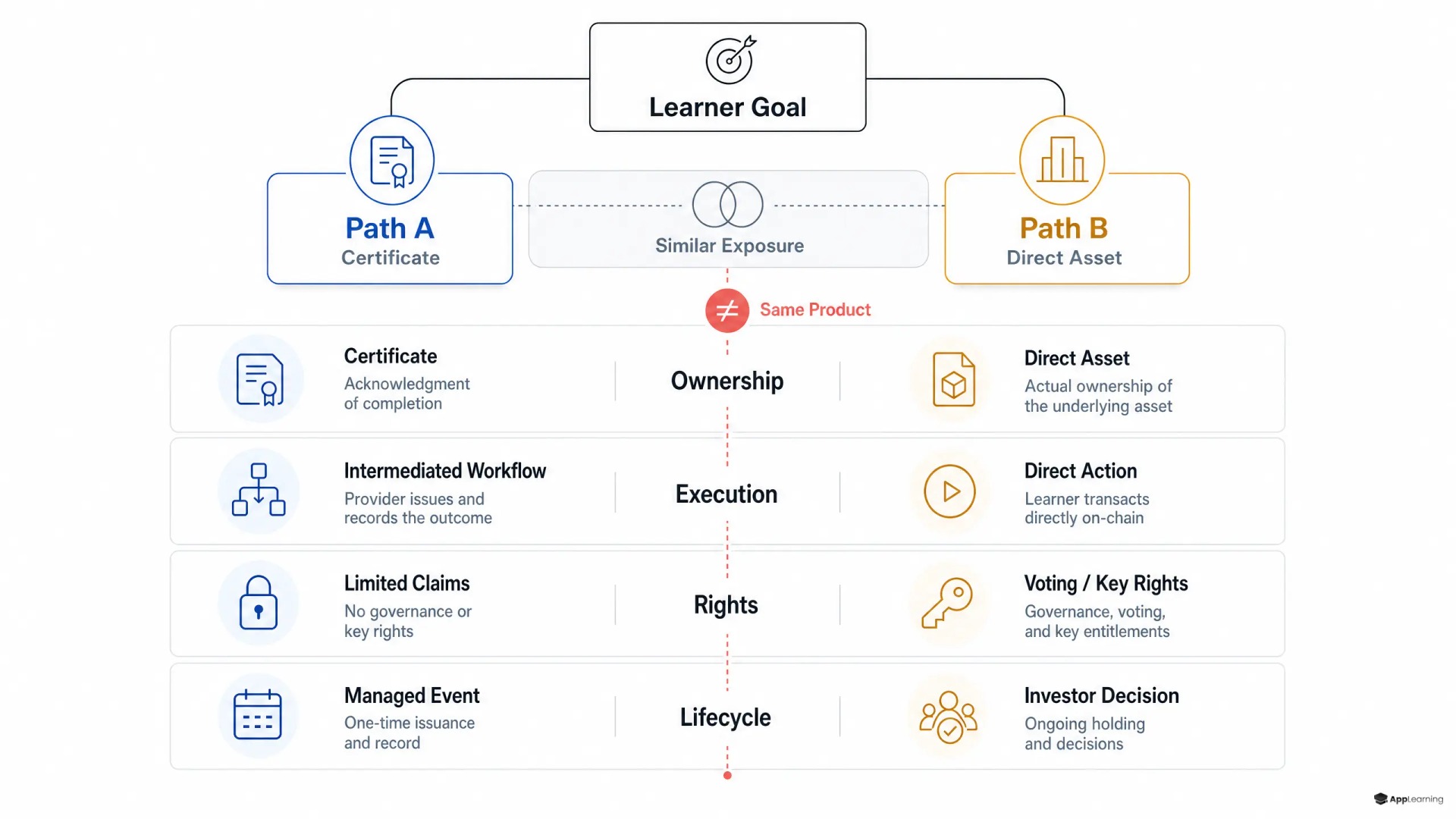
The failure begins when a learner converts a narrow similarity into a complete claim. Two products may reference the same market, move with similar price dynamics or appear in the same portfolio view. That does not mean they create the same ownership position, execute in the same way, carry the same rights or process lifecycle events alike.
This is not a minor wording issue. Work on analogy-induced misconception cautions that a single analogy can create deeply held erroneous knowledge when learners carry the mapping too far. Disclaimer-heavy prose at the end of a screen rarely repairs a model that was wrong from the start.
Mechanics make the comparison useful
Build comparison-based learning around the product mechanics that determine the customer’s real position. For a direct-holding route and a synthetic digital-asset route, price exposure may be the relevant commonality. The learning design must then separate that commonality from everything it does not establish.
- Ownership: Does the customer hold the underlying asset, a beneficial interest, or a contractual claim?
- Execution: What happens when the customer buys, sells, transfers or closes the position?
- Rights: Are voting, information, income or other issuer-linked rights attached, excluded or represented differently?
- Lifecycle events: How are splits, dividends, mergers, delistings or other corporate actions handled?
- Risk and custody: Which party holds assets, manages collateral, sets terms or carries operational responsibility?
The exact answer depends on the product structure and governing documents. That is precisely why customer product training should not lean on shorthand such as “you own the stock” when the product only delivers a different form of economic exposure.
The boundary belongs inside the learning flow
A strong explanation does not place caveats after the analogy. It turns the boundary into an observable interaction. Start with a comparison card that shows “same market exposure” beside “different legal and operational position.” Then place the learner in a scenario: a corporate action occurs, the customer wants to transfer the position, or an issuer right becomes relevant. Ask what happens next and why.
This approach makes distinctions concrete. It also prevents a common content failure: explaining a product accurately in one long paragraph while leaving learners unable to use the information when a real decision appears.
Misconception checks reveal overreach
Completion is not evidence of understanding. The decisive assessment asks whether the learner extended the analogy beyond its valid limit. A useful misconception assessment presents a believable but incorrect statement, such as: “Because both products track the same underlying market, they provide the same ownership rights.” The learner must reject it, select the precise distinction and see a short explanation.
Use answer patterns as product signals. If customers repeatedly confuse price exposure with ownership, the issue may sit in onboarding language, product labels or feature design rather than in a single lesson. Learning analytics should identify the broken mental model, not merely count finished modules.
Good to know
What makes a product education analogy effective?
It gives learners a familiar entry point while naming the exact dimensions that match and the dimensions that do not. The comparison should lead to product mechanics, not replace them.
Which dimensions matter most in fintech product education?
Ownership, execution, rights, lifecycle events, custody and risk allocation usually produce a more useful comparison than broad labels such as investing, trading or exposure.
How should teams assess whether learners understood the distinction?
Test the predictable overreach directly. Present a plausible false claim that extends the analogy too far, then ask the learner to identify the missing distinction.
Durable education separates stable concepts from changing terms
Product mechanics evolve. Providers, account structures, settlement routes and event handling can change faster than a static help article is reviewed. Design the curriculum in layers: retain stable concepts such as ownership, execution and rights, then update the product-specific rules beneath them. This keeps the core model intact while reducing maintenance work and review risk.
Turn product distinctions into learning flows customers can use.
Talk to usApp-Learning turns distinctions into product behavior
App-Learning can structure fintech product education as a sequence of comparison cards, scenario questions and misconception checks within the customer journey. Teams can embed a brand-consistent learning flow in web or mobile onboarding, localise it for new markets and see where learners confuse similar-looking products. The result is not more explanatory text. It is a clearer system for helping customers recognise the point where the analogy stops.
Good education does not avoid analogies. It controls them. When the lesson teaches both the bridge and its endpoint, customers can act with a more accurate model of the product they are using.