

Key takeaways
- Search language exposes buyer problems more clearly than platform architecture.
- Customer education, microlearning, and branded learning can share one LMS core.
- Use-case pages should show outcomes and the capabilities that enable them.
- A modular platform avoids building separate products for each market label.
- Search demand can sharpen product positioning and roadmap decisions.
The buyer’s language arrives first
Learning-platform teams often describe themselves through architecture: multi-tenancy, content models, APIs, permissions, white-label layers, and analytics. Those capabilities matter. But they are rarely the words a buyer starts with. A fintech growth leader is more likely to search for a customer education platform that improves activation, a microlearning platform for product updates, or a branded learning experience that makes complex financial concepts easier to trust.
This is not a superficial messaging problem. It changes how a platform should be positioned, structured, and sold. Buyers first name the work they need done. The platform must then prove it can deliver that outcome without creating a new technical product for every use case.
Search demand maps jobs, not system diagrams
Recent organic-search analysis at App-Learning showed growing interest across customer education platform comparisons, microlearning platform comparisons, responsible-AI training, branded learning, employee-training microlearning tools, and the broader term learning app. These terms address different audiences, yet they share a pattern: people search for a learning format or business outcome, not for a rendering layer or tenant model.
That makes search data useful positioning input, not just an acquisition metric. Google’s Search Console query data can show the terms that lead people to a site, although anonymized queries and data limits mean it should be treated as directional evidence rather than a complete market census.
For a fintech, this distinction is practical. “Customer education platform” may signal a need to reduce confusion before a user funds an account. “Learning app” may signal a mobile-first education journey. “Branded learning” may signal a trust problem, where the product must feel like a credible extension of the company rather than a detached help centre.
Different entry points can lead to one academy
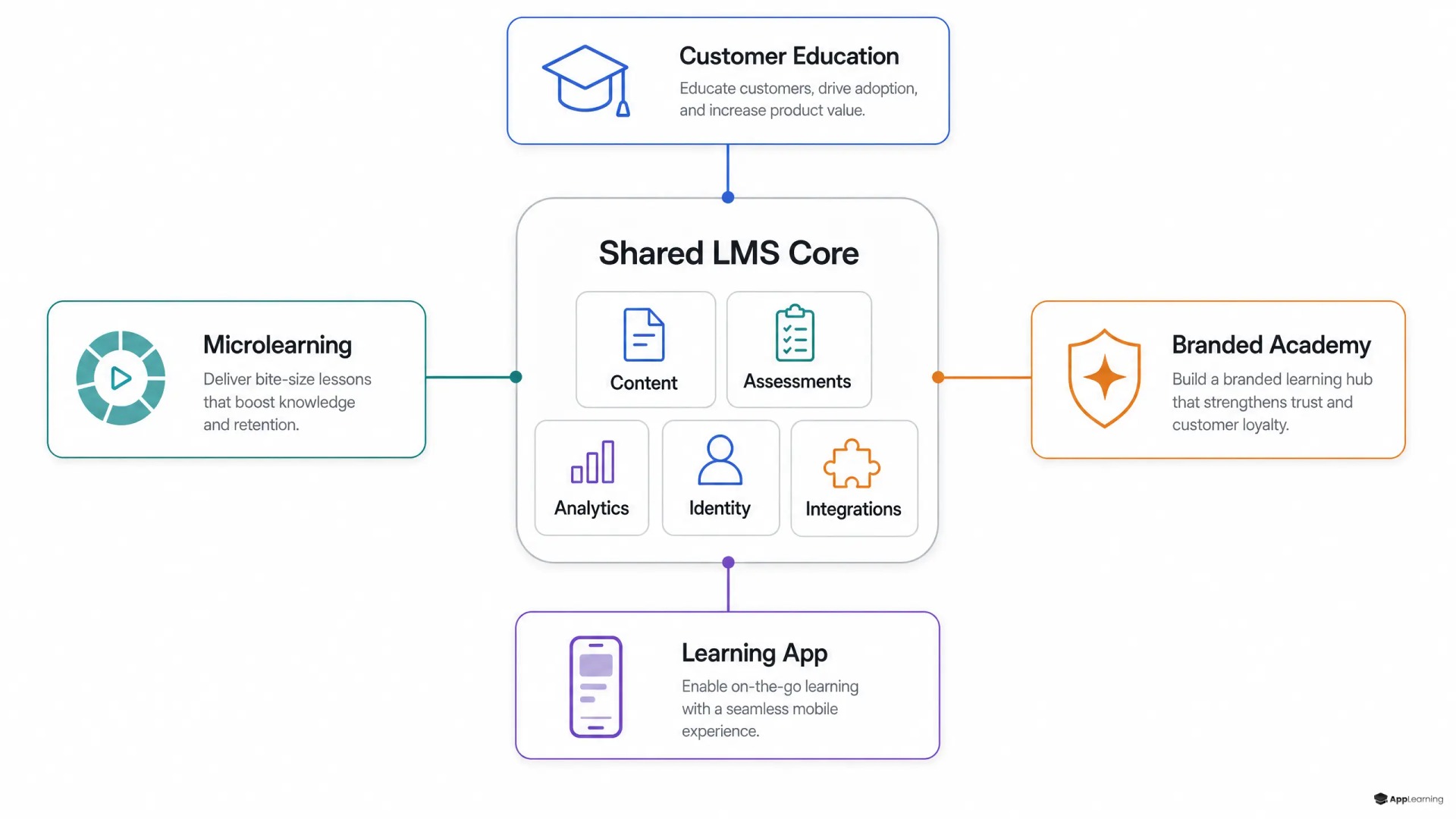
Customer education, microlearning, and branded learning should not become three disconnected product lines. They are entry points into the same learning system.
- Customer education organizes onboarding, feature adoption, certification, and support deflection around the user journey.
- Microlearning breaks high-friction concepts into short, repeatable units that fit lifecycle messages and product moments.
- Branded learning gives the academy a distinct visual identity, domain, tone, and audience experience.
- AI training provides structured paths for new capabilities, policy changes, and responsible use practices.
The visible experience can change by audience and use case. A retail investing academy may teach risk, order types, and portfolio basics. An internal academy may prepare support teams for the same feature release. A partner academy may certify advisers. The underlying platform should still manage content, user access, progress, assessments, reporting, and integrations through a shared core.
The shared core prevents a fragmented product
A modular LMS does not mean every customer receives the same academy. It means the system separates what must stay stable from what should adapt. Stable components include identity, roles, content operations, learning records, analytics, and integration patterns. Adaptable components include branding, navigation, learning paths, audience rules, surfaces, and activation triggers.
This separation matters when education becomes part of a fintech growth system. Product teams need learning embedded in onboarding. Lifecycle teams need modules linked from email, push, or in-app messages. Content teams need to update explanations when product rules change. Compliance teams need governance and evidence of completion. A separate tool for each need creates duplicate content, conflicting data, and slower releases.
Good to know
Why should a learning platform use use-case language in its positioning?
Use-case language matches the problem a buyer is trying to solve. It creates a clearer path from search, to evaluation, to the platform capabilities needed for delivery.
Can one LMS support customer education and employee training?
Yes. The audiences, branding, and learning paths can differ while the core system manages shared content operations, access rules, reporting, and integrations.
How should fintech teams connect education to growth?
Place learning at high-friction moments such as onboarding, feature discovery, and product changes. Measure progress alongside activation, product adoption, support demand, and retention signals.
Use-case pages must reveal the machinery
A use-case page should lead with the buyer’s desired outcome, then show the capabilities that make it repeatable. A customer education platform page can explain activation journeys, product academies, segmented paths, and progress data. A microlearning platform page can show short modules, mobile delivery, reminders, and campaign integration. A branded learning page can show white-label design, audience separation, and tailored academy experiences.
The mistake is to hide the platform entirely. Outcome language earns attention, but buyers still need to see how the system works. Each use case should connect to the same technical proof: modular content, configurable learning paths, audience management, branded delivery, integrations, analytics, and governance. This gives commercial teams a clear story without oversimplifying the product.
Search becomes a positioning feedback loop
Treat high-intent search themes as hypotheses about buyer framing. Review the queries, pages, conversions, sales conversations, and implementation requests together. Then ask whether a theme represents a distinct audience, a different buying trigger, or merely another label for the same core capability.
This process keeps content strategy tied to product reality. If branded learning content attracts fintech teams that need trust-building education, that insight should shape examples, onboarding templates, and sales discovery. If microlearning content attracts internal enablement teams, the platform may need stronger lifecycle orchestration rather than a separate microlearning product.
Build education journeys that turn complex products into confident user actions.
Talk to usOne platform can speak several market languages
The commercial task for a modular academy provider is not to force every buyer into generic LMS terminology. It is to meet them where their problem is most concrete, then show the shared system behind the experience. App-Learning can surface as a customer education platform, a microlearning platform, a branded learning environment, or a learning app without losing architectural coherence.
That is the stronger position for complex fintech education. Users need clear, timely learning before they can act with confidence. Teams need one operating model for content, product education, and lifecycle delivery. The winning platform does not ask buyers to understand its architecture first. It uses that architecture to make the buyer’s job easier.