

Key takeaways
- Teach the developer mental model before presenting integration instructions.
- Connect each learning path to one measurable sandbox task.
- Use cohorts for acquisition and evergreen modules for retention.
- Track first successful task, not certificate volume alone.
- Separate training activity from proven integration conversion.
Education starts before the developer portal
The Encode Club programme listing shows Arc 101 Bootcamp as a beginner, online programme that began on October 5, 2026 and runs for six weeks. Its partner listing names Arc as lead partner. That makes the programme useful as a product-growth signal, not as proof of outcomes: stablecoin infrastructure providers are willing to meet developers before the API call.
For a fintech platform, this is the gap between awareness and integration. A developer may understand that stablecoins can support payment flows, but still lack a working mental model for wallets, transaction lifecycle, treasury movement, cross-chain transfer, key management, testing and operational risk. Sending that person straight to reference documentation turns a learning problem into a navigation problem.
The Arc 101 Bootcamp is therefore best read as a developer funnel. It can introduce concepts, establish terminology and create a reason to build. The commercial value does not come from issuing a completion badge. It comes when the education layer moves qualified developers into a verified product action.
Documentation cannot carry the whole onboarding load
Technical documentation must be precise. It should not also be expected to teach beginners why a payment rail exists, when a wallet model fits, or how a prototype maps to a real customer journey. Those are different jobs, with different formats and measures of success.
A strong developer onboarding academy separates them. Short stablecoin developer education modules explain the system. Scenario checks test whether the learner can choose between plausible approaches. The developer portal provides the implementation detail. A sandbox task then proves whether the learner can use that detail.
- Concept module on wallet types, payment flows and the role of settlement.
- Scenario check that asks a builder to select an architecture for a stated use case.
- Guided sandbox exercise that creates one test transaction or retrieves one verified result.
- Clear call to action that moves the learner into SDK setup, a prototype or office hours.
This structure also protects the product team. It prevents basic conceptual questions from crowding reference material and lets developer relations focus live support on people who have reached a meaningful technical threshold.
The path from curiosity to a working sandbox
A six-week cohort can create momentum because the next step is visible and time-bound. But it should not be the only route. The cohort is the acquisition layer for Web3 developer training; an evergreen, role-based path keeps serving developers who arrive through search, partnerships, events or the product itself.
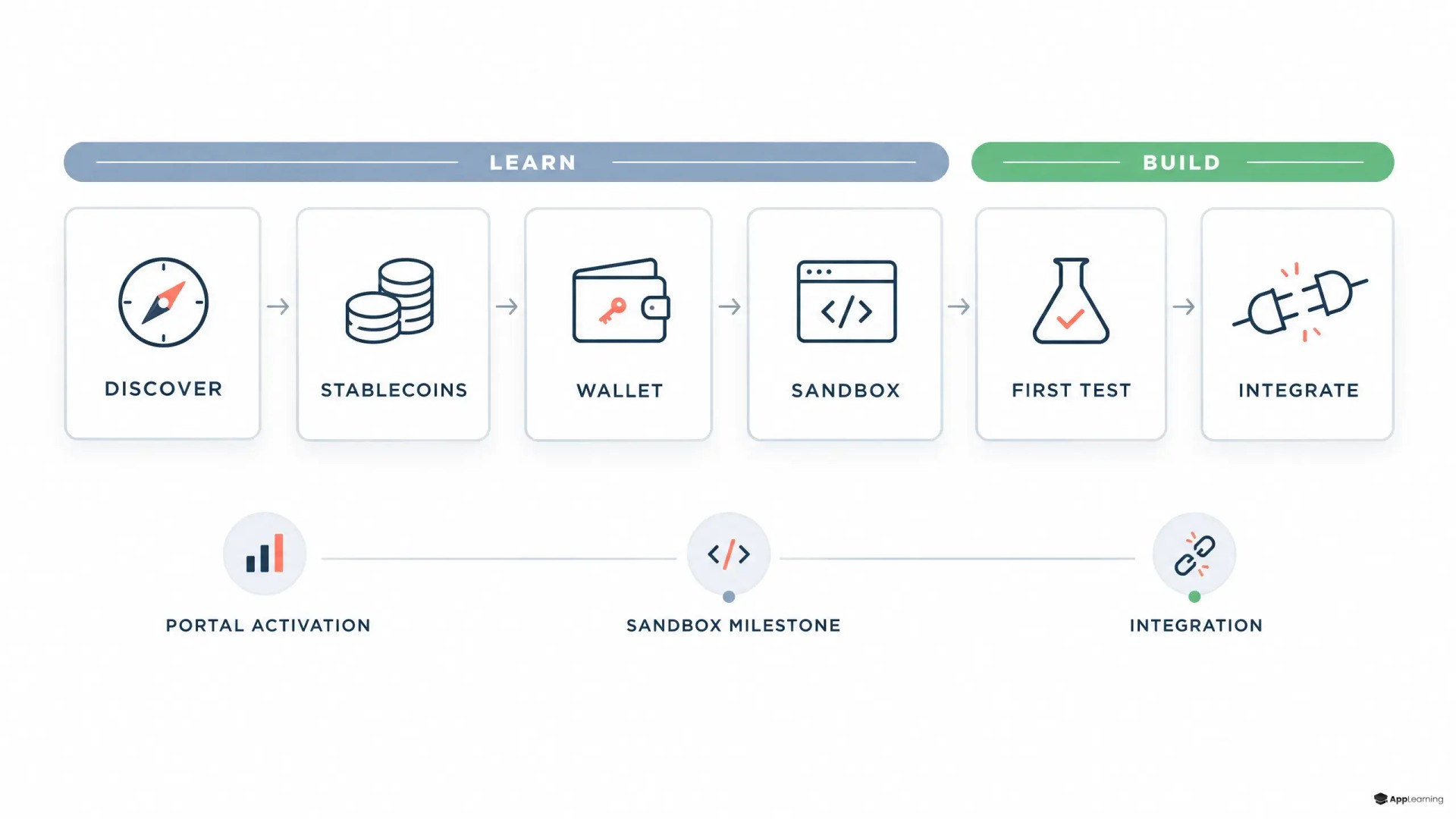
The journey should be explicit. First, a developer identifies a relevant problem, such as paying contractors or moving funds between supported networks. Next, they learn the minimum concepts needed to reason about the flow. Then they complete a small implementation task in the sandbox. Only after that should the platform ask for a deeper build, a production-readiness conversation or an integration commitment.
The first sandbox milestone should be narrow enough to finish in one sitting and meaningful enough to signal readiness. “Created an account” is weak. “Completed a test payment flow and handled its result” is stronger. It connects learning to product behavior without pretending that a tutorial completion equals adoption.
Learning design becomes a product instrument
Quizzes belong before irreversible technical effort. They reveal whether a developer understands the trade-off they are about to make. Microlearning works best between larger steps, where it answers one blocker without demanding an hour of study. Office hours belong after the first build attempt, when questions are concrete. Build tasks are the proof layer because they produce observable events.
For a white-label developer onboarding academy, App-Learning can deliver the role-based journeys, modular content, knowledge checks and learning analytics inside a branded web or mobile experience. The infrastructure provider supplies the SDK, technical review and sandbox validation. This division keeps ownership clear: the education system qualifies intent and understanding; the platform confirms technical execution.
Good to know
What should a stablecoin developer academy teach first?
Start with the mental model: wallets, payment and settlement flows, key concepts, basic risk boundaries and the developer’s likely use case. Introduce SDK instructions after the learner understands the job the integration must perform.
Which metric best shows whether developer education works?
Track the first successful, validated sandbox task. It is more meaningful than enrolment or certificate count because it records a concrete product behavior.
Should a fintech run cohorts or evergreen training?
Use both. Cohorts create urgency and community for acquisition, while evergreen learning gives developers a self-serve route to activation after a campaign or event has ended.
What does a white-label partner model require?
The education partner should own learning design, delivery and measurement. The infrastructure provider should own technical accuracy, SDK maintenance, sandbox access and validation of build tasks.
Measure readiness rather than applause
Certificates, registrations and video views describe learning activity. They do not establish that a developer can integrate. A practical measurement model follows the journey from entry to validated task, then compares those stages with downstream product events.
- Qualified enrolment rate by acquisition source and developer role.
- Concept mastery rate on the decisions that affect the first implementation.
- Sandbox activation rate within a defined period after the relevant module.
- First successful task rate, including completion without human intervention.
- Progression from sandbox task to prototype, technical call, application or live integration.
- Support demand per activated developer and the most common knowledge gaps.
These measures also prevent a common category mistake. A programme can be well attended yet fail to create integrations. Conversely, a small cohort can be valuable if it consistently produces developers who reach validated sandbox milestones. The public Arc 101 listings establish the programme format and partnership, but they do not publish enrolment, completion or conversion results. Those outcomes must be instrumented by the platform rather than inferred from the existence of the bootcamp.
Build an academy that measures developer readiness.
Talk to usA partner model built for durable activation
The best model combines a live cohort with an owned academy. A partner programme creates attention, community and deadline-driven participation. The white-label academy retains the curriculum, captures consented learning data and gives every later developer a route to the same sandbox milestone. Over time, the platform learns which roles, use cases and modules predict productive integrations.
That is the strategic role of crypto ecosystem education. It is not a detached content programme and it is not a substitute for strong documentation. It is a measured bridge between a developer’s first interest in programmable money and a verified capacity to build with the platform. Build that bridge well, and developer education becomes part of the activation system rather than an expensive side project.