

Key takeaways
- The 21-study review covers software-engineering education, not all corporate learners.
- Learning activity and quiz success do not prove workplace skill transfer.
- Match assessment complexity to the capability being built.
- Keep real tasks and observed practice for high-stakes judgment.
- Measure retention and transfer after training, not only completion.
The Evidence Boundary
Microlearning has a clear operational advantage. It can explain one rule, prompt one decision, or refresh one piece of knowledge without taking people away from work for an hour. That makes it useful for policy changes, product releases, security reminders, and foundational onboarding.
The problem starts when short-form engagement becomes a proxy for competence. A completed swipe lesson shows exposure. A correct quiz answer may show recall. Neither result alone shows that a relationship manager can spot a suspicious transaction, that an operations analyst can resolve an exception, or that a leader can make a defensible judgment under pressure.
This is the central limit of microlearning evidence. The format can support learning, but the format does not settle what has been learned. Complex skills assessment must test the decisions, trade-offs, and execution conditions that define the real job.
A Narrow Research Base
The review behind the headline synthesized 21 empirical studies published from 2015 to 2026 in software-engineering education. It found encouraging signs for engagement and discrete knowledge, yet identified major gaps around advanced subjects such as architecture, requirements engineering, and testing strategy. It also found no longitudinal or transfer studies in its included evidence base.
That finding deserves careful use. It does not prove that microlearning cannot build advanced capability. It does show that the published evidence reviewed does not yet establish it. The studies concern software-engineering education, much of it in academic settings, so they should not be converted into a universal effect claim for corporate learning in banking, fintech, or crypto.
For L&D leaders, this is a design constraint rather than a reason to abandon short modules. Use microlearning where its evidence and mechanics fit. Do not ask it to carry the entire burden of professional judgment.
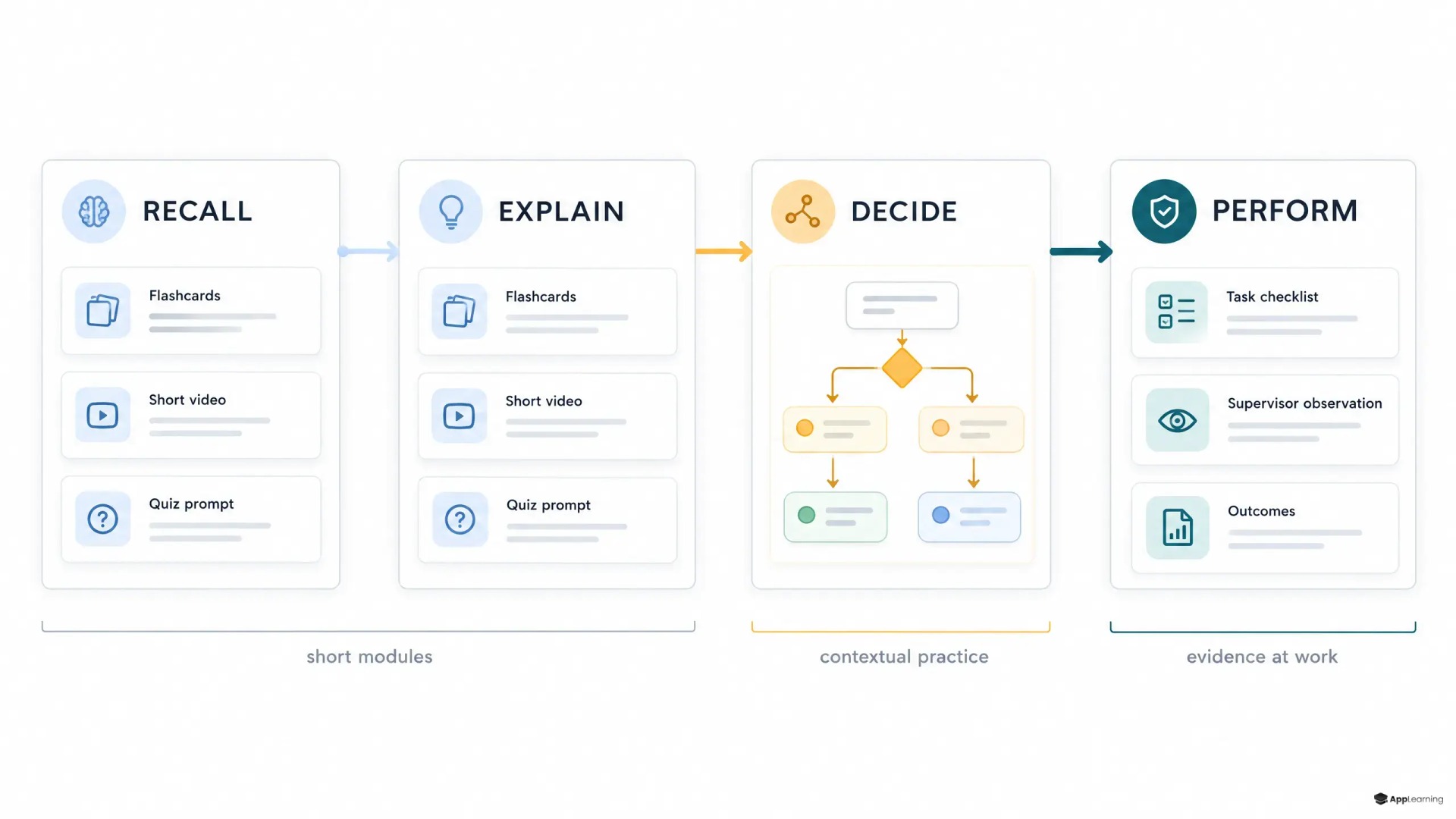
The Ladder From Recall to Performance
A stronger learning system assigns each format a defined job. The learning objective determines the assessment, not the other way around.
- Foundational explanation uses a swipe lesson for terms, policy principles, process steps, and simple distinctions.
- Applied judgment uses a scenario or branching quiz that requires the learner to choose between plausible actions.
- Retention uses spaced refreshers that bring critical rules and decisions back after the initial lesson.
- Critical capability uses a practical assessment, supervised task, role play, case review, or work-sample assessment.
This ladder matters in regulated work. A short lesson can introduce the conditions for escalating a possible financial-crime concern. A scenario can test whether someone recognizes the right escalation route. But the final proof should come from reviewed case handling, calibrated manager observation, or an assessed simulation that includes incomplete information and competing priorities.
Good to know
Does the review prove that microlearning does not work for complex skills?
No. The review's scope does not establish that microlearning fails for complex skills. It shows that the included software-engineering studies provide limited evidence for advanced, integrated competence and durable transfer.
Which learning goals fit microlearning best?
Focused concepts, policy updates, process reminders, recall prompts, and small decision rules are strong candidates. Use a different layer when the goal requires synthesis, judgment under uncertainty, collaboration, or reliable execution in live work.
When should a practical assessment be mandatory?
Use one when a wrong decision creates regulatory, customer, financial, security, or safety risk. The assessment should resemble the job and include the evidence, constraints, and escalation paths that employees face in practice.
What should finance and crypto teams measure after launch?
Track completion and immediate understanding, but add delayed retention checks, scenario performance, manager observations, quality reviews, and relevant operational signals. Compare results over time and use the findings to revise the pathway.
Short Units Inside a Performance Architecture
A practical pathway combines formats instead of treating them as substitutes. Start with a focused lesson. Move into a realistic decision. Reinforce the decision over time. Then test performance in a setting that resembles the work. This design protects learner time while preserving a serious standard for skill mastery.
- Explain the rule or model in a short module.
- Test interpretation through a branching scenario.
- Schedule spaced practice for the highest-risk decisions.
- Require a work sample or observed task where errors carry material consequences.
- Use manager feedback to close gaps and target the next learning prompt.
App-Learning’s format flexibility is useful here because it supports a layered curriculum rather than a single-content gamble. A swipe lesson, quiz, scenario, refresher, and practical check can serve one coherent pathway. The platform should make the pathway easier to operate, not imply that engagement data equals real-world job performance.
Build learning pathways that test performance, not just completion.
PlanMeasurement That Survives the First Quiz
Microlearning effectiveness should be evaluated at three levels. First, check retention after time has passed. Second, inspect transfer through sampled decisions, simulations, case quality, or manager observation. Third, monitor operational measures that the capability should influence, while accounting for changes in process, workload, tooling, and supervision.
- Retention measures whether people can still retrieve the rule or decision logic weeks later.
- Transfer measures whether they apply it correctly in realistic or live work.
- Operational metrics track outcomes such as rework, quality findings, escalation quality, error patterns, or time to proficiency.
Not every capability needs the same proof. A low-risk product update may need only completion and a knowledge check. A role that approves transactions, handles customer vulnerability, manages market-sensitive information, or leads an incident needs a higher bar. The measurement plan should reflect the consequence of getting the decision wrong.
Short learning is most valuable when it is precise about its limits. Use it to build knowledge, trigger practice, and sustain recall. Then let realistic assessment establish whether people can perform. That is how microlearning becomes part of a credible capability system instead of a polished record of participation.