

Key takeaways
- Assisted task success is not evidence of independent capability.
- Every AI tutor pilot needs an unassisted post-test.
- Delayed checks distinguish short-term scaffolding from retained knowledge.
- Transfer tasks reveal whether learners can apply knowledge at work.
- Compare learning gain with cost, latency, engagement and assistance use.
An AI tutor can produce a polished conversation, high satisfaction scores and fast task completion while teaching very little. The learner may have followed hints, accepted a generated answer or relied on the tutor to choose each next step. Those are useful operating signals. They are not proof of AI tutor effectiveness.
For HR and L&D leaders in regulated finance and crypto firms, this distinction is practical. A learner must still recognise a policy breach, explain an escalation decision or apply a control when the assistant is unavailable. An AI tutor benchmark should therefore measure independent performance after support ends, not only performance inside the chat.
The conversation is the treatment
Conversation quality matters because it affects whether people engage. But a tutor session is an intervention, not the outcome. Completion rates, thumbs-up feedback, answer acceptance and time in chat tell you whether the system is being used. They do not tell you whether the learner can now perform alone.
This is the central measurement error in enterprise AI tutoring. When assistance and assessment occur in the same flow, the tutor can help create the evidence used to judge itself. The result is inflated performance, especially where the learner can ask for an answer rather than retrieve, reason and decide.
Learning gain becomes the harder signal
The StudentBench research moves the field toward a stronger design. It measured GRE learning gains across AI-tutored, human-tutored and no-tutoring conditions rather than rating explanations alone. Its results are promising, but the boundary matters: this is a recent preprint on student GRE preparation, not direct evidence that enterprise AI tutoring improves workplace performance.
The AI and Human Skill Atlas points to the same evaluation principle by bringing together studies that measure learning without AI. Controlled logical-reasoning research also finds that heavier AI use can be associated with weaker skill development, while the quality of assistance and the learner's pattern of use shape the result. The lesson is not that AI support is inherently harmful. It is that assisted performance cannot stand in for AI learning outcomes.
Assessment needs a clean boundary
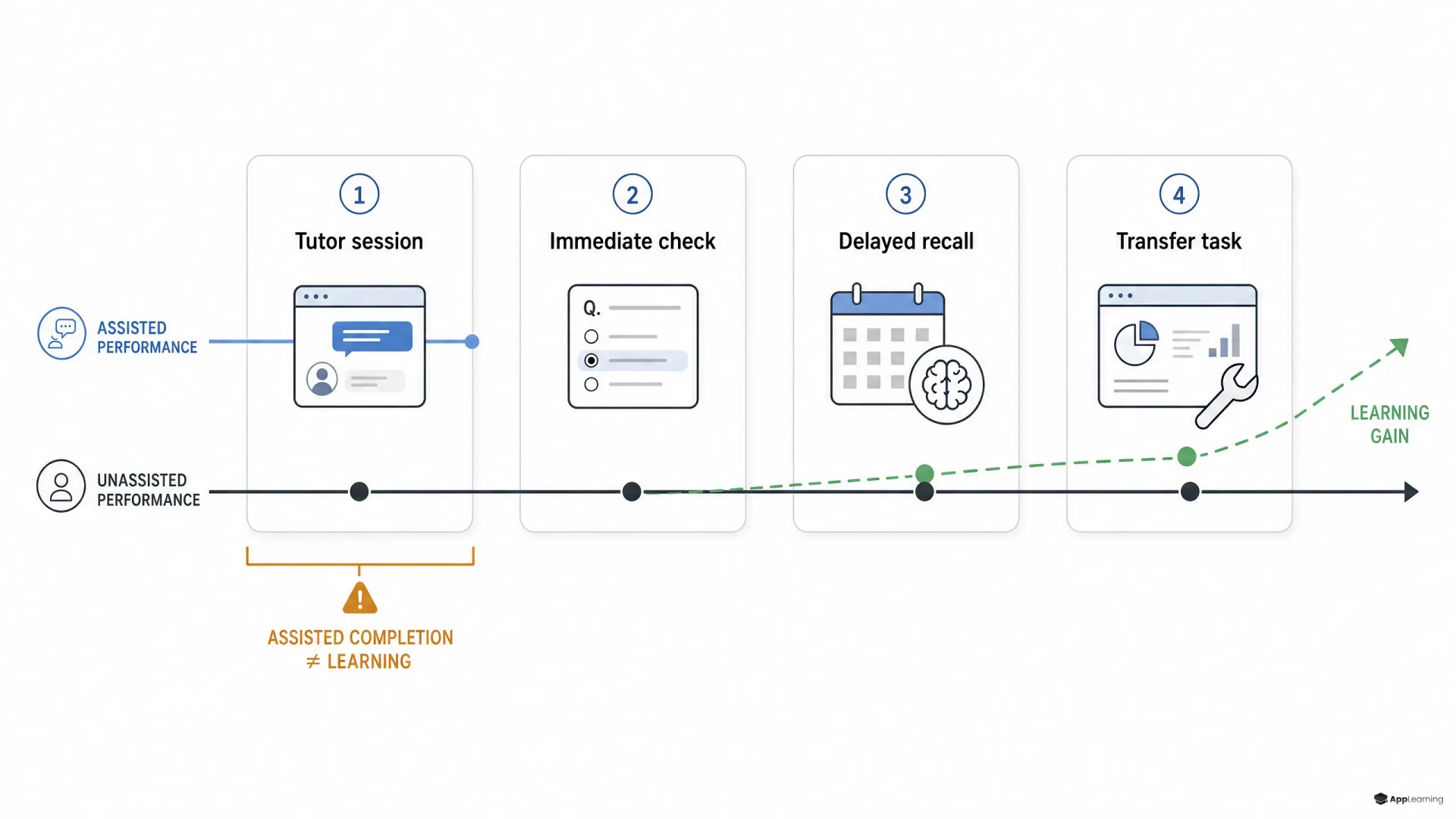
Separate learning support from assessment by design. During the tutor session, allow explanations, practice, hints and feedback. At the checkpoint, remove the assistant and use new items that test the same learning objective. Do not let the tutor generate the final answer, rephrase the question or offer a clue once the assessment starts.
This boundary protects validity. It also protects trust with risk, compliance and business leaders. You can show that a learner completed training, received help when needed and then demonstrated a defined level of independent judgement.
Retention and transfer expose dependency
A useful AI tutor assessment has three layers. First, run a short no-assistance check immediately after the session to capture initial learning gain. Second, repeat a small equivalent check after a defined delay, often seven to 14 days, to test retention. Third, use a scenario task that resembles a real decision, such as identifying the next control action from an incomplete case and defending the rationale.
The transfer task is the decisive layer for enterprise learning. A compliance learner who recalls a definition may still fail when customer pressure, ambiguous evidence and time constraints appear together. Build scenarios around the judgement the role requires, not around the wording of the tutor conversation.
Good to know
Does an unassisted post-test mean AI should be banned from learning?
No. Use AI during practice and coaching. Remove it only when you need a valid measure of what the learner can do independently.
How long should the delayed check be?
Choose a delay that reflects the work context and expected use of the skill. A seven- to 14-day check is a practical starting point for many academy pilots, then adjust based on risk and skill decay.
What makes a transfer task credible?
It should require the same judgement, constraints and evidence patterns found in the role. Use new scenarios so learners cannot pass by recalling the tutor session or a memorised answer.
Variant testing needs assistance telemetry
Do not compare one tutor model with another using satisfaction alone. Hold the objective, assessment difficulty and learner population as constant as possible. Randomly assign eligible learners to tutor or model variants, keep a no-tutor holdout where feasible, and compare independent learning gain by cohort.
Record the assistance state for every learner: whether AI was available, whether it was opened, the number of requests, the hint level used and whether generated content was accepted. An app-learning system can attach these events to each tutor session, no-assistance checkpoint and scenario task. That makes dependency visible instead of burying it inside chat logs.
Validity comes before unit economics
Cost, latency, throughput and engagement still belong on the scorecard. They matter once you have established that the tutor produces valid learning. A cheaper model that drives assisted completion but leaves no retained capability is not efficient. It simply shifts the cost to supervision, errors and repeat training.
Make independent performance the gate for your AI tutor pilot.
AssessA scorecard built for independent performance
- Independent learning gain from matched no-assistance pre- and post-checks
- Retention gain from delayed reassessment on equivalent objectives
- Transfer performance in realistic role-based scenarios
- Assistance-state telemetry including requests, hints and answer acceptance
- Cost per retained learner, alongside latency, engagement and completion
This scorecard turns enterprise AI tutoring from a chat feature into a capability system. It lets L&D teams improve tutor prompts, models and learning flows without confusing support with mastery. The benchmark starts when the conversation ends, because that is when the organisation learns whether the learner can perform without it.