

Key takeaways
- AI platforms now belong in the financial-education delivery model.
- Governance must follow content when interfaces summarise or transform it.
- Versioned source objects preserve provenance, ownership and update history.
- Educational neutrality and advice boundaries need separate controls.
- A central academy can supply governed education across every customer surface.
Financial education now has more front doors
A customer may learn about saving, risk, Bitcoin, credit or investing inside a product flow, from a support agent, through a partner campaign, or in an AI assistant. The lesson may start as a carefully reviewed academy module, then become a three-sentence answer, a generated summary or a contextual prompt. Each format changes what the customer sees and what the business must govern.
That changes the working definition of a financial educator. It is no longer only the team that publishes a course. It includes every surface that selects, compresses, frames or personalises financial information for a customer. AI financial education is therefore a content-governance problem as much as a model or interface problem.
An OECD draft shifts attention to distribution
The OECD consultation opened on September 15, 2026 and remains open until October 2. Its draft update explicitly considers finfluencers and the emerging role of AI platforms in financial information, education and advice; the OECD expects the final text to go for approval on November 2–4. This is draft guidance, not final policy, but it is a clear market signal.
The draft also names providers of consumer-facing AI tools among the stakeholders that may provide information, education or advice on personal financial matters. It recognises a central tension: AI can increase reach and personalisation, while creating questions around quality and the amplification of biased or commercially driven information. The consultation document frames that tension directly.
A course page cannot govern transformed content
A reviewed course page is necessary, but it is not a control system. It cannot tell a product assistant which explanation is current, whether a support macro uses an outdated risk statement, or whether a partner campaign removed the qualification that made the original lesson balanced.
That is the practical gap in fintech education governance. Governance must travel with the content into each transformation and delivery path. Otherwise, every team rebuilds explanations from memory, every translation becomes a separate liability, and product promotion can quietly blend into education.
Education needs to operate as a source system
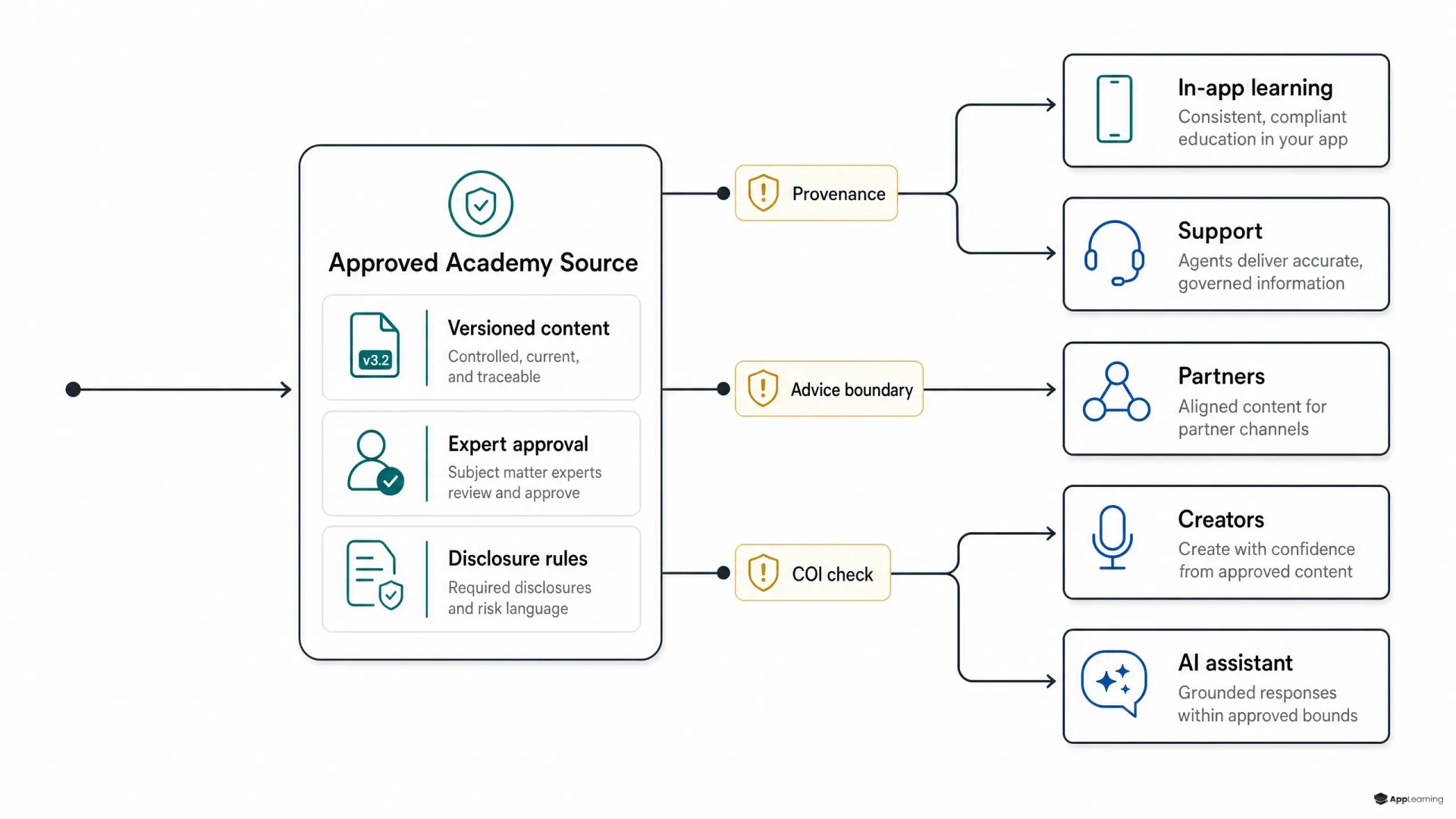
Treat approved education as versioned source objects rather than as pages in a learning library. A source object can be a lesson, concept card, scenario, glossary entry, quiz item or approved answer pattern. It should carry the fields that make reuse safe and traceable.
- A stable identifier, audience, market, language and reading level
- Source references, review status, content owner and next review date
- Version history with changed claims and retirement rules
- Permitted uses across academy, product, support, partner and assistant channels
- Clear labels for educational content, product explanation and content that must not become personal advice
This structure gives an AI assistant a controlled source of truth instead of a vague instruction to be helpful. It also gives compliance teams a practical review unit. They can assess a claim, its framing and its allowed use without re-approving an entire experience every time a screen changes.
Neutrality must survive the assistant interface
The draft OECD guidelines are precise on the risk: digital and interactive delivery can blur education and marketing, as well as neutral information and personalised advice. They propose that financial education should not promote specific products and may require controls over calls to action, product links, regulated personal advice and funding disclosure. Those proposed safeguards should shape assistant design even before the text is final.
For a fintech, this means separating three layers in both content and interface: neutral capability education, factual explanation of the product, and regulated or suitability-sensitive advice. An assistant can route between them, but it should not erase the boundary. Sponsorship, commercial context and the limits of an answer must remain visible when they matter.
Good to know
Is the OECD guidance final?
No. The current text is a consultation draft open from September 15 to October 2, 2026, with final approval expected to be considered on November 2–4.
Does a governed academy prevent an AI assistant from making mistakes?
No. It reduces avoidable variance by giving the assistant approved, current and scoped source material, while preserving review ownership and clear escalation paths.
What should fintech teams govern first?
Start with high-impact concepts that drive activation, support demand or suitability risk. Define the approved explanation, its owner, review date, market scope and rules for product and AI use.
One academy can serve every customer surface
A governed customer education academy can become the shared source layer behind onboarding lessons, in-app help, feature education, support guidance and assistant retrieval. Product teams can place the right learning object at the moment of friction. Support can link to the same approved explanation. AI can retrieve current, scoped material rather than improvise from a broad and ageing knowledge base.
This is where App-Learning fits best: not as a detached course catalogue, but as the operational layer that turns complex financial products into structured, mobile-first learning objects. Quizzes and learning analytics then reveal knowledge gaps without forcing product teams to build a parallel education system from scratch.
Build a governed education source layer with App-Learning.
DiscussGovernance becomes part of product delivery
The strongest model assigns clear ownership. Content owners maintain accuracy. Compliance defines prohibited transformations and advice boundaries. Product teams define moments of need. Support reports recurring misunderstandings. Local market owners approve jurisdictional and language adaptations. The academy records the evidence trail across all of them.
The point is not to replace an AI assistant with a course. It is to ensure that every human or AI-mediated explanation draws from an approved educational source, carries the right framing and can be updated everywhere when facts, products or rules change. In distributed fintech education, that source layer is no longer back-office infrastructure. It is part of the customer experience.