

Key takeaways
- Governance can sit around the model call, not inside every mobile client.
- Pre-request controls can block, reshape, and budget tutor prompts before generation.
- Post-request controls can redact output and create useful audit events.
- Tenant policy should be configuration, not a forked tutor implementation.
- Tutor telemetry becomes valuable when linked to learning outcomes and policy decisions.
Every AI Tutor Call Can Pass Through a Policy Layer
The AI tutor is becoming part of the mobile learning runtime. It answers questions during onboarding, explains new banking products, rehearses difficult conversations, and supports employees in the flow of work. That makes each tutor interaction a production request with cost, privacy, conduct, and evidence implications. AI tutor governance cannot remain a loose set of prompts, client checks, and manual reviews.
On September 10, 2026, Firebase’s release notes announced custom server-side scripts for Firebase AI Logic that run before and after each `generateContent` request sent to Gemini through the service. Google lists prompt moderation, token caps, generation logging, analytics, and response redaction as intended uses. For a Flutter AI learning product, this creates a useful boundary between the reusable tutor interface and the controls required by each customer.
This is an architectural option, not a complete compliance answer. Firebase labels the trigger capability as Preview, with no SLA or deprecation policy, so banks should assess its maturity, location design, failure behavior, data handling, access controls, and supplier obligations before treating it as a regulated production control.
Client-side guardrails fragment under tenant pressure
Client-side rules are tempting because they are close to the learner experience. But white-label academies rarely stay uniform. One bank may require strict handling of customer data and extensive audit events. Another may prioritize concise answers, lower token limits, and minimal retention. A third may allow only approved internal knowledge domains for a specific employee group.
If those controls live in the app, every policy variation becomes a release-management problem. Teams duplicate logic across iOS and Android paths, policies drift between versions, and urgent rule changes wait for store rollout. Worse, a client cannot be the final authority for a control that must apply consistently to every supported version.
The stronger pattern is to keep the client responsible for a fast, clear tutor surface. The server decides whether a request may proceed, what constraints apply, what may be returned, and what evidence should be retained.
Pre-request controls shape the request boundary
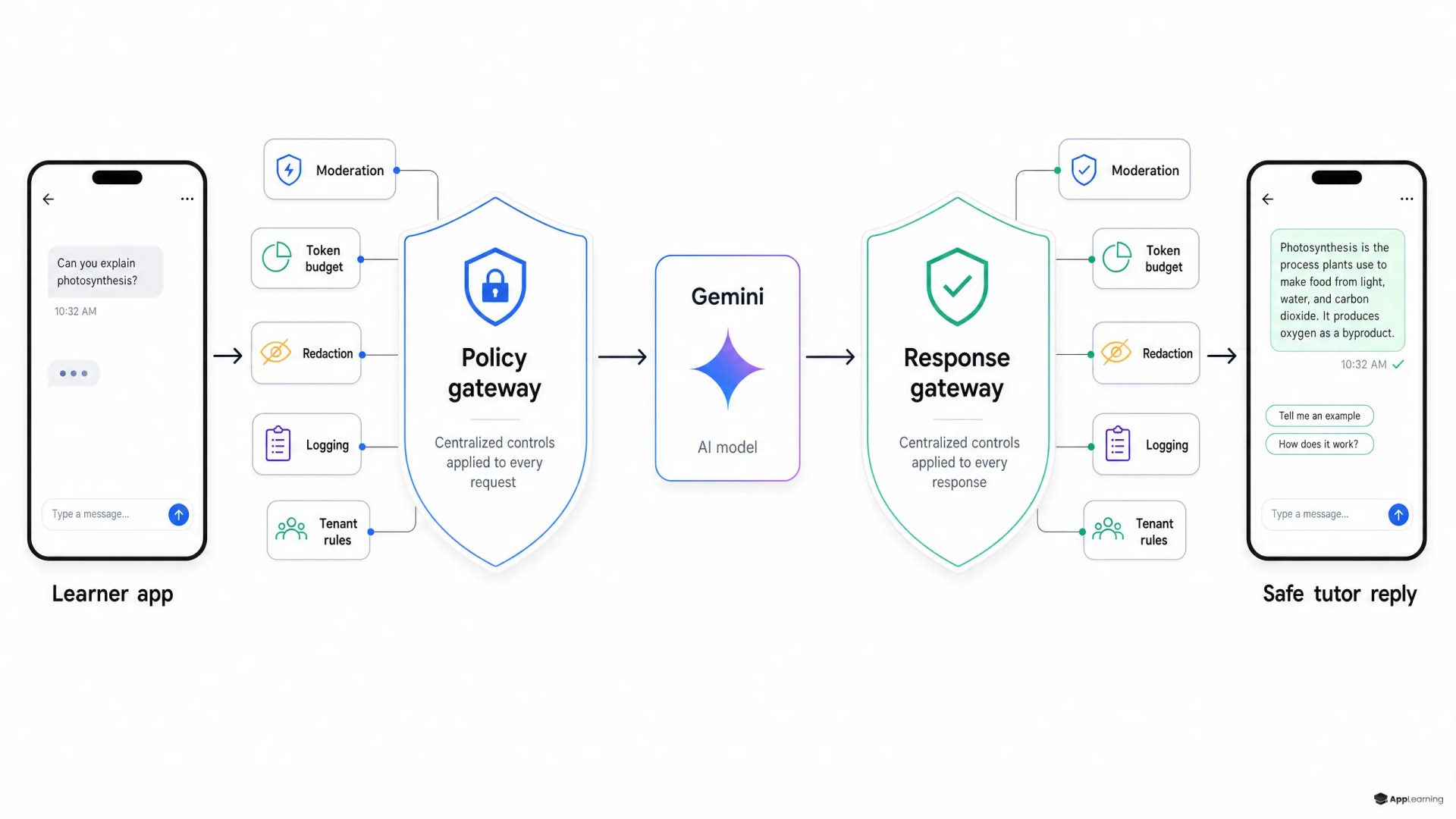
A Firebase AI Logic `beforeGenerateContent` function runs before the request reaches the model. It can inspect the request, return a modified version, or reject it. That makes it a practical implementation point for server-side AI guardrails.
- Resolve the tenant, learner role, academy, course, and policy version from trusted identity and request context.
- Reject prompts that violate the tenant’s defined topics, use cases, or content boundaries.
- Cap output tokens and enforce per-user or per-tenant usage limits through a shared quota service.
- Apply approved system instructions that keep the tutor within the intended learning task.
- Route requests to an approved model and configuration for the relevant tenant profile.
A token cap is useful, but it is not a full cost-control system. It limits one response. Aggregate quotas, rate limits, and anomaly controls require shared state beyond the individual model call. The policy layer should make that distinction explicit rather than presenting a single configuration value as financial governance.
Post-request controls govern the answer and its evidence
An after-request function can inspect, modify, block, or observe the model response before it returns to the learner. That is where response redaction and structured event capture belong. The learner still receives the answer in the same tutor UI, while the platform can apply a consistent output policy across academies.
- Redact content that breaches the tenant’s defined policy before it reaches the device.
- Replace unsafe or unsupported output with a short, controlled fallback and a route to approved learning material.
- Record model, token counts, policy version, decision outcome, course context, and redaction status.
- Store only the minimum necessary event data and separate operational telemetry from raw conversational content.
- Send high-risk patterns into a review workflow with clear ownership and retention rules.
Logging is not automatically an audit trail. A bank should design event schemas around decisions and evidence: which policy applied, what rule fired, whether the response changed, and which learning context was active. Storing every raw prompt and answer by default can create a new sensitive-data problem without producing better assurance.
Tenant policy becomes a product configuration
The central move in an enterprise AI tutor architecture is to model policy as data. The tutor does not need a separate codebase for every bank. It needs a policy profile selected from authenticated tenant context. That profile can define permitted learning domains, moderation thresholds, model settings, token budgets, retention categories, redaction rules, escalation paths, and the customer’s policy version.
This supports a reusable App-Learning tutor surface without forcing a shared risk posture. A high-control academy can block open-ended questions outside approved curricula and capture decision events for review. A lower-risk internal innovation academy can allow broader exploration while applying tighter spend controls. Both learners use the same mobile interaction pattern; the policy layer changes the operating conditions behind it.
There is one implementation constraint to plan for. Firebase AI Logic supports at most one pre-request and one post-request function per project. In a multi-tenant setup, that favors a policy dispatcher inside each function. The dispatcher loads the relevant tenant profile and applies rules in a predictable order rather than creating a separate trigger for every customer.
Good to know
Which tutor requests pass through Firebase AI Logic policy hooks?
The hooks apply to `generateContent` requests made through Firebase AI Logic. Firebase documents that streaming requests and Gemini Live API requests bypass these functions, so those interaction modes need their own control design.
Can this policy layer satisfy a bank’s AI governance requirements on its own?
No. A policy layer is one technical control within a broader operating model that includes risk assessment, identity and access management, data protection, model approval, human oversight, testing, incident handling, and vendor governance. The Firebase feature is currently Preview, which should be considered in any production suitability assessment.
Can policy changes be made without updating the mobile app?
Yes, for the server-side controls covered by the functions. Firebase states that the scripts run without client-side code changes, and updated functions take effect after deployment. Changes that alter the tutor interface, client request type, or learner workflow can still require an app release.
Tutor telemetry must connect to capability evidence
Model telemetry alone measures system activity, not workforce capability. A useful learning analytics design joins tutor events with course progression, scenario attempts, assessment performance, confidence signals, manager observations, and role-based skill targets. This shows whether employees used the tutor, where they got stuck, and whether support led to better application of knowledge.
For banking transformation, this matters most in new or changing domains such as AI, cybersecurity, automation, digital assets, and new operating processes. Innovation leaders need to see both adoption and readiness. Compliance leaders need to see policy decisions and exceptions. Learning teams need to see content gaps. A shared event model can serve all three without turning the tutor into a surveillance tool.
Design a governed AI tutor layer for every academy.
TalkThe governed tutor becomes a reusable system
A workable reference architecture is straightforward: the Flutter app sends a tutor request through Firebase AI Logic; a pre-request policy function resolves tenant context and applies controls; the model generates the answer; a post-request function redacts, blocks, or records the result; and a separate analytics pipeline joins structured tutor events to learning outcomes. Sensitive content should follow explicit minimization and retention rules, not default logging.
The operational gain is not that governance disappears. It becomes easier to own. Product teams preserve a fast in-app experience. Customer teams receive controls that match their policies. Platform teams can update central rules without a mobile release. For AI-enabled academies, that separation is the difference between shipping a tutor feature and operating a governed learning system.