
Key takeaways
- A mobile AI tutor can support users at the exact point of product confusion.
- Direct client access shifts work from custom backends to a stronger control plane.
- Prompts and models need remote governance because app-release cycles are too slow.
- App Check and rate limits are product safeguards, not infrastructure details.
- On-device AI learning needs platform-specific fallbacks and clear capability boundaries.
The tutor reaches the moment of friction
Learning support often sits in a help centre, a separate academy or a support queue. That is too far from the moment when a user cannot interpret a Bitcoin feature, fails a quiz, or hesitates in an onboarding flow. A mobile AI tutor can work inside the lesson, the simulation or the product journey instead. Firebase AI Logic makes that delivery model more practical by letting mobile and web clients send model requests through dedicated SDKs, including Dart for Flutter. It changes implementation feasibility, not the evidence base for learning effectiveness. (firebase.google.com)
Flutter loses a layer of plumbing
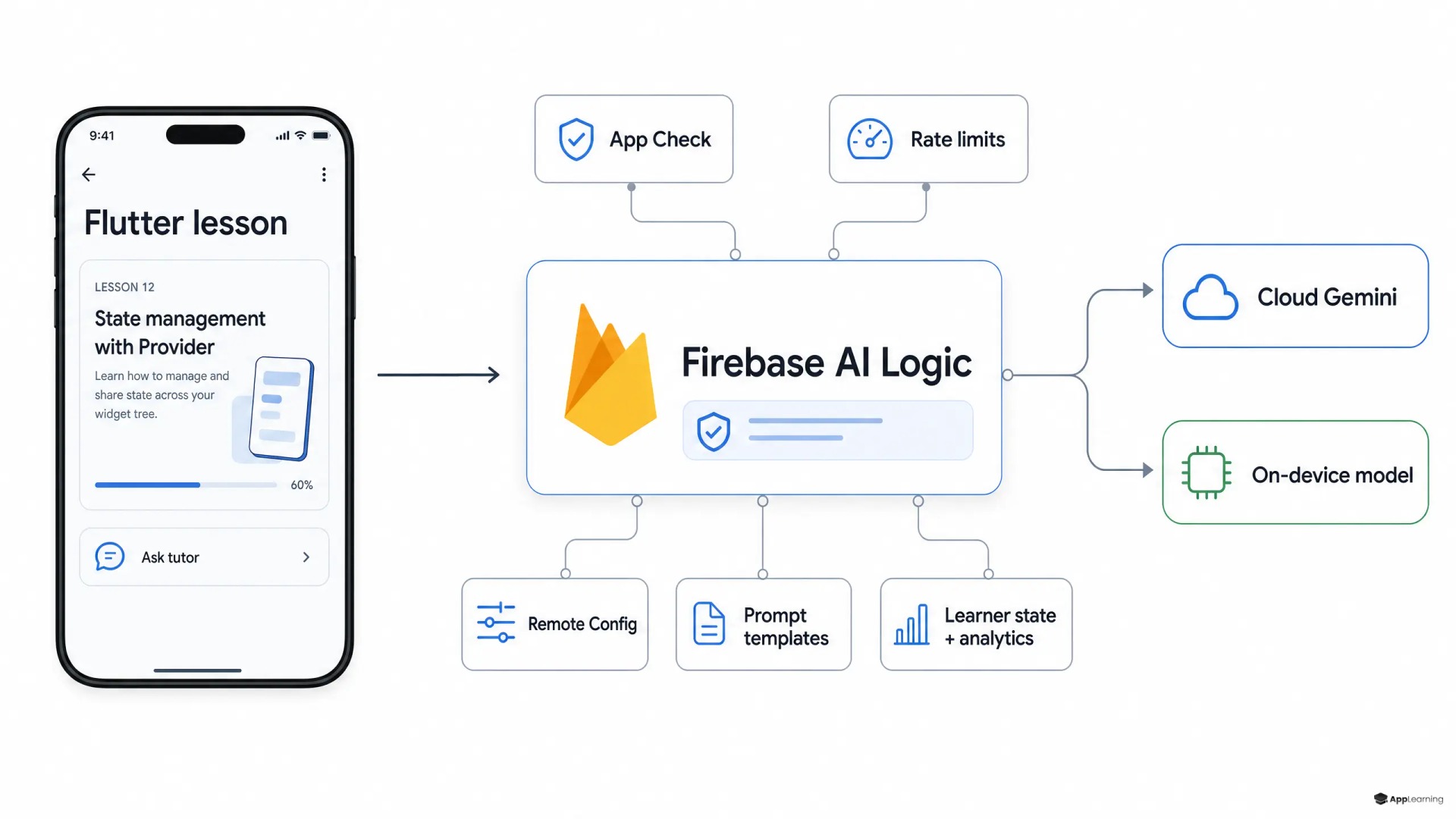
For an AI tutor in Flutter, the important shift is architectural. The Flutter plugin can call Gemini through Firebase rather than requiring every tutoring interaction to pass through a bespoke application backend. Firebase’s overview was last updated on 19 August 2026 and its reference index on 8 September 2026, rather than on 1 September 2026 as the source brief suggests. The current documentation lists Dart/Flutter alongside the other client SDKs and includes App Check integration in the Flutter setup. (firebase.google.com)
The interface is local but the policy is central
Client-side inference access does not mean client-side product governance. The app should render the conversation and collect only the learner signals needed for the next response. A central control plane should determine what the tutor is allowed to teach, which content it may retrieve, which model it may use, and when it must stop or escalate. For Firebase AI Logic education, that boundary is the difference between an embedded learning feature and an ungoverned chat box.
- Curriculum and approved source retrieval by market and product
- Learner-state rules such as level, progress, language and entitlement
- Prompt versions, model routing and response-format constraints
- Safety policies for financial education and prohibited advice
- Evaluation traces, feedback signals and fallback decisions
Abuse prevention becomes product design
A direct client call is not a reason to trust the client. Firebase’s proxy gateway supports App Check, which verifies requests from legitimate app instances and can use replay protection; Firebase also exposes a configurable per-user rate limit for AI Logic calls. Those controls should translate into product rules: cap free-form tutor turns, distinguish assisted learning from open chat, and provide a clear recovery path after a quota or model error. (firebase.google.com)
Function calling needs the same restraint. A tutor can safely use narrow, read-only tools to fetch an approved lesson, explain a feature state or launch a practice task. It should not receive authority to execute transactions, alter financial settings or infer suitability. The model may decide when to request a tool, but the product must validate every request and own the final permission check.
Release cycles cannot govern prompts
Models, prompts and output settings change faster than a mobile release cycle. Firebase recommends Remote Config or server prompt templates for changing settings such as model names without releasing a new app version. For a white-label academy, remote configuration can also select tenant language, curriculum version, safety policy and feature availability. Server prompt templates are currently a Preview feature, so teams should version them, test them outside production and keep a rollback path. (firebase.google.com)
Good to know
Does direct client access remove the need for a backend?
No. It can remove a custom relay for routine model calls, but a serious AI learning app architecture still needs central services for learner state, approved content, policy decisions, analytics and any sensitive action. Firebase’s client path is a delivery mechanism, not a substitute for those responsibilities.
Can a fintech tutor use customer account information?
Only use the minimum approved context needed to explain the learning moment. Keep tutoring separate from transaction execution and financial suitability decisions, apply tenant and entitlement rules centrally, and make tool access read-only unless a separate verified flow takes over.
Can Flutter teams rely on on-device tutoring today?
Flutter teams can use Firebase AI Logic for direct Gemini access, but hybrid and on-device behaviour must be verified for each target platform and use case. Firebase’s published hybrid guides describe platform-specific support and material feature limits, particularly for multi-turn and tool-enabled tutoring.
Hybrid inference needs explicit routing
On-device AI learning is useful for short, private and latency-sensitive tasks such as explaining a screen, reframing a quiz hint or drafting a recap. But it is not a blanket cloud replacement. Firebase documents hybrid on-device and cloud routing for several SDKs, while its Android guidance describes the feature as experimental and limits on-device inference to narrower capabilities such as single-turn generation. It does not support multi-turn chat, function calling or server prompt templates in that path. For Flutter academies, treat hybrid support as a platform-validation item rather than an assumed cross-platform SDK capability. (firebase.google.com)
Map the control plane before you ship the tutor.
PlanA tutoring control plane for every academy
App-Learning can use this pattern to keep the learner experience native to each branded app while operating one governed tutoring system behind it. The shared layer should provide content retrieval, policy enforcement, evaluation and observability. Each tenant layer should provide its own brand, product taxonomy, languages, learner journeys and entitlement rules.
- Flutter or web client renders tutoring in lessons and onboarding flows.
- Identity and learner state supply minimal, purpose-bound context.
- A policy service selects the tenant, prompt, model and allowed tools.
- Approved content retrieval grounds explanations in current product material.
- Analytics records completion, confidence, error states and human escalation signals.
The winning implementation will not be the app with the most fluent chatbot. It will be the learning product that makes support present at the point of confusion, bounded by policy, measurable in operation and maintainable across every branded academy.