
Key takeaways
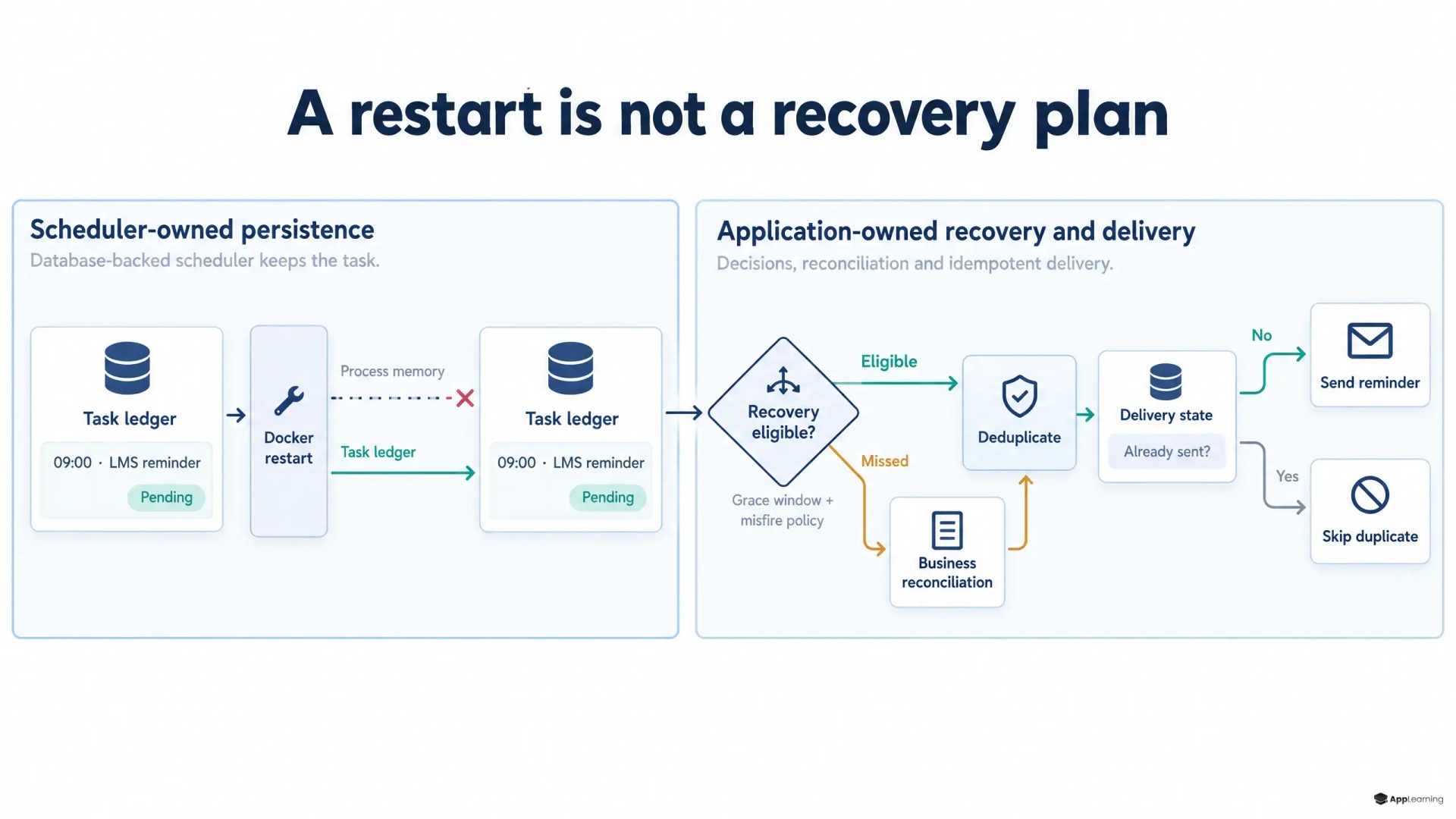
- Pending runs survive restarts, but grace periods and misfire policies still govern late execution.
- The default misfire policy skips overdue runs rather than replaying the backlog.
- Minute intervals become publication-anchored; use cron when fixed clock times matter.
- Deduplicate business actions and record delivery outcomes separately from workflow execution.
- Test redeploys and monitor overdue actions, opt-outs and time-zone behaviour per tenant.
Consider a fictional startup academy. A new hire leaves an onboarding quiz unfinished. A reminder is due during a server deployment, but never arrives. The manager eventually chases it manually. The failure is small; the operational consequence is clear. Training still depends on someone remembering.
The restart no longer erases the schedule
The October 20, 2026 n8n changelog (docs.n8n.io) announces database-backed Schedule Trigger runs by default in v2.45, including existing workflows without republishing. At the October 22 check, that page lists stable 2.44.6 and beta 2.45.2—not the earlier 2.44.5 and 2.45.1 patch numbers. Treat v2.45 as a beta rollout candidate, not an already production-stable upgrade.
The n8n durable scheduler changes where pending work lives. It does not prove that an email arrived, a certificate reached another system or a content update became visible.
Downtime still needs a business decision
Under n8n’s documented misfire rules (docs.n8n.io) the grace period defaults to 60 seconds, while the default policy discards missed executions. Check the effective instance settings and node options rather than assuming those defaults apply.
- Short restart — a pending run can execute late within its grace period.
- Extended outage — beyond grace, the configured misfire policy determines whether to skip or catch up.
- Multi-main deployment — mains share the queue and claim individual runs instead of relying on one scheduling leader.
Catch-up policies collapse missed work into the latest execution, optionally per rule. They do not replay every occurrence. Recover missing learner actions from business records, not timer history.
Give every reminder a durable contract
Design the LMS reminder workflow around a persistent action record containing tenant_id, learner_id, assignment_id, action_type, due_at and delivery_outcome. Add an idempotency key, attempt history and last_successful_action_at.
The scheduler’s lease configuration (docs.n8n.io) explicitly warns about double-run risk. Use that as a design constraint, not a reason to promise exactly-once email delivery.
- Quiz nudges — recheck completion and applicable opt-outs before sending; suppress stale reminders.
- Certification automation — reconcile each eligible certificate against confirmed exports, not merely the last workflow start.
- Content publication — verify approval and version, then publish overdue eligible content without replaying obsolete releases.
- Duplicate control — enforce a unique action key atomically and use provider idempotency where supported.
- Audit trail — distinguish attempted, provider-accepted, confirmed-delivered, suppressed, failed and uncertain outcomes.
Good to know
Should every overdue reminder be sent?
No. Recheck completion, message relevance and applicable communication preferences before recovering an overdue action.
Clock time is part of the tenant contract
The n8n Schedule Trigger documentation (docs.n8n.io) confirms that seconds and minutes intervals now count from publication. Use cron for fixed clock times. Set the workflow timezone explicitly; otherwise the instance timezone applies. Store due_at in UTC alongside the tenant’s named timezone, then test daylight-saving transitions.
Review your academy’s recovery rules with App-Learning.
DiscussProve recovery before expanding the rollout
Stage the upgrade with one test tenant. Verify the publication service remains enabled and no scheduler override disables durability. Recreate the Docker container while retaining its database. Test downtime inside and beyond grace, concurrent workers and a crash after provider acceptance but before local confirmation.
Use n8n’s scheduler observability (docs.n8n.io) to track lag, missed runs and exhausted retries. Add tenant-level overdue actions, delivery failures, duplicate suppression and opt-outs. Assign an owner to unresolved work.
For App-Learning, learning automation reliability belongs inside the academy design. The standard is not that a timer survived. It is that each due action completed, was deliberately suppressed or reached an accountable recovery queue—without making managers the fallback scheduler.