
Key takeaways
- Inventory every system that creates, changes or distributes course content.
- Internet visibility is a signal, not proof of compromise or vulnerability.
- Assign a named owner to every automation service and connected credential.
- Review access, update cadence and recovery paths before a workflow fails.
- Test whether course creation can continue when automation is unavailable.
The visible LMS is only one part of the academy
A growing startup may have a well-configured LMS, clear onboarding paths and strong course templates, yet still depend on a small automation service that nobody formally owns. That service may pull source material from a knowledge base, draft a lesson, send content for review, trigger translation, publish modules, enroll learners and notify managers. If it stops, the academy may remain online while the operating system behind it fails.
That is the gap in many LMS integration security reviews. They assess the application employees can see, then leave the surrounding workflow infrastructure outside the scope. For a managed academy, that boundary is too narrow. Learning content automation governance must cover every system that can change course content, access learner data or interrupt the publishing process.
Exposure is a signal rather than a verdict
On October 14, 2026, Censys found 113,926 exposed n8n hosts. Its research also made an important distinction: exposure alone does not establish that a system is insecure, vulnerable or compromised. The useful operational conclusion is not to assume a breach. It is to ask whether an internet-visible endpoint exists, what it can reach, who owns it and how its condition is checked.
This matters because workflow tools often hold the connections that make an academy useful. A single service account can bridge the LMS, cloud storage, translation provider, email platform and internal knowledge base. The workflow may be low-code, but its permissions and failure modes are not low-impact.
The academy has a control plane behind the course catalog
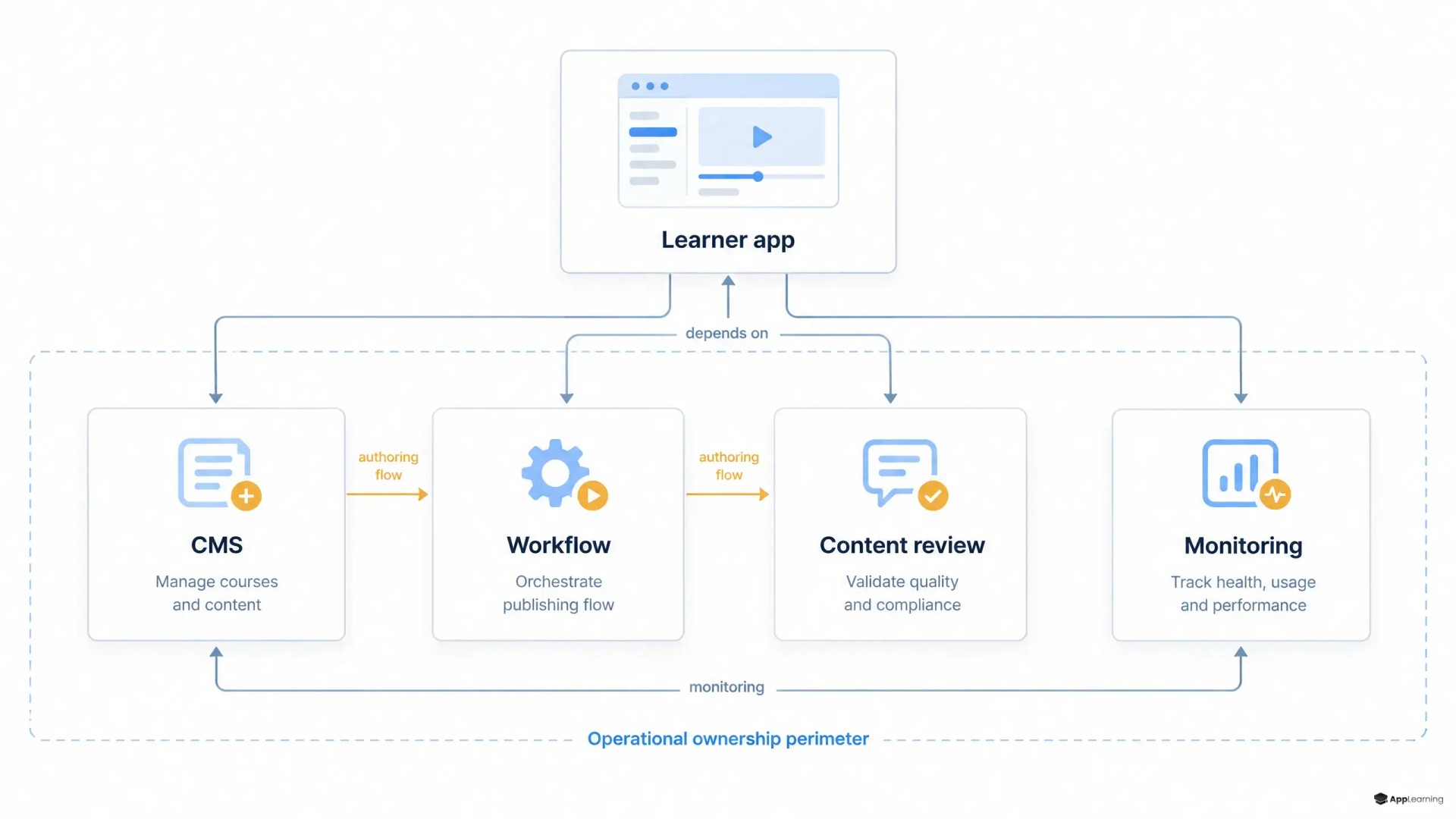
Map the academy as a flow of work, not as a list of software subscriptions. Start with a real course change and trace it from request to learner. Include manual steps, scheduled jobs, webhooks, APIs, shared mailboxes and human approvals. This turns an abstract architecture diagram into a record of how a course is actually produced.
- Source systems such as handbooks, product documentation and knowledge bases
- Authoring, translation, review and media-generation services
- Automation workflows, API endpoints, webhooks and scheduled jobs
- The LMS, identity provider, learner groups and reporting destinations
- Storage locations, service accounts, secrets and notification channels
The output should show which dependencies are essential for publishing, which only improve speed, and which hold sensitive credentials or learner information. It should also separate vendor-managed services from systems the startup configures or hosts itself. That distinction is central to n8n hosting practices and to any other automation tool used in the stack.
Names turn dependencies into managed assets
Build one compact asset and ownership register. NIST guidance identifies asset inventory, documented information flows, defined responsibilities and least-privilege access as foundational practices. The register does not need a governance platform. A maintained spreadsheet or ticketed service catalog is enough if it records the operational facts.
- Asset name, purpose, environment and internet exposure status
- Business owner accountable for the learning workflow
- Technical owner accountable for configuration, updates and incidents
- Connected systems, data types and service accounts
- Authentication method, credential location and access-review date
- Update approach, backup method and recovery instructions
- Last continuity test, known limitations and replacement path
Do not assign ownership to a department alone. Name a person and a backup. A workflow with no owner tends to become a hidden dependency, especially after a founder, engineer or operations lead changes role.
A short review routine prevents silent drift
Run the following checklist for each automation endpoint that supports the academy. It is vendor-neutral and proportionate for a startup with limited security capacity.
- Discover endpoints. List public URLs, inbound webhooks, scheduled workflows and external API connections. Confirm whether each one must be reachable from the internet.
- Review access. Remove former employees, replace shared administrator accounts, limit service-account scope and record who can change credentials or publish workflows.
- Check maintenance. Record the deployed version, update owner, test path and target patch window. If using n8n, its release documentation and update guidance make clear that maintenance is an ongoing operating task, not a one-time setup.
- Test continuity. Disable or simulate the loss of one workflow and prove that the team can still create, approve, translate and publish an urgent course through a documented fallback.
- Capture exceptions. If a workflow cannot yet meet the intended standard, log the reason, compensating control, owner and review date.
Good to know
Does an internet-facing automation host mean it is compromised?
No. As Censys states in its 2026 research, exposure alone does not prove insecurity, vulnerability or compromise. It does justify verifying purpose, ownership, access and maintenance.
Which automation systems belong in an academy register?
Include any system that can author, translate, approve, publish, enroll, notify or report on learning content. Include connected storage, identity services and service accounts when they enable those actions.
How often should a startup review the register?
Review access and ownership after material role or system changes, and run a broader review at least quarterly. Test the recovery path after major workflow changes and before high-stakes onboarding periods.
Buyer assurance needs operational evidence
Enterprise buyers do not only assess the course experience. They may ask how content is controlled, who can access connected systems and what happens if a dependency fails. A concise evidence pack reduces the scramble when those questions arrive.
Keep a current architecture map, the asset register, access-review records, change and update history, and the result of the latest recovery test. NIST contingency-planning controls emphasize defined recovery roles, restoration priorities, plan updates and lessons learned from testing. The goal is not to imitate an enterprise compliance program. It is to demonstrate that the academy can keep operating under predictable stress.
Make your onboarding academy easier to run and easier to trust.
TalkReliability begins before the learner opens a course
For founders, the practical test is simple. If the automation layer vanished this morning, could the team identify the affected courses, revoke the right credentials, communicate clearly and publish a critical update by another route? If the answer is unclear, the automation server belongs on the academy risk register. Teams using App-Learning can apply this discipline without turning onboarding into an infrastructure project: make the learning system visible, assign ownership and rehearse the work that keeps knowledge moving.