

Key takeaways
- Local facilitators extend reach without replacing trusted in-person relationships.
- Open materials need version control, ownership, and clear adaptation limits.
- Facilitator training should test delivery practice, not just Bitcoin knowledge.
- Required updates and renewal prevent outdated guidance from lingering.
- Cohort data makes a decentralized education program manageable at scale.
Local Trust Needs a Single Source of Truth
Bitcoin education scales differently from a conventional online course. People do not only need definitions. They need to ask basic questions without embarrassment, handle wallets in a safe setting, and understand where education ends and personal financial responsibility begins. A local educator can make that first experience feel credible in ways a generic content library often cannot.
The model already exists in the ecosystem. Bitcoin Austria’s workshop model publishes open-source concepts and materials that other meetups may adapt as community editions. Its program also separates general entry content from practical tracks for individuals and for businesses or nonprofits. Trezor Academy describes a three-session, local-expert format and reports delivery across more than 30 countries; its Mauritius series ran on August 28–30, 2026.
These are useful operating examples, not controlled evidence of learning outcomes. They show the central trade-off: local delivery expands access and trust, but it also distributes responsibility for quality.
The Facilitator Becomes Part of the Product
For a Bitcoin company, the facilitator is not a detached event host. They shape how learners interpret risk, custody, privacy, fees, product claims, and security. A clear educator can help a hesitant user take a first informed step. An unprepared one can spread outdated guidance or create confidence without competence.
That makes facilitator training a product-quality function. It should cover subject knowledge, safe demonstrations, learner support, escalation routes, and the boundaries around regulated or personal financial advice. The standard is not that every facilitator sounds identical. The standard is that every learner receives the same essential safeguards and can complete the same core actions.
Curriculum Drift Is the Hidden Scaling Cost
Open content invites useful local adaptation. Examples, language, payment habits, local regulations, and common misconceptions differ by market. Yet each copied slide deck, translated handout, and improvised workshop creates another version that can diverge from the source. Over time, a program may no longer know which learners received which guidance.
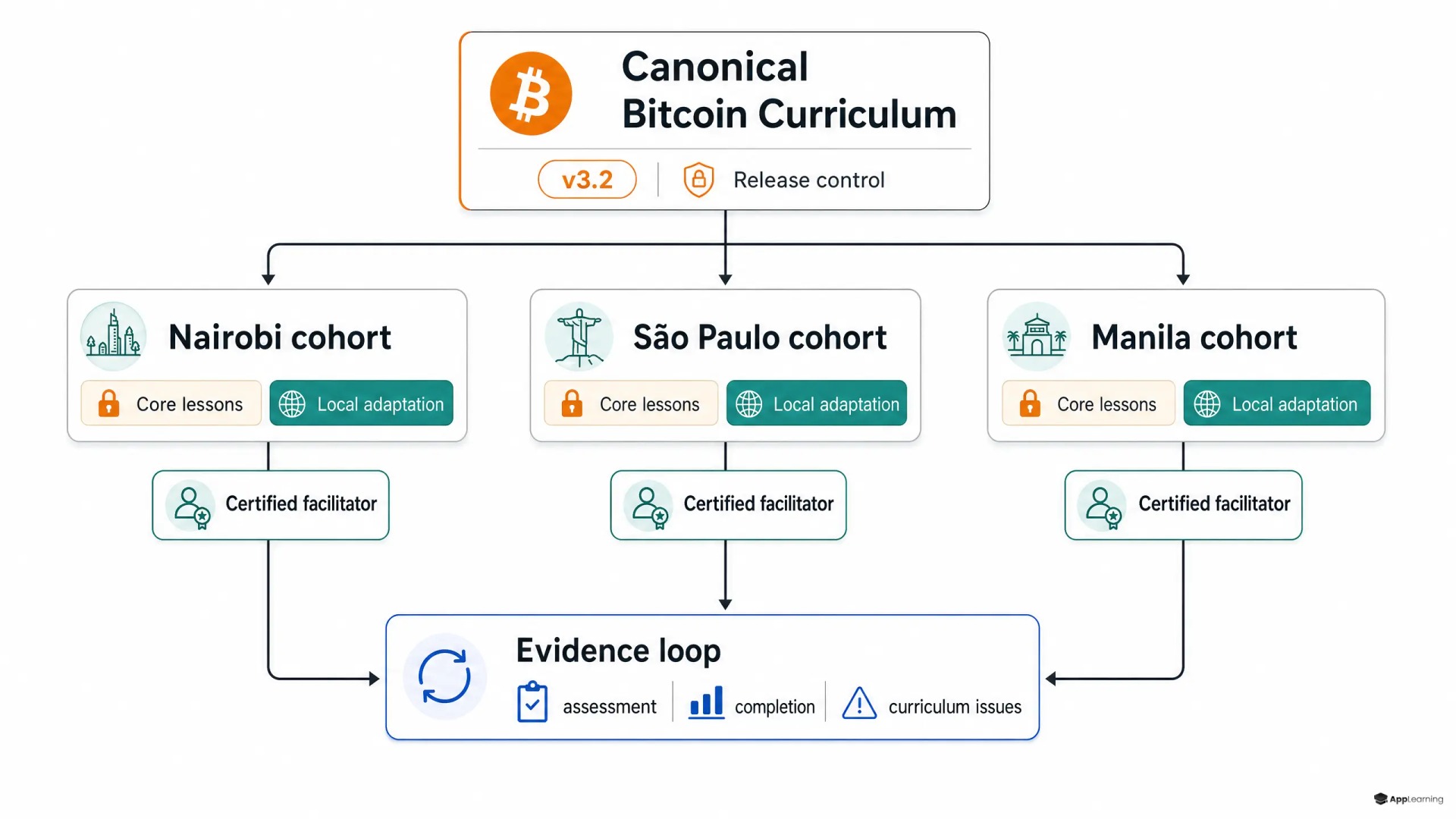
Bitcoin curriculum governance solves this with a firm distinction between the canonical core and permitted local variants. The core contains non-negotiable learning objectives, security guidance, required disclosures, assessments, and approved product statements. Local variants can change language, examples, cultural references, session timing, and community partners. They cannot silently alter high-risk concepts or remove required learning checks.
- Assign every module a version number, owner, review date, and change log.
- Make local adaptations fork from the current approved version rather than from downloaded files.
- Flag material that expires after a policy, product, or security update.
- Require facilitators to acknowledge critical changes before teaching the next cohort.
Certification Must Remain a Living Control
A one-time certificate proves very little after the first workshop. A stronger model uses onboarding evidence: a short knowledge assessment, a recorded or observed delivery simulation, acceptance of teaching standards, and completion of required product or security modules. Certification then expires unless the facilitator completes relevant updates.
This protects educators as well as learners. Facilitators receive a clear answer to what has changed, what they must teach now, and where to escalate difficult questions. Program owners gain auditable evidence that an educator was current when a cohort ran. That is far more useful than a static badge in a shared folder.
Good to know
What belongs in the canonical Bitcoin curriculum?
Include core learning objectives, security guidance, approved product statements, required disclosures, key exercises, and assessments. These elements should have named owners, version numbers, and clear review dates.
What can local communities adapt?
They can adapt language, examples, cultural references, scheduling, venue format, and local partnerships. Changes that affect security guidance, financial claims, required assessments, or essential learning outcomes should require central approval.
How should facilitator certification be renewed?
Renewal should combine required update completion with periodic knowledge checks and delivery evidence. Trigger earlier renewal when material changes materially, such as a product flow, security procedure, or policy requirement.
Which metrics matter for a decentralized education program?
Track enrollment, attendance, completion, pre- and post-assessment results, confidence changes, common learner questions, facilitator status, and outcomes by curriculum version. Use the data to improve content and support, not to rank communities superficially.
Local Autonomy Still Needs Measurable Learning
Measurement does not require centralizing every session. Use a small common assessment before and after the program, plus completion data, confidence signals, recurring questions, and facilitator notes. Compare cohorts by curriculum version, market, language, and facilitator status. Keep personal data minimal and consent-based, especially when education sits close to financial products.
The resulting data should improve the system, not police local educators. If one cohort repeatedly misses wallet-backup questions, review the module and the exercise. If a local adaptation drives better completion without reducing assessment results, promote it for reuse. This turns community learning infrastructure into a feedback loop rather than a collection of one-off events.
Build trusted Bitcoin learning without losing control of the system.
Talk to usAn Operating Layer for Distributed Academies
A Bitcoin academy platform should connect the work that usually fragments across slide decks, messaging groups, forms, spreadsheets, and event tools. It needs a canonical curriculum repository, controlled localization workflows, facilitator profiles, certification evidence, release notes, learner assessments, and cohort dashboards. It should also make required updates visible inside the facilitator’s next teaching workflow, not bury them in an email.
This is where App-Learning can provide the operating layer behind a distributed academy. The same system can support an in-person community program and extend selected modules into a fintech’s mobile onboarding, where users need contextual guidance before a first purchase, recurring buy, wallet setup, or self-custody decision.
The scalable model does not centralize every conversation or force every community into one script. It centralizes the commitments that must stay true: the curriculum source, safety standard, facilitator evidence, update process, and learning signal. Local educators retain the relationship. The program retains its integrity.