
Key takeaways
- Learner state and completion events serve different integration needs.
- Polling learner records creates coupling, latency, and stale-state risk.
- Completion events need clear scope, timing, identity, and content-version semantics.
- Idempotent, versioned contracts protect host apps as the academy evolves.
- Learning events let product teams automate action without rebuilding LMS logic.
The record is not the signal
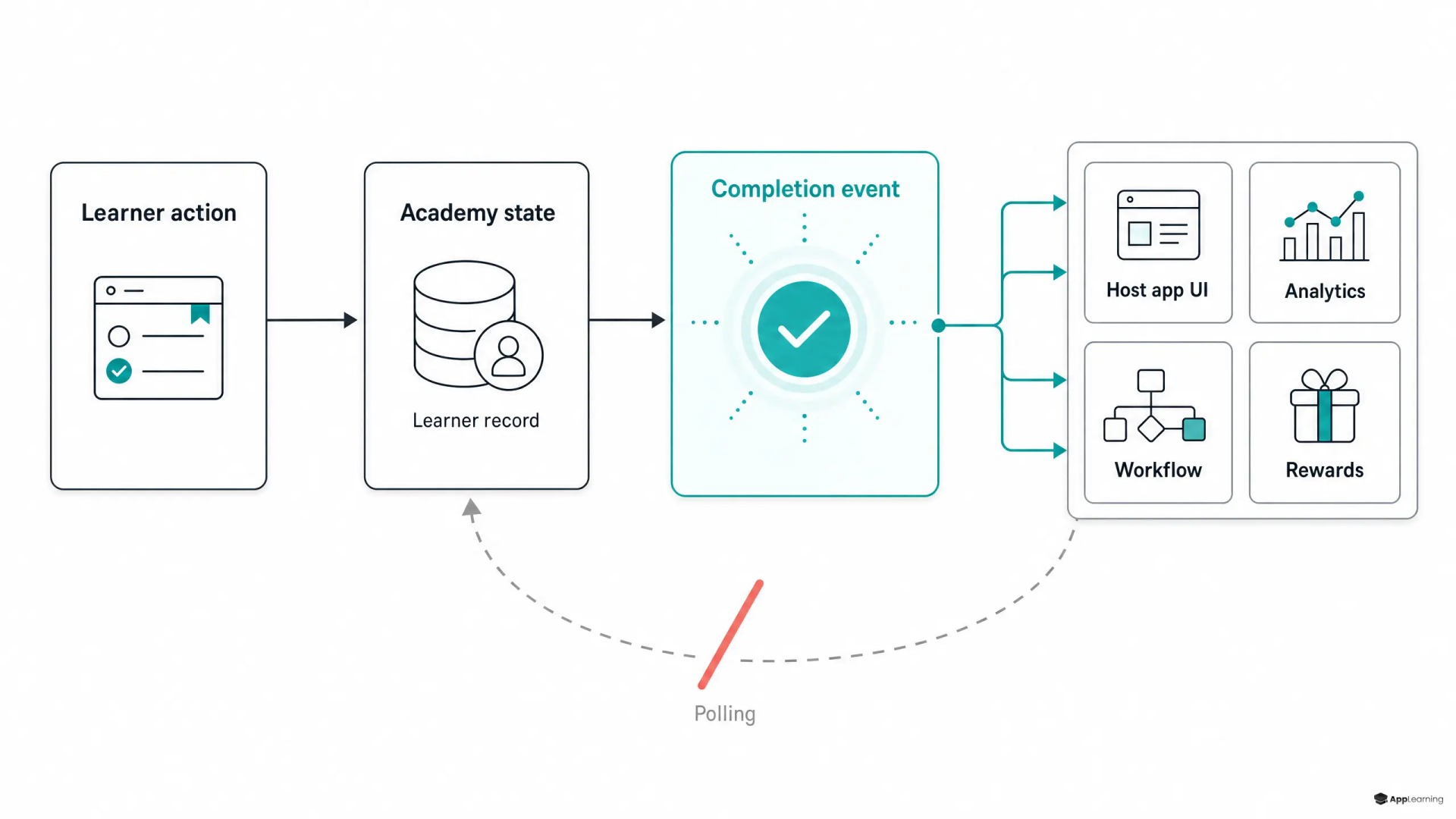
A learner record answers a present-tense question: is this person complete now? An LMS completion event answers a different question: did completion happen, exactly when did it happen, and what should react to it? Both surfaces matter. State supports screens, support teams, and progress recovery. Events support action.
The gap often appears during an in-app academy integration. The academy already marks a chapter as complete on the learner model, but the host application needs to unlock the next product step, show a success state, award points, or record activation at the instant that state changes. If it must repeatedly inspect a learner record to infer the transition, the host application has inherited part of the academy’s logic.
Polling spreads LMS logic across the product
Polling looks simple at first. The host app requests progress when a user opens a screen, on a timer, or after an assumed learning action. But it creates unnecessary coupling. The consuming team must know which fields indicate completion, distinguish old from new progress, handle delayed updates, and decide how often to query. It also produces awkward user experiences when the academy and product UI disagree for a few seconds or minutes.
An event-driven LMS reverses that responsibility. The academy remains the authority on completion rules. The host application subscribes to a clear business occurrence and reacts only after the academy has made its decision. That keeps learning rules in the learning system and product rules in the product.
A completion contract needs more than a boolean
A useful learning events API should use a stable event envelope and a specific payload. The CloudEvents specification provides a practical reference model with identifiers for the event, source, type, subject, and occurrence time. The academy does not need to adopt that standard wholesale, but it should offer the same level of clarity.
- A precise type such as learning.chapter.completed.v1 rather than a generic progress.changed message
- A unique event identifier and delivery identifier
- The learner, tenant, and relevant host-product identifiers
- The completed object’s canonical ID, object type, and course hierarchy
- The content version or revision that the learner completed
- The completion timestamp and the rule that qualified as completion
- Useful outcome data where relevant, such as score, attempt, or pass threshold
- A correlation ID that connects the event to a product journey or workflow
The critical field is often content version. Completing “Bitcoin basics” is not enough context when the course has been revised, localized, or assigned under different rules. A downstream system needs to know what the learner completed, not merely that a progress flag became true.
Completion has distinct meanings
Chapter completion, module completion, course completion, and assessment completion are separate business events. A learner may finish every chapter yet fail a required assessment. They may pass an assessment without meeting a time-based or compliance requirement for course completion. One broad completed flag hides these distinctions and forces downstream consumers to reverse-engineer them.
Define the vocabulary before publishing the academy webhook. Use event types that map to the actual learning model, document the qualifying rule for each type, and state whether an event can be emitted again after a reset, reassignment, or newer content version. Clear semantics prevent rewards, access rights, and reporting from drifting apart.
Reliable delivery requires defensive consumers
A webhook receiver should treat delivery as at-least-once unless its contract guarantees otherwise. Store processed event IDs and make the reaction idempotent: a repeated chapter-completed message must not grant the same reward twice or create duplicate CRM tasks. CloudEvents explicitly allows re-sent duplicates to retain the same source and ID, which gives consumers a sound basis for deduplication.
Version the contract from the beginning. Backward-compatible additions can extend a payload, but a breaking change should publish a new event type or schema version. The CloudEvents versioning guidance recommends distinguishing incompatible changes so consumers can migrate without being silently broken. This discipline matters most after the first integration succeeds and more teams start depending on it.
Good to know
What is the difference between learner state and a completion event?
Learner state describes the current result, such as completed equals true. A completion event records the transition itself, including when it occurred and the context needed for another system to act.
Should every progress update create an event?
No. Publish events for meaningful business occurrences. Chapter completion, assessment pass, course completion, reset, and certificate issuance are usually clearer than a high-volume stream of minor progress changes.
How should a host app handle duplicate completion webhooks?
Use the event ID as a deduplication key and make the downstream action idempotent. The same message may arrive more than once, but the reward, UI update, or workflow should take effect only once.
Learning activity becomes product capability
Once completion is an explicit event, host applications can react without rebuilding academy logic. They can unlock advanced financial features after a required learning path, change onboarding UI after a chapter, trigger a contextual notification, grant a reward, enrich activation analytics, route a user to support, or start a workflow for a relationship manager. The same event can serve web, mobile, analytics, and operations teams.
For fintech product leads, this turns education from a separate course surface into part of the activation system. The academy can measure knowledge and maintain learner state while the product responds to verified learning moments in the customer journey.
Make learning progress actionable inside your product.
Talk to usIntegration belongs inside the academy product
At App-Learning, the practical standard is not simply to embed learning in a product shell. It is to make the academy a dependable participant in the wider product ecosystem. The platform should own content, progress, assessments, and completion rules, then expose those decisions through a versioned LMS completion event and a clear academy webhook contract.
That separation creates a cleaner system. The academy remains the source of truth for learning. The host app remains free to shape its customer experience. Neither side has to simulate the other, and learning completion becomes a moment the business can use rather than a field another service has to keep checking.