

Key takeaways
- Learner-region measurements reveal delays that office tests and hosting dashboards can miss.
- Chapter APIs, images and third-party services need separate performance traces.
- p75 and p95 chapter usability and image readiness expose persistent and severe waits.
- Smaller assets and cache-friendly delivery deserve priority over heavier interface effects.
- Performance improvements remain hypotheses until they reach the screens learners actually use.
A short lesson is not necessarily a fast experience. Consider a customer learning about transaction fees inside a fintech app. The reading takes little time, but opening the chapter, seeing its diagram and receiving quiz feedback each introduces another wait.
Short sessions expose repeated waiting
Google’s user-centric performance guidance distinguishes useful content from usable interaction and explains how devices and networks change the experience. (web.dev) For microlearning, the operational implication is straightforward: lesson length alone is a poor proxy for effort when progress depends on repeated loading steps.
The learning journey needs separate clocks
A useful mobile LMS performance review follows the learner’s actions rather than treating the academy as one page.
- Module open to navigation ready.
- Chapter tap to required text and controls usable.
- Chapter tap to essential image visibly rendered.
- Answer submission to feedback shown and progress confirmed.
The W3C Resource Timing interface exposes timings for individual resources in web applications. (w3.org) Pair those traces with screen-level events. Keep text/API requests, images and third-party services separate so that a slow illustration does not become a vague diagnosis of application latency.
Distance enters the request chain
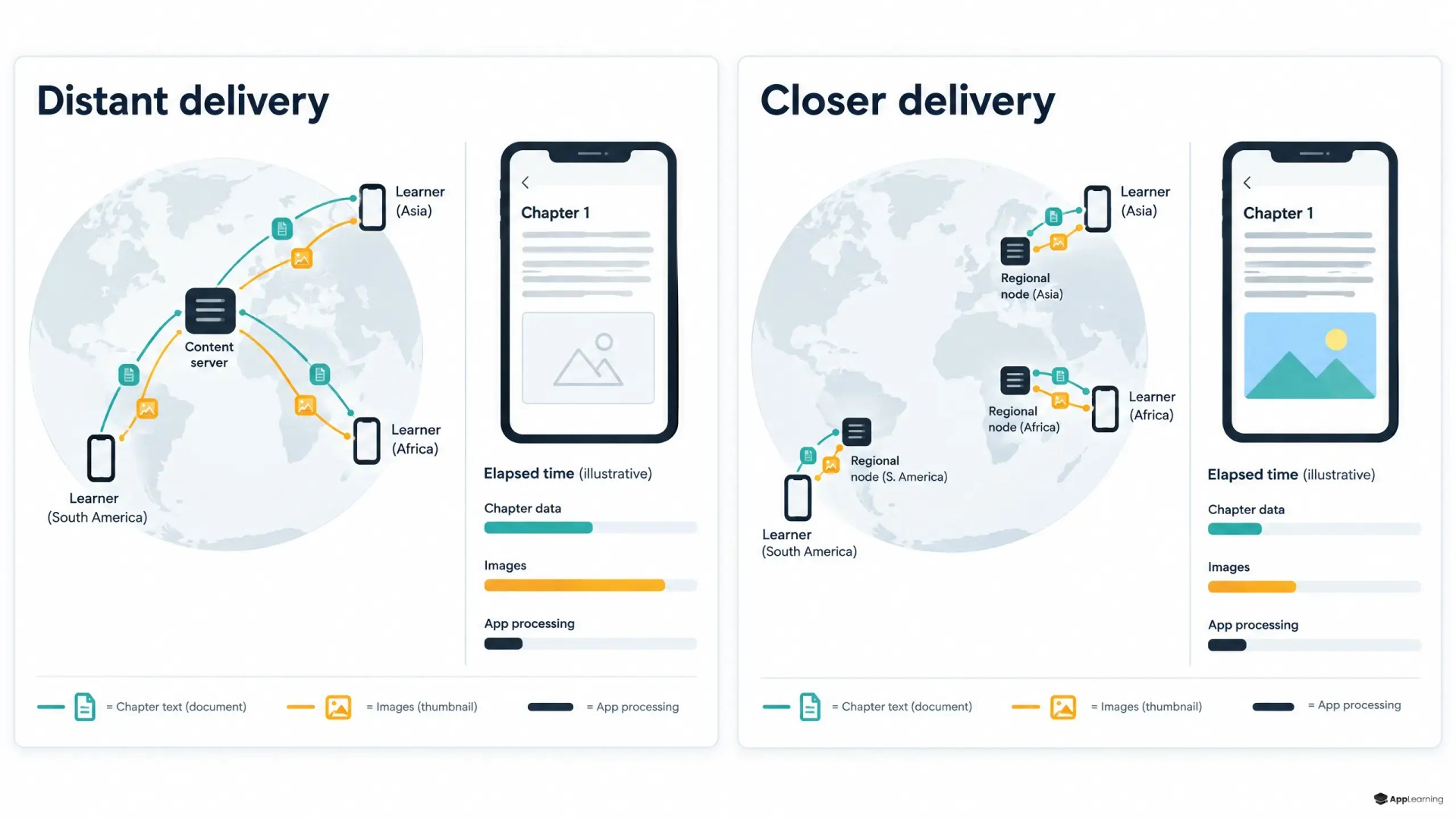
Request waiting includes network round-trip latency as well as server preparation time. (developer.chrome.com) Global academy latency therefore cannot be judged from backend execution alone. If an image request starts only after chapter data arrives, the learner encounters those waits in sequence.
The academy review behind this piece identified chapter requests and image loading as suspected contributors for a distant audience. Delivery adjustments addressed both paths, but no independently verified before-and-after measurements were available. Faster loading remained an expectation, not a demonstrated result.
Microlearning image loading needs its own budget
Google’s loading guidance identifies resource size, delivery distance and caching as distinct ways to reduce transfer delays. (web.dev) For LMS content delivery, the choice should follow the trace: oversized illustrations call for smaller assets; repeat downloads suggest cache work; regional waits justify testing closer delivery. These are different interventions, not interchangeable infrastructure upgrades.
MDN’s caching guidance distinguishes shared resources from personalised responses and warns against sharing private content. (developer.mozilla.org) An academy’s delivery policy should make that boundary explicit, with versioned lesson assets handled separately from learner progress and quiz results.
The test environment must resemble the audience
Field measurements reflect actual devices, networks and geographic locations; controlled lab tests serve a different purpose. (web.dev) A useful test matrix combines representative phones and target-region connections with repeatable throttled tests. It includes first visits, warm-cache returns and authenticated chapter and quiz journeys—not merely the academy landing screen.
Review your academy’s loading experience with App-Learning.
DiscussImprovement needs a screen-level acceptance test
The proposed scorecard tracks p75 and p95 time to first usable chapter, essential-image readiness and confirmed quiz feedback. When an image is required for comprehension, chapter usability includes it. Results should be segmented by region, device class and cache state, with sample counts visible. Before release, the team defines acceptable thresholds and regression limits, then compares equivalent journeys before and after each change.
For App-Learning, responsibility for the shared academy platform extends beyond the lesson CMS. It includes representative testing, asset and delivery optimisation, and checking whether changes reach the chapter, quiz and image screens. Heavier interactions should wait until that baseline is dependable.
Learning app speed belongs to the learning journey, not the hosting dashboard. The work is complete when learners can move through the lesson with less waiting—not when one server metric turns green.