
Key takeaways
- Compare first-attempt accuracy with eventual pass rates, including learners who never return.
- Audit unclear wording, distractors, missing prerequisites and alignment with the lesson objective.
- Let difficulty grow with competence without weakening sales-readiness standards.
- Read scores alongside retries, feedback use, abandonment and learner comments.
- Test targeted revisions before expanding the rollout.
The Hardest Quiz Was the First One
An academy can look successful while its opening assessment deserves attention. In the rollout described here, learners joined voluntarily and completed training before broad promotion. Yet operational feedback flagged unusually frequent wrong answers in the first chapter’s quiz.
That supports a review, not a verdict. Missing scaffolding and useful challenge remain rival explanations. No controlled test has established which applies. For learner activation, training leaders should treat first quiz difficulty as a possible barrier between signup and sales readiness.
The opening failure carries a different risk
Retrieval-practice experiments found greater persistence among learners with higher academic self-efficacy. (pmc.ncbi.nlm.nih.gov) This does not prove the opening quiz damaged confidence. It makes confidence worth examining rather than assuming every learner will persist.
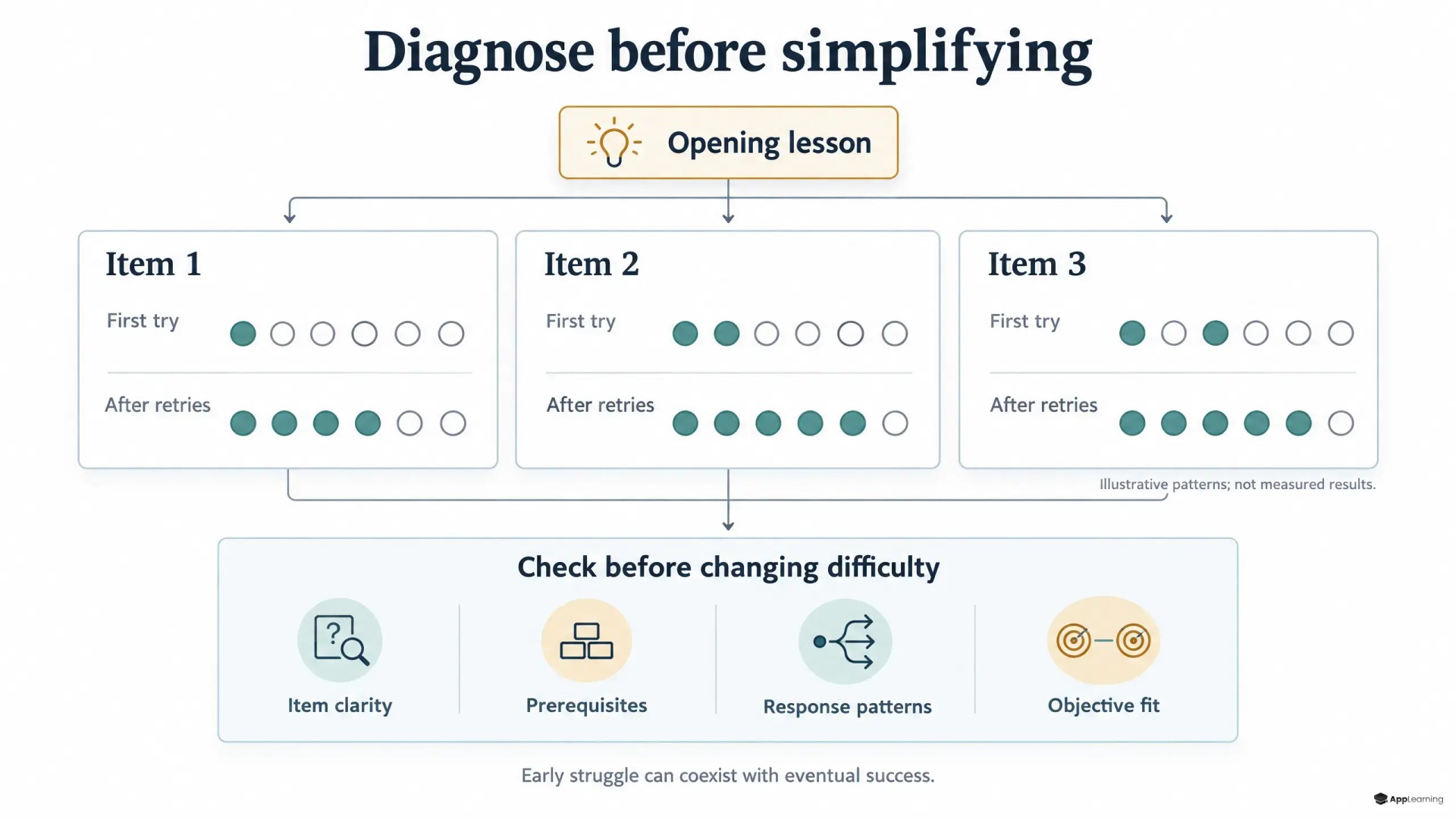
Course averages cannot show where learners struggle. Eventual passes cannot reveal the effort required to reach them. Compare first-attempt performance, retries to pass and eventual pass rates with explicit denominators and a fixed observation window. Include learners who never return, not just completers.
Four checks before changing the pass mark
NBME’s assessment guidance separates item difficulty, answer-option patterns and flaws that add irrelevant difficulty. (nbme.org) Apply that distinction through four checks in LMS quiz item analysis.
- Clarity. Review the stem, answer key, translation and distractors. Ask an agent to explain what the question requires.
- Prerequisites. Locate the explanation or worked example needed to answer. Check that it appears before the quiz.
- Alignment. Compare the lesson objective with the decision tested. Recognizing a tariff differs from calculating a customer’s total cost.
- Response patterns. Examine accuracy by attempt and selected option alongside explanation-view time, post-failure exits and learner comments.
Useful difficulty must earn its place
Experiments on pretesting found that unsuccessful retrieval attempts followed by study could improve later performance. (pubmed.ncbi.nlm.nih.gov) A wrong answer is therefore not automatically evidence of bad design. But this research does not validate an ambiguous question or prove that this academy’s challenge is useful.
Good onboarding assessment design should preserve the relevant sales decision while removing unrelated obstacles. Teach the payment prerequisite before testing transaction readiness. Increase complexity as learners demonstrate competence, rather than making the first quiz a gatekeeping event.
Recovery belongs inside the learning sequence
A study of pretesting found better recall with immediate than delayed corrective feedback. (pubmed.ncbi.nlm.nih.gov) For microlearning retries, test a short explanation after an error, a targeted hint and another attempt that requires the same reasoning without copying the answer.
The Institute of Education Sciences recommends spaced learning and using quizzes to revisit content. (ies.ed.gov) Add a later, unhinted check. On low-end phones, keep explanations lightweight, preserve progress and synchronize offline events before classifying an exit as abandonment.
Review your academy’s first assessment with App-Learning.
ReviewRevise one cause before scaling
App-Learning’s practical approach is to pair item-level analytics with editorial review. Correct confirmed ambiguity for everyone. For uncertain sequencing changes, randomly assign new learners to the current or revised sequence while holding the readiness standard constant.
Agree on the observation window and decision criteria first. Compare first-attempt results, continuation after failure, retries, delayed unhinted accuracy and support requests. Track first-sale activation separately without treating a quiz improvement as proof of higher sales.
Keep a revision when learners progress more reliably without losing independent accuracy. Reject an easier route that merely inflates passes. The first quiz should make the next useful action clear—not make learners prove they can survive the academy.