
Key takeaways
- Treat course images as governed learning objects with stable identifiers, not disposable uploads.
- Track licensing, source, owner, localized alt text and affected chapters separately.
- Gate agent move and delete operations on dependency checks and reviewer approval.
- Automated metadata updates need deterministic validation before publishing.
- Measure time to approved, reusable asset rather than images generated.
The Media Library Just Became an Agent Workspace
On October 14, Strapi described how its rebuilt Media Library, which became the default in v5.54.0 on September 16, 2026, gives agents tools to search, read, update, move and delete assets through MCP. The Strapi release also states that these tools enforce the same Media Library permissions as a human user. That is a real shift for AI media asset management: files are now part of an agent workspace, not just an attachment field. (strapi.io)
A naive workflow generates an image, uploads it, inserts it into a lesson and moves on. It works until the academy runs several products, languages and customer tenants. Then nobody can answer which chapter uses the illustration, whether German copy changes its meaning, who approved it, or whether removal will damage published learning content.
Learning assets carry more context than marketing files
An illustration in an LMS asset pipeline can explain a safety step, reinforce product language or provide essential context for a new hire. The same visual may be reused in a course, knowledge card, assessment and tenant-specific onboarding path. Multilingual course content automation therefore needs an asset model, not a folder convention.
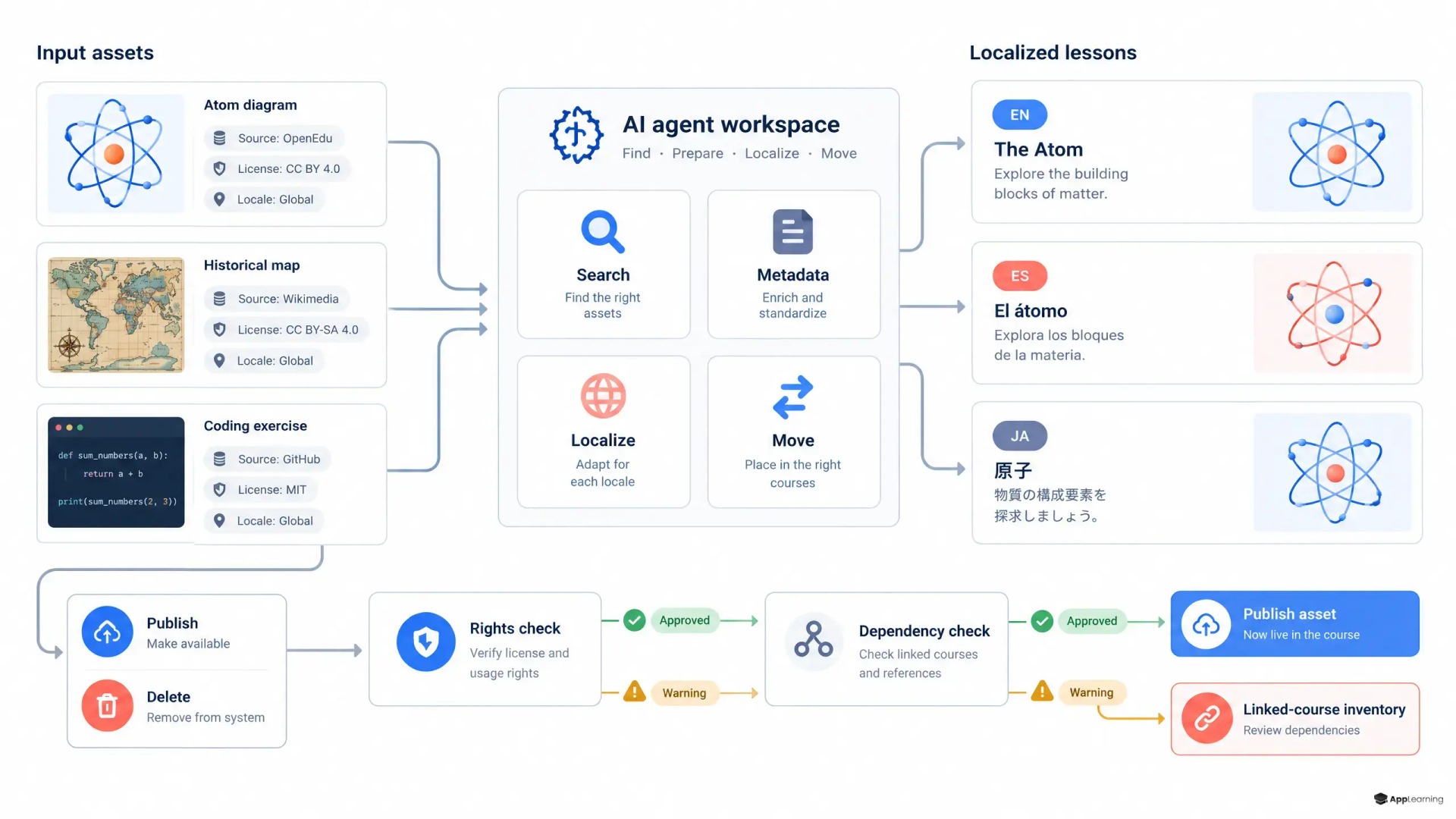
- Ingest the source file and assign an immutable canonical asset ID.
- Create localized captions and alt text for each active locale.
- Capture owner, source, rights status, approval state and expiry rules.
- Write references from the asset to chapters, lessons, cards and tenants.
- Publish only approved variants and retain the replacement history.
Accessibility and rights must be first-class data
Alt text cannot be a filename translated by a model. The W3C image guidance requires text alternatives to reflect an image’s information or function, and says the author must determine them from usage, context and content. Store localized alt text separately from the generic media description, then validate required locales before a lesson can publish. (w3.org)
The text alternative needs to be determined by the author, depending on the usage, context, and content.
Rights need the same discipline. For Creative Commons material, Creative Commons recommends TASL attribution covering title, author, source and licence. Even where that format does not apply, retain the source URL, rights holder, permitted uses, modification status, territory, expiry date and reviewer. An agent may draft metadata, but it should not infer commercial reuse rights from an image alone. (creativecommons.org)
Deletion becomes a controlled change
Strapi has improved important platform safeguards. In v5.54, replacing a file keeps its folder and existing details; in v5.56, deleting a folder checks whether the user may remove every contained asset. Those controls protect the Media Library, but they do not establish whether an asset is still referenced by a published lesson, assessment or tenant variation. The reference graph belongs in the academy’s content model. (strapi.io)
- Block deletion when active published references exist.
- Offer safe replacement when a successor asset is approved.
- Create a change request for bulk moves or removals.
- Require a reviewer for rights, accessibility or learner-impact flags.
- Record the agent request, validator result, approver and final action.
Good to know
Does Strapi provide the learning-content dependency graph by default?
No. The Media Library tools manage files and permissions, but the academy must model references between assets, lessons, chapters, locales and tenants.
Can an agent generate localized alt text?
Yes, as a draft. Validate locale coverage and route meaning-bearing images to a reviewer who understands the lesson context.
Which actions should require approval?
Require approval for deletion, replacement in published content, rights-sensitive metadata changes and bulk operations across tenants or locales.
What is the first practical step?
Introduce a canonical asset ID and require every published learning object to reference it rather than a loose upload URL.
Agents need narrow authority and visible evidence
Give an agent separate capabilities for discovery, metadata drafting, movement and destructive actions. Search and draft updates can be automated within a scoped tenant and locale. Replacing or deleting an asset should call a deterministic dependency check, create a review task and wait for approval. Strapi’s audit logs can record actions made by people and MCP-driven agents, which makes the system useful for investigation rather than just automation. (strapi.io)
Build governed media workflows before agents inherit your file chaos.
TalkThe useful KPI is approved reuse
For a growing startup, the reference implementation can stay lean: Strapi stores the files and governed fields; the learning platform stores asset references; a validation service checks locale, rights, approval and dependency state before publishing. App-Learning projects should measure time from ingestion to approved reusable asset, reuse rate across courses, rejected automated changes and broken-reference incidents. Image volume is activity. Approved reuse is capability.
The advantage is not that an agent can clean a folder faster. It is that onboarding and internal learning can grow without making every course owner a librarian, accessibility reviewer and rights expert at once. Build the controls before the agent receives delete access, and media automation will make the academy more reliable rather than merely more active.