
Key takeaways
- Source sensitivity should select the AI execution mode.
- Local inference helps protect confidential inputs but does not replace governance.
- Approved cloud models can support lower-risk authoring under defined controls.
- CMS writes need scoped permissions, audit trails and review in every mode.
- One structured course model can operate across several privacy tiers.
One AI path creates the wrong trade-off
Banks need faster ways to turn policy updates, product changes and transformation knowledge into learning. Yet a single hosted model path forces an unhelpful choice: either block AI for sensitive material or accept that confidential source packs, prompts and drafts travel through a route that does not fit their classification. The better design treats privacy as an authoring-mode selector, not as a reason to abandon AI authoring.
This matches the risk logic in NIST’s Generative AI Profile, which calls for risk management tailored to the system architecture, data types and use-case context. For regulated learning content, the question is not which model is best in general. It is which execution environment is approved for this source material and this action.
Source classification comes before model selection
Classify the full authoring transaction, not only the document. A confidential policy excerpt may enter the prompt, shape the generated lesson, appear in a tool call and persist in a draft. Each step needs a defined boundary. This is the foundation for private AI authoring and for defensible AI data residency training content.
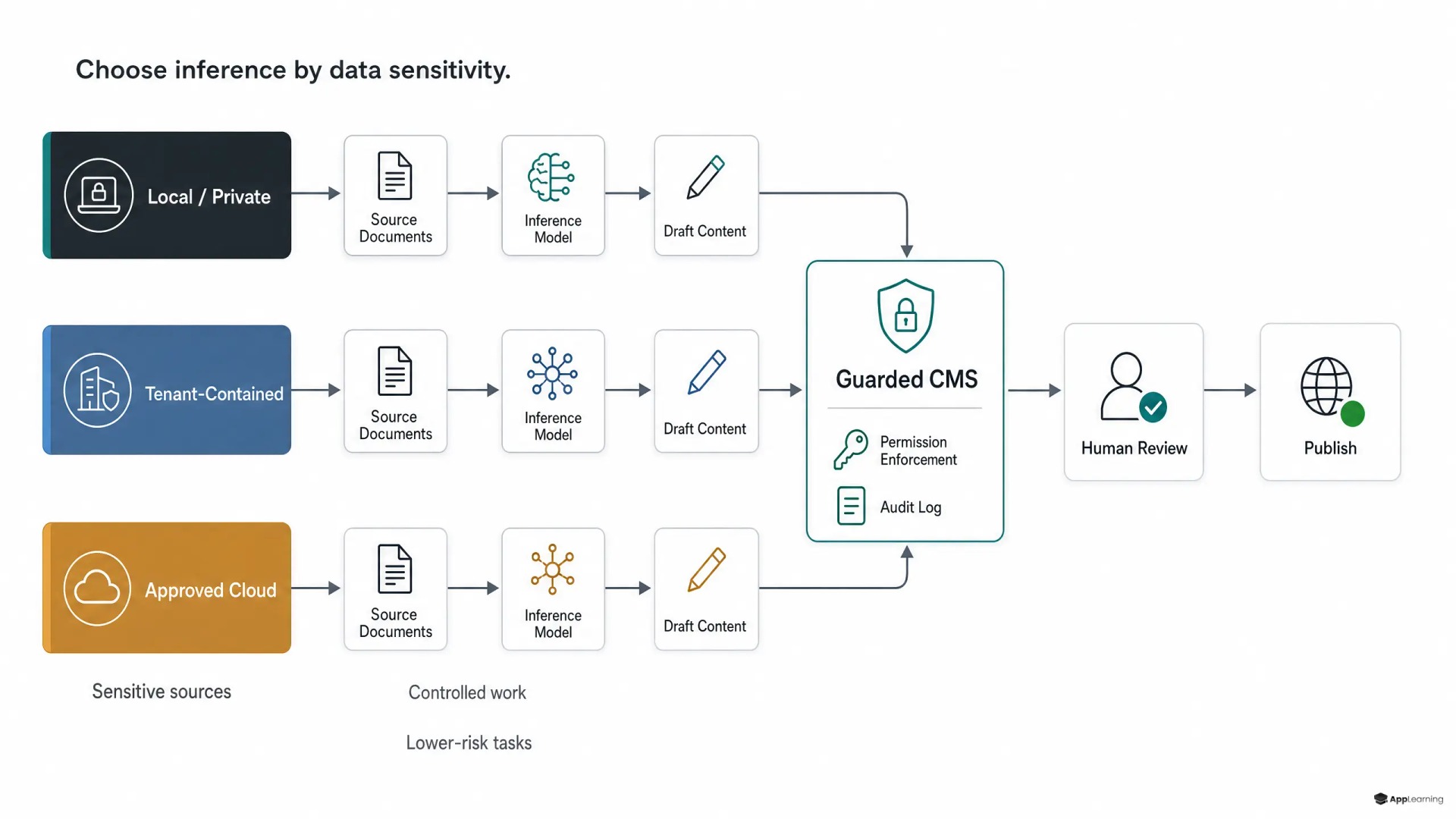
- Local/Private for confidential policies, client-derived material, investigations and restricted internal procedures.
- Approved Cloud for lower-risk internal knowledge, approved reference content, translation and controlled drafting.
- Manual for material that must not enter an AI workflow or requires direct expert authorship.
The classification should live with the course brief or source record. That makes the chosen mode visible to authors, reviewers and auditors instead of leaving a privacy decision to individual judgment at the point of prompting.
Local inference protects the most sensitive drafting work
Local LLM course authoring is useful when an author needs help extracting learning objectives, creating a first draft or restructuring dense content without sending the source material to an external model endpoint. A September 26, 2026 Strapi implementation demonstrates an admin chat using Ollama on the author’s own machine, with the stated aim that content and API keys do not leave the laptop.
That capability is valuable, but it is not a security verdict. A local mode still needs managed devices, disk encryption, endpoint controls, model approval, access management and clear retention rules. It also needs a defined limit: local inference can produce a draft, but it should not gain broad permission to change a learning catalogue or publish a course.
Tenant-contained and approved cloud modes keep work moving
Not every task warrants a local model. Teams may use an approved hosted model for lower-risk work when the operating environment, contracts, data handling and identity controls meet the bank’s standard. Microsoft’s September 25, 2026 Copilot announcement illustrates the direction of tenant-contained agent runtimes, sandboxed execution and administrator-defined model availability.
The operating rule is simple. Do not label a cloud route safe merely because it is enterprise software, and do not label a local route safe merely because it is local. Assess each mode against source sensitivity, allowed data flows, tool access, output use and operational ownership.
Good to know
What belongs in Local/Private mode?
Use it for source material whose confidentiality, client sensitivity or internal restriction makes an external model route inappropriate. The exact boundary should come from the bank’s classification policy and approved AI controls.
Can Approved Cloud support regulated learning content?
Yes, when the content is classified for that route and the approved environment meets the bank’s requirements for data handling, identity, access, retention and supplier governance. Approval should be specific to the use case, not assumed from a model name.
Who can publish AI-assisted learning?
Publishing authority should remain with designated human roles. AI may prepare or revise drafts, but the final release should follow the same approval workflow, permissions and evidence requirements as human-authored learning.
Model location does not govern CMS authority
Inference location and content authority are separate controls. Whether a draft came from a local model, an approved cloud model or a human author, CMS mutations should pass through narrowly scoped permissions. A Strapi MCP security guide describes token-scoped access, field filtering, runtime checks and audit logging as distinct enforcement layers for agent actions.
For an academy, this means separating read, draft creation, revision, approval and publishing rights. An authoring assistant may create a lesson draft in a designated workspace. It should not change a learning path, replace a mandatory compliance module or publish to production unless an explicit workflow permits it. Strapi’s September 2026 update also shows MCP-originated actions appearing in audit logs, reinforcing the value of recording agent activity beside human activity.
Review states turn AI output into controlled learning
Human review is not a ceremonial final click. It is the control that checks whether the draft preserves policy meaning, uses accurate examples, avoids disclosing restricted details and fits the learner’s role. For banking programmes, assign review by content risk: compliance validates obligations, business owners validate process reality, learning specialists validate instructional quality and publishing owners validate release readiness.
- Draft generated in the selected privacy tier
- Subject-matter review with source traceability
- Learning design review for clarity, assessment and role relevance
- Approval and controlled publication with version history
Build privacy-aware authoring modes in App-Learning.
PlanA three-tier architecture keeps one course model intact
App-Learning can expose Local/Private, Approved Cloud and Manual as clear modes inside one authoring workflow. The author still works with the same structured course model, modular content blocks, review states and publishing controls. Only the permitted AI route changes. That prevents a common failure mode in regulated academies: creating separate tools and disconnected processes for every security exception.
The result is a system that lets innovation teams move faster without asking compliance to accept a blanket model decision. Privacy becomes a practical routing rule. Sensitive material receives the tightest boundary, lower-risk work uses approved capacity, and every publishable learning asset remains attributable, reviewable and governed.