

Key takeaways
- Cheap agent creation does not make every agent worth operating.
- Every production agent needs one accountable owner and one measurable business outcome.
- Cost, risk, quality, and permissions must be reviewed as one operating decision.
- Renewal, consolidation, and retirement criteria belong in the launch definition.
- Agent-owner training must cover shutdown decisions, not only deployment.
Agent abundance becomes a portfolio problem
The agent backlog is no longer the main issue. Persistent agents create a running estate of permissions, model usage, tool calls, handoffs, exceptions, and operational risk. On September 25, 2026, Microsoft announced long-running Copilot capabilities with usage-based billing and FinOps controls; four days later, OpenAI introduced always-on agents designed to work continuously on a user’s behalf. Those launches do not prove that governance improves returns, but they make the need for enterprise agent governance much more immediate. (blogs.microsoft.com)
Retool’s September 29 discussion makes the commercial tension plain: it argues that returns concentrate in a small share of agents and describes a company with roughly 500,000 agents but limited visibility into where spend went. That is vendor evidence and a panel anecdote, not causal proof. Still, it names the operating failure correctly. When agents are easy to create and expensive to observe, an innovation pipeline quickly becomes an unmanaged portfolio. (retool.com)
A production agent is an operating service
Treat each production agent as a service with a business case, not as a prompt that happened to work in a demo. AI agent ROI should include the full cost of operation: model and infrastructure spend, connected-tool charges, human review, exception handling, monitoring, support, and rework caused by poor outputs. It should also name the outcome that matters, such as reduced processing time that removes real cost, fewer avoidable errors, faster case resolution, or a measurable improvement in customer conversion.
- One named business owner with authority to change or stop the agent
- One outcome metric with a baseline and a target
- One monthly cost envelope covering usage and human oversight
- One defined operating boundary for tools, data, and actions
This definition prevents a common banking mistake: treating adoption as value. A relationship-manager assistant that is used often may still add no commercial value. A back-office agent that handles fewer cases may be highly valuable if it removes a bottleneck, reduces rework, and stays within its control limits.
Ownership must include permissions and risk
Every production agent needs an accountable owner, a technical custodian, and a control contact. The owner owns the business outcome. The custodian maintains integrations, evaluation, and reliability. The control contact validates that the agent’s data access, escalation path, and approval rules match its risk tier. One person may hold more than one role in a small team, but the responsibilities must remain visible.
Risk tiers should reflect what the agent can see, decide, recommend, and do. An internal research assistant is not equivalent to an agent that drafts customer communications, accesses sensitive client records, or triggers a workflow with financial consequences. The tier should set permission scope, logging, required review, human approval points, and the frequency of reassessment.
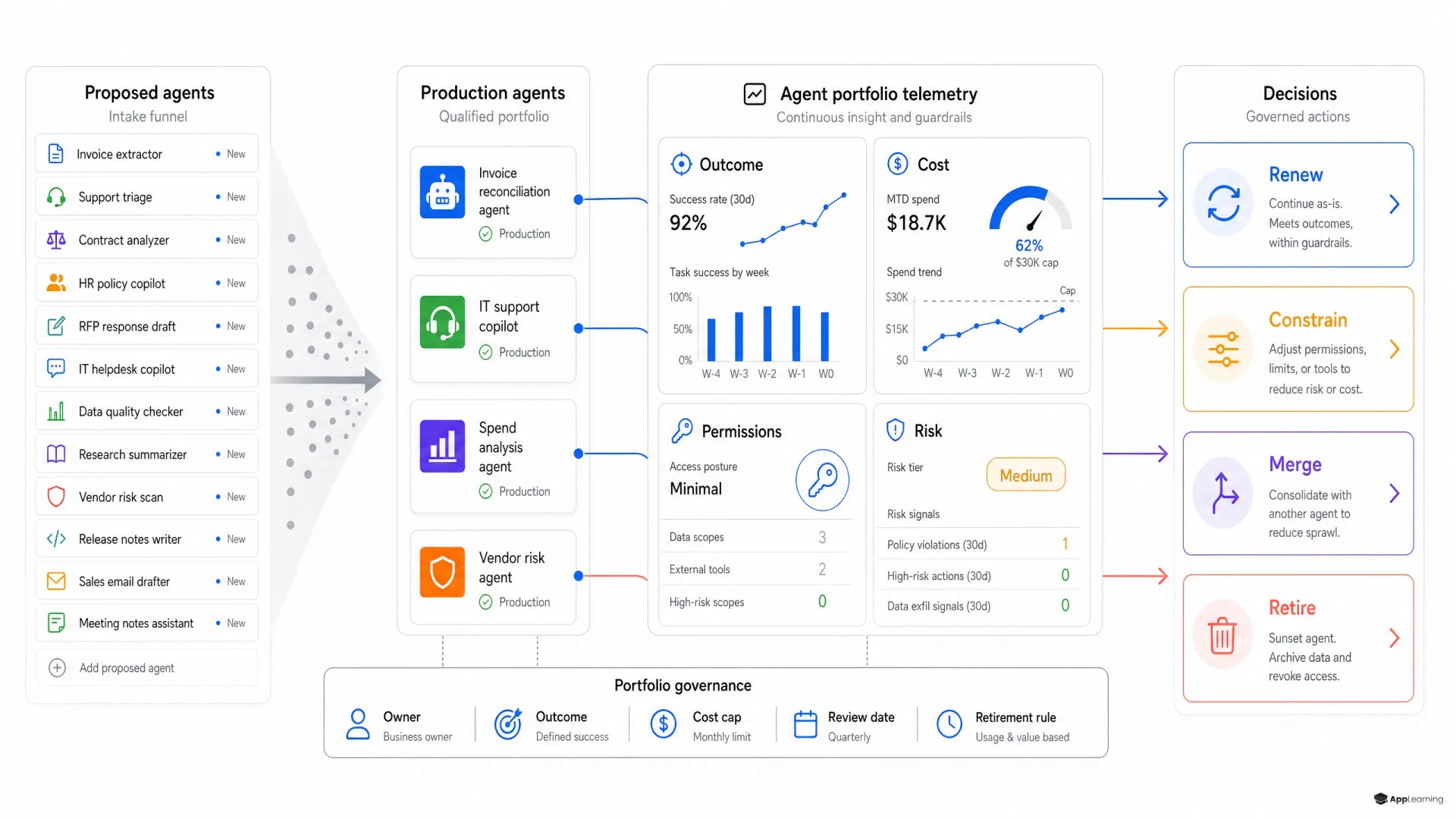
The review date belongs in the launch plan
Agent portfolio management starts before release. Launch approval should include a review date and a retirement rule. Without both, agents survive through inertia, even when the original need disappears, a better workflow replaces them, or their cost grows faster than their outcome.
- Renew when the outcome is verified, risk remains acceptable, and cost stays within the agreed envelope.
- Constrain when the value is sound but permissions, autonomy, or task scope exceed what evidence supports.
- Merge when multiple agents duplicate data access, workflows, or ownership.
- Retire when the outcome cannot be demonstrated, the process is better as deterministic automation, or no accountable owner remains.
Good to know
What should count as a production AI agent?
Any agent that runs against business data, uses connected tools, acts repeatedly, supports customer or operational work, or creates a recurring cost should enter the production portfolio.
How often should an agent be reviewed?
Set the first review before launch. Higher-risk or higher-spend agents need more frequent reviews, while low-risk agents can follow a defined quarterly or semiannual cycle.
Who should own an agent in a bank?
The business owner should own the outcome and the decision to renew or retire it. Technology, risk, compliance, and operations should each hold explicit supporting responsibilities.
Learning makes lifecycle decisions executable
This is where AI FinOps training and operating discipline meet. Agent owners do not need a long technical course. They need short, role-based practice: calculate an agent’s total cost, identify an unsafe permission set, decide whether a use case needs an agent or a workflow, interpret outcome telemetry, and make a renewal or shutdown call. Scenario-based decisions are more useful than generic AI awareness because they mirror the choices owners face after launch.
App-Learning can turn the AI agent lifecycle into a repeatable enablement system for innovation, operations, technology, risk, and business owners. A launch-readiness check can confirm that an owner understands spend, permissions, escalation, and retirement criteria. Periodic recertification can test whether that understanding still holds when tools, models, and policies change. Completion alone is not the evidence; sound decisions in realistic scenarios are.
Build agent ownership into your learning system.
TalkTelemetry closes the loop
A useful portfolio view joins four signals at agent level: usage, total cost, output quality, and business outcome. Usage without outcome measures novelty. Spend without quality hides operational damage. Quality without risk misses whether the agent has too much authority. When these signals sit together, leadership can direct funding toward proven services and remove agents that only create activity.
The capability gap is no longer only how to build an agent. Banks also need people who can constrain it, consolidate it, and end it. The agent portfolio earns its keep when every live agent has a clear reason to exist and a disciplined path out when that reason disappears.