

Key takeaways
- Disaster recovery and editorial portability solve different operational problems.
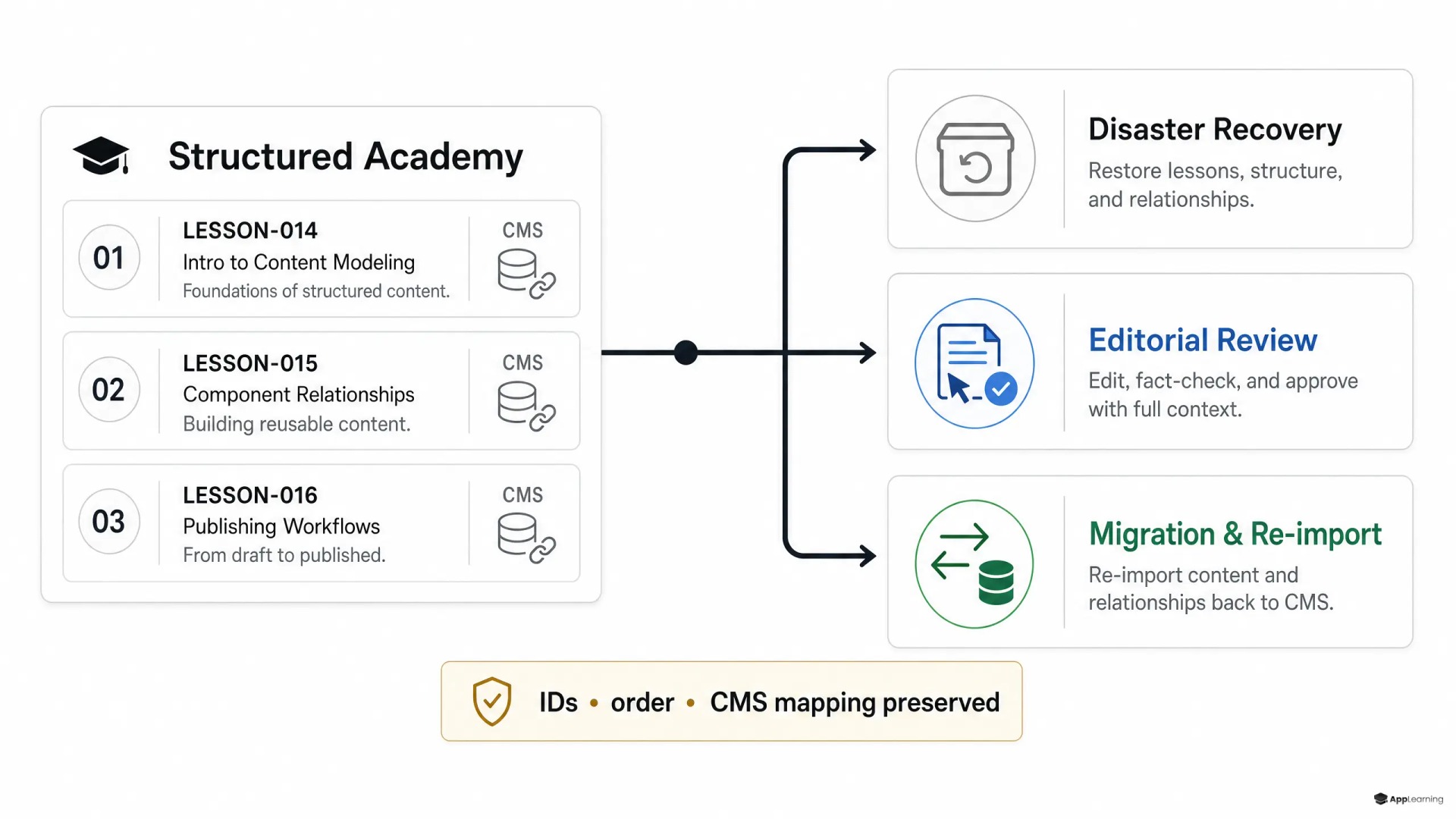
- Preserve stable IDs, hierarchy, ordering and asset references with every export.
- Readable review copies speed up fact-checking without breaking production mapping.
- Controlled re-import depends on version checks and deterministic content keys.
- Portable curriculum backups reduce migration risk and routine maintenance effort.
Restoring a platform is not owning the curriculum
An LMS content backup is necessary for recovery. But recovery answers a narrow question: can the platform return to a known working state after failure? An editable course export answers a broader one: can the L&D team safely inspect, challenge, improve and move the curriculum without rebuilding it by hand?
For regulated financial organisations, recovery remains essential. The EU’s Digital Operational Resilience Act requires in-scope financial entities to document backup, restoration and recovery procedures and test them periodically. (eur-lex.europa.eu) Yet a restorable database snapshot can still leave the learning team unable to review a policy lesson, update a fact or compare revisions outside the LMS.
That is the distinction. Restore capability protects availability. Editorial portability protects the organisation’s ability to govern its learning content.
An operational export retains the course model
A curriculum backup should not be a folder of rendered pages or a proprietary dump that only the original platform can interpret. It needs to preserve the course model, not merely the visible prose.
- Course, module, chapter and block IDs that remain stable across exports
- Parent-child relationships and the intended learner order
- Content type, completion logic, assessment settings and metadata
- Asset references, embedded links and media locations
- Version markers, export date and the source CMS record for each item
This is the minimum structure that turns an export into a working representation. Without it, a reviewer can improve the words but cannot reliably tell where an approved change belongs in production. Without the readable words, technical teams hold the only usable copy of the curriculum.
Readable content needs persistent identity
Human readability and machine mapping should sit together, not compete. The working copy may use clean Markdown, HTML or a document format that subject-matter experts can comment on. A companion manifest or mapping file should retain the stable key, source path, parent record and order for every learning object.
This approach reflects a basic interoperability principle. The 1EdTech content-packaging model supports moving course content while retaining the information that describes how resources are structured, including elements such as a table of contents and launch order. (learn.1edtech.org) The format alone is not enough, however. Your own CMS mapping must also survive the export.
A useful editable course export therefore has two layers: a review-friendly representation for people and a structured identity layer for systems. One makes change possible. The other makes change safe.
Review work deserves a safe copy
Compliance content changes often begin with a small correction: a threshold, product rule, process owner or regulatory reference is out of date. The operational risk appears when that correction happens directly in a live course, with no clear comparison point and no reliable way to verify what changed.
An editable backup creates a safer workflow. Export a defined course version. Let legal, compliance, product and L&D review the human-readable copy. Record proposed changes against stable content keys. Then compare the approved revision with both the exported baseline and the current CMS state before anything is published.
The backup becomes a controlled review workspace rather than a dormant insurance policy. It also gives teams a clear audit trail of what was reviewed, which content object changed and which version went live.
Good to know
Can an editable export replace a disaster recovery backup?
No. A disaster recovery backup protects the ability to restore systems and data. An editable export complements it by giving content owners a workable, review-ready representation of the curriculum.
Which format works best for an editable course export?
Use a human-readable format that reviewers can work in, paired with a structured manifest or mapping file. The exact format matters less than preserving stable IDs, hierarchy, order, asset references and version information.
Does a curriculum backup eliminate vendor lock-in?
No. Platform-specific features may still need redesign during a migration. But a structured curriculum backup reduces the amount of content that must be manually recovered, interpreted or rebuilt.
Controlled re-import starts with a map
Re-import should not mean replacing an entire course because one paragraph changed. It should work as a governed update process: match the stable key, confirm the base version, validate the changed field and publish only the approved delta.
That requires a few hard controls: immutable identifiers, explicit field mappings, a conflict rule when production has changed since export, and a pre-publish preview. If any of these are missing, the team is no longer re-importing with confidence. It is reconstructing the course.
For fast-moving finance and crypto businesses, this matters because content operations need to match the pace of policy, product and market change. The goal is not to make every editor a CMS administrator. The goal is to let experts improve learning content while the system preserves production discipline.
Portability needs more than a download
Learning content portability is not a promise that every LMS feature will transfer perfectly. Platforms differ in assessment engines, automation, analytics and delivery logic. A good curriculum backup makes those differences visible early by separating portable learning content from platform-specific configuration.
The direction of EU policy also reinforces the value of knowing what can leave a system. For covered data-processing services, the Data Act requires contractual transparency on switching and porting, including the available methods, formats and data structures for exportable data. (eur-lex.europa.eu) An LMS may need a separate scope assessment, but the practical lesson holds: portability must be designed, documented and tested before a migration becomes urgent.
A CMS course export with stable mappings reduces the cost of future options. It supports platform migration, vendor due diligence, content version comparison and internal resilience without pretending that technology choices carry no trade-offs.
Make your academy content easier to govern.
DiscussContent portability becomes a capability
At App-Learning, the practical pattern is to treat academy content as a governed asset with two linked forms: the production structure that powers engaging learning experiences, and an editable working representation that supports expert review. The connection between them is maintained through identifiers, hierarchy and version-aware mappings.
That design gives L&D teams a better way to maintain regulated learning at speed. They can create review-ready copies, involve the right experts, verify changes against the live academy and prepare controlled updates without losing the path back to the original course records.
Your LMS can remain the delivery layer. It should not be the only place where your organisation can read, understand and improve its curriculum. A backup becomes genuinely useful when it protects both system recovery and the team’s ability to change learning with control.