

Key takeaways
- Visual QA checks the interface, not the complete integration.
- Identity, saved progress, host messages and analytics belong in one acceptance journey.
- Completion events should follow persisted state, not the final button click.
- Test records need explicit cleanup or reporting isolation.
- The same acceptance journey becomes a regression test after integration changes.
An Academy Launch Needs an Integration Acceptance Test
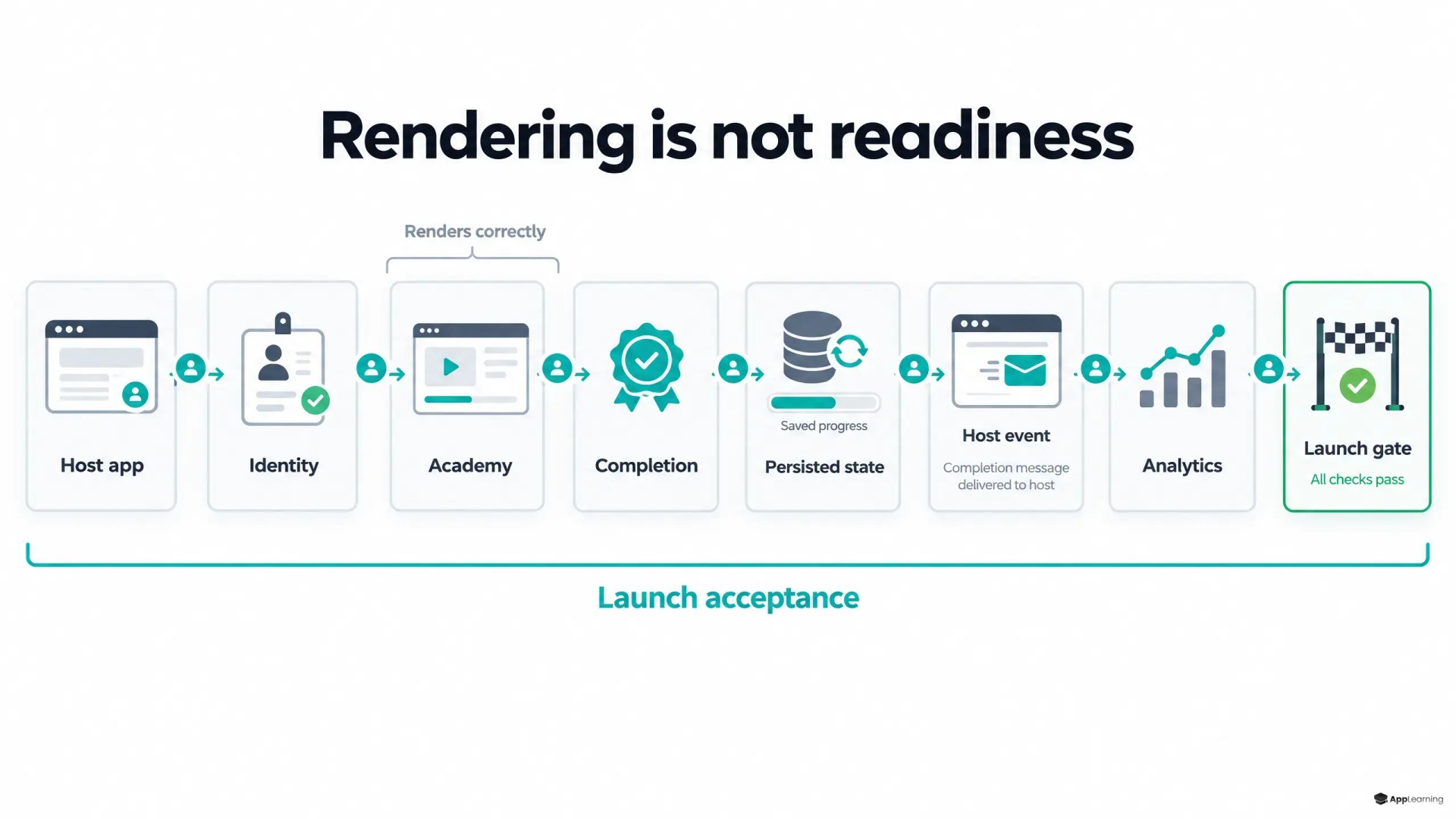
A branded course, working quiz and completion animation are not enough to approve an embedded academy. The release gate should prove that one learner can cross the full integration path and leave consistent records behind. Visual QA remains necessary, but it should not carry the launch decision alone.
One learner journey defines the release gate
The LMS launch checklist should name one complete journey through the host product. Playwright’s testing guidance, (playwright.dev) which prioritises user-visible behaviour, provides a useful foundation. For academy integration testing, the proposed journey starts with a fresh learner entering through production-like authentication, then covers partial progress, re-entry, completion, the host response and reporting. Identity and event delivery should remain real rather than mocked.
Identity must stay consistent across systems
The test account should originate through the normal host-app entry path, not an academy administrator shortcut. The acceptance record should connect the host user, academy learner and reporting identity. For OpenID Connect integrations, (openid.net) issuer and subject together provide the stable identifier pair. The test should verify the configured mapping, tenant and language, then confirm that re-entry does not create another learner.
Progress must survive a new session
The persistence check should stop midway through a lesson, close the academy and return in a fresh authenticated session. Expected progress should match both the learner view and authoritative backend state. In PostgreSQL’s transaction model, (postgresql.org) uncommitted changes remain invisible to other transactions. The acceptance criterion should therefore be a committed result that can be read back, not merely a successful-looking interaction.
Completion follows persistence and reaches the host
Completion should become eligible for notification only after its state is persisted. A controlled failed save should produce no completion event; recovery should leave the academy and host in agreement. Replayed delivery should not repeat rewards or activation actions. For iframe messaging, (html.spec.whatwg.org) the HTML standard calls for checking the sender’s origin and message format. Acceptance should also verify that the host receives the expected payload and performs the intended response.
Reporting must reconcile with the journey
The analytics pass condition should be a matching reporting record within a defined processing window, not an event visible only in browser logs. With JSON Schema, (json-schema.org) payload structures and constraints can be validated. End-to-end LMS testing should go further by reconciling learner identity, course version, completion and timestamps at the reporting destination. Learning completion and subsequent product activation should remain separate measures.
The test footprint needs its own acceptance step
A progress reset should prepare a retest, not serve as proof of complete cleanup. The procedure should separately cover accounts, enrolments, rewards and reporting records. Synthetic learners should be isolated from customer metrics before testing begins. Final sign-off should confirm deletion where appropriate and explicit exclusion where retained records are required.
Review your academy’s integration acceptance path with App-Learning.
ReviewThe launch test becomes a regression contract
The reusable asset should contain the journey, expected identifiers, state checks, message payloads, reporting window and cleanup evidence. Embedded academy QA should rerun that contract after changes to authentication, persistence, messaging or analytics, using each supported web or mobile integration surface.
An App-Learning academy should meet the same release standard as the product around it. Launch readiness means one learner’s identity, saved state, host response and reporting agree—not merely that a course looks finished.