

Key takeaways
- Shared data does not guarantee shared meaning across LMS, CRM and reporting agents.
- Completion, passing scores, credential issuance and verified skills describe different states.
- Each metric needs an owner, population, time window and traceable calculation.
- Agents need approved query paths and explicit handling of ambiguous or unknown terms.
- Snowflake’s announcement is not evidence of a proven LMS implementation.
Two correct counts can answer different questions
Imagine asking two agents how many customers are certified. The CRM assistant reports 8,000. HR reports 5,000. In this hypothetical academy, the first counts course completions; the second counts current credentials. Neither calculation is broken. Their agreement on the word “certified” is.
For a fintech product lead, that mismatch could turn onboarding progress into an unsupported claim about customer knowledge. Adding another agent interface would only give the disagreement another outlet.
Snowflake puts business meaning under governance
Snowflake’s 3 November 2026 announcement (snowflake.com) describes Business Ontology as a governed home for approved business definitions linked to underlying data. It distinguishes official meaning from the Semantic Views that calculate metrics. That distinction is useful for learning systems too.
Snowflake’s accompanying product explanation (snowflake.com) lists Business Ontology as “public preview soon.” These are vendor-described capabilities, not proof of a production LMS integration. The architecture below is a proposal, not a claim that App-Learning deploys Snowflake.
Learner events and credential states stay separate
The xAPI data specification (github.com) represents completion, success and score separately. A proposed academy event model should preserve that separation, with stable event and learner identifiers, course version, timestamp and source. Passing a score threshold should not silently become credential issuance.
The Open Badges specification (standards.1edtech.org) models an achievement credential as an issuer’s claim that a learner met defined criteria, with provisions for evidence, validity and status. For reporting, issuance, expiry and revocation therefore deserve explicit states rather than one permanent “certified” flag.
The glossary must bind words to calculations
W3C’s DCAT 3 vocabulary (w3.org) provides versioning and responsibility metadata. An LMS metrics ontology can adopt that discipline without adopting a particular platform.
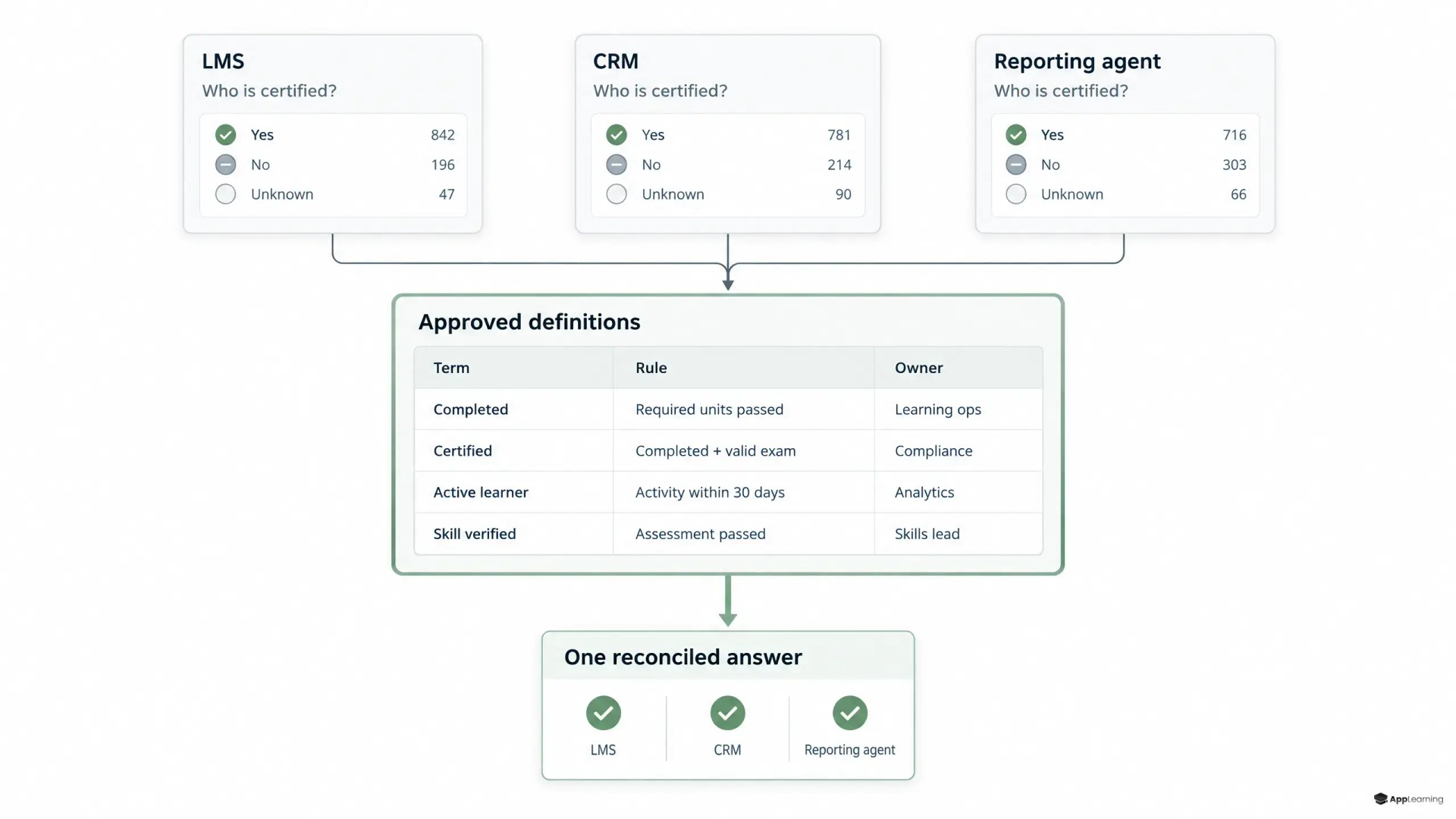
Each published entry should include a metric ID, definition, accountable owner, eligible population, rate denominator where applicable, time window, timezone, version and provenance from source events to approved calculation. For one proposed academy, the glossary could read as follows.
- Trained is an ambiguous alias, not an approved metric. Requests must resolve to a specific outcome.
- Completed counts distinct eligible learners who finished required activities for a named course version during the reporting period.
- Certified counts distinct eligible learners with an issued, valid, unrevoked credential at the requested timestamp.
- Active learner counts distinct eligible learners with a qualifying learning interaction in the previous 30 days, excluding login alone.
- Skill verified counts learners with accepted assessment evidence against a named skill rubric and validity rule.
Course operations could own completion, the credential issuer certification, and an assessment lead skill verification. The certified vs completed distinction then becomes a maintained contract, not a dashboard footnote.
Ambiguity becomes a controlled query path
In this design, AI agent learning analytics runs through approved metric APIs or views, not unrestricted SQL over raw events. Each answer returns the metric version, scope, reporting time and data freshness.
An ambiguous request triggers clarification between completion and current certification. An unknown definition triggers no number and a referral to its owner. Permission checks remain separate. Test cases should cover expired credentials, duplicate events, missing evidence and intentional differences between metrics—not merely whether the answer sounds plausible.
Define the learning metrics your academy and agents can share.
DiscussThe first semantic contract can stay small
An incremental implementation could start with one onboarding course, three approved metrics, version-controlled definitions and tested queries. The CRM, dashboard and agent would consume the same contract.
That is the App-Learning design principle here: an embedded academy should expose measurable learning states that other systems can interpret. Snowflake is optional. Owning what “certified” means is not.