

Key takeaways
- The LMS remains authoritative for curriculum, progress, assessments and certificates.
- Agent planning and deterministic learning actions need separate responsibilities.
- Scoped capabilities and tenant-bound identities define the integration boundary.
- Replay tests and publication approvals belong in the pilot acceptance criteria.
- Early-adopter access and a beta release are not general availability.
SAP Just Put n8n Workflows Inside the Agent Studio
At SAP TechEd on 28 October 2026, SAP said Joule Studio early adopters can design and execute n8n workflows within its agent development environment, with broader availability to follow. (news.sap.com) That boundary matters when planning a deployment: this is not access for every SAP customer.
Separately, n8n released version 3.0 beta on 27 October 2026, with a stable release planned for early December. (blog.n8n.io) The beta announcement does not establish which n8n version SAP embeds or which customers can use it.
Enterprise coordination does not replace learning ownership
SAP also announced MCP and A2A interoperability, a centralized Enterprise AI Gateway, and expanded agent observability. (news.sap.com) Read together, these point toward enterprise coordination infrastructure. They do not remove the need to define who may change a learning record.
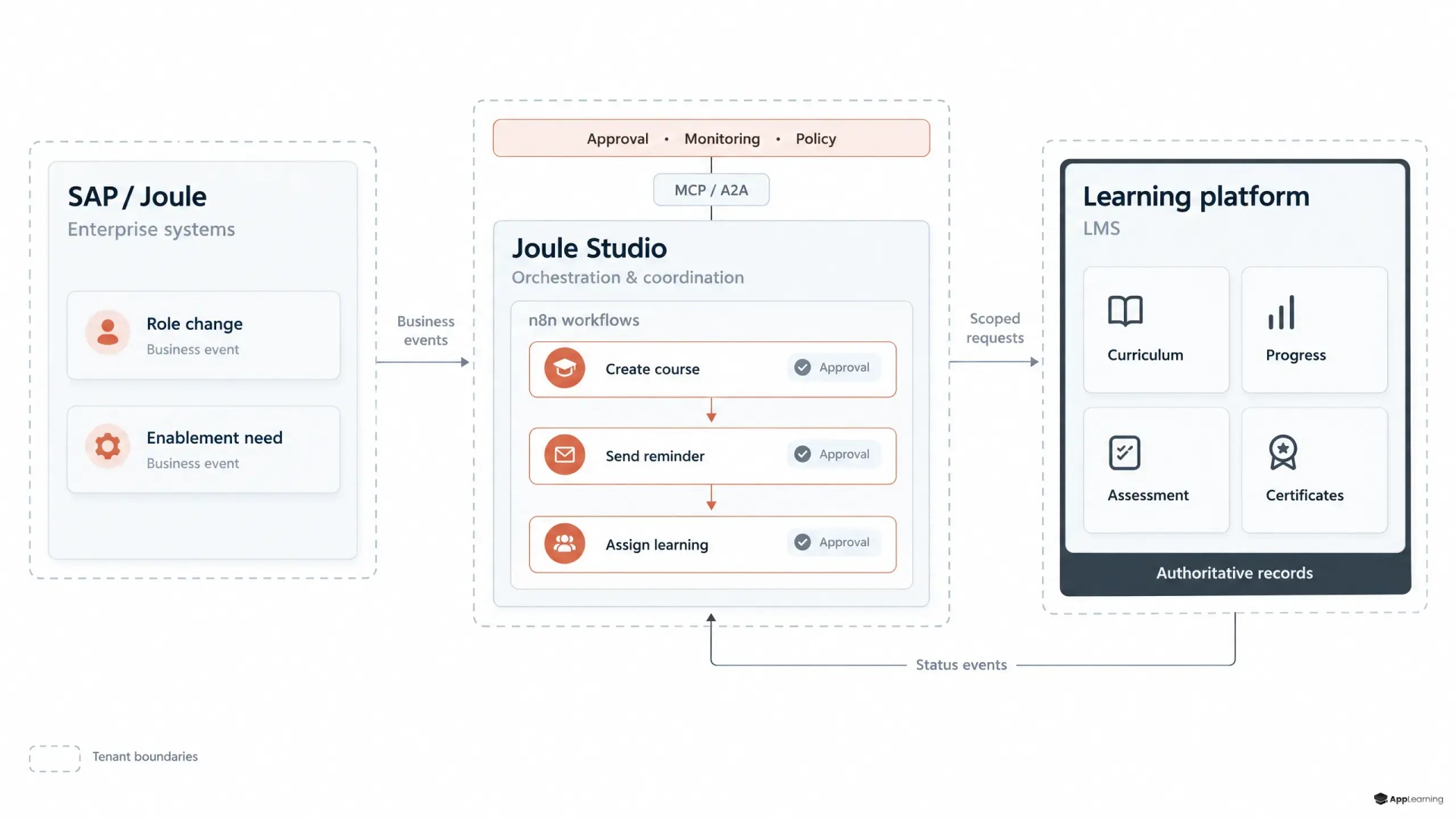
For a founder trying to standardize onboarding, the useful enterprise LMS integration pattern is enterprise context → Joule → deterministic n8n workflow → scoped LMS API. This is a generic reference architecture, not a shipped SAP integration or native connector offered by App-Learning.
- The LMS owns curriculum versions, learner experience, progress, assessment evidence and certificate issuance.
- The workflow handles validated enrollments, scheduled reminders, draft-content tasks and authorized evidence exports.
- The agent interprets requests and proposes plans within approved capabilities, without authority to declare completion.
The proposed interfaces should stay narrow. Enrollment accepts an approved course and learner. Reminders check current status. Certification access retrieves LMS-issued evidence rather than creating certificates. Policy-change requests reference approved versions instead of rewriting requirements.
A policy deadline exposes the real boundaries
Consider a compliance policy update that requires training by a fixed date. A pilot could follow this sequence.
- An authorized owner approves the policy version, target roles, course and deadline.
- A workflow validates tenant and employee identities, then requests enrollment through the LMS API.
- Before each reminder, the workflow checks current completion and employment status. A manager change updates escalation routing, not learning history.
- At the deadline, the workflow exports authorized LMS evidence and routes exceptions for review. Reassignment preserves the original record.
n8n documents approval gates that pause selected agent tool calls for human review. (docs.n8n.io) In this design, AI-generated lessons remain drafts until a named owner approves publication, assessment criteria and any changed learning requirement.
Identity and replay safety define acceptance
Access should be tenant-bound and checked at the LMS boundary, not inferred from an agent prompt. The pilot should define permitted data use, any required consent, notification preferences and retention. Trace records should connect each action to its requester, approval, workflow version and LMS result.
n8n supports retrying failed executions with previous execution data. (docs.n8n.io) The integration should therefore use durable idempotency keys so replaying an event cannot create duplicate enrollments or reminders. Acceptance tests should cover duplicate delivery, timeouts after successful writes, revoked access, cross-tenant requests and denied approvals.
Plan a focused learning workflow pilot with App-Learning.
DiscussThe smallest useful integration earns its complexity
Integration makes sense when recurring handoffs between business systems and learning create measurable work. It is harder to justify when the LMS already handles the process or nobody owns the underlying policy. A sensible first pilot covers one cohort and one workflow, with manual effort and exception handling measured before expansion.
For App-Learning, the design principle is straightforward: professional onboarding should not require a second learning administration system. Learning operations automation earns its place when AI agent workflows reduce coordination work while leaving learning ownership clear. The goal is fewer manual handoffs, not more systems that can change the truth.