
Key takeaways
- Treat agent research as evidence collection, not automatic truth.
- Keep each proposed lesson change attached to its source and rationale.
- Separate AI suggestions from CMS writes and publication rights.
- Review translations, quizzes, and answer rationales with every approved update.
- Measure evidence completeness and approved changes, not agent activity.
A reviewer that can stay on the job
On October 19, 2026, Notion announced longer-running agents with browser and computer capabilities. That matters for learning teams because an agent can now stay with a task that spans many lessons, source pages, versions, and languages. It can inventory a course catalog, isolate claims that may have changed, find relevant evidence, and produce a review queue without treating every lesson as a separate prompt.
For a growing startup, this changes the shape of learning content automation. The first use case is not an autonomous author that edits onboarding or customer education overnight. It is a persistent research assistant that turns a scattered, manual maintenance task into a structured set of proposed changes for an editor to assess.
Research does not equal reliable instruction
A browser gives an agent access to more information. It does not give it editorial judgment. Sources can be outdated, commercial, jurisdiction-specific, incomplete, or in conflict. The agent may also match a source to the wrong learner level, confuse a general principle with an operational rule, or lose the qualifiers that make an explanation accurate.
That is the central design constraint for AI course content review. A model should not return a verdict that a lesson is “correct.” It should return evidence: the original claim, the proposed replacement, the source passage or data point, the source URL, retrieval date, confidence level, and any conflicting sources. Editors then decide whether the evidence warrants a change.
The unit of automation is the evidence-backed proposal, not the published lesson.
The lesson review pipeline
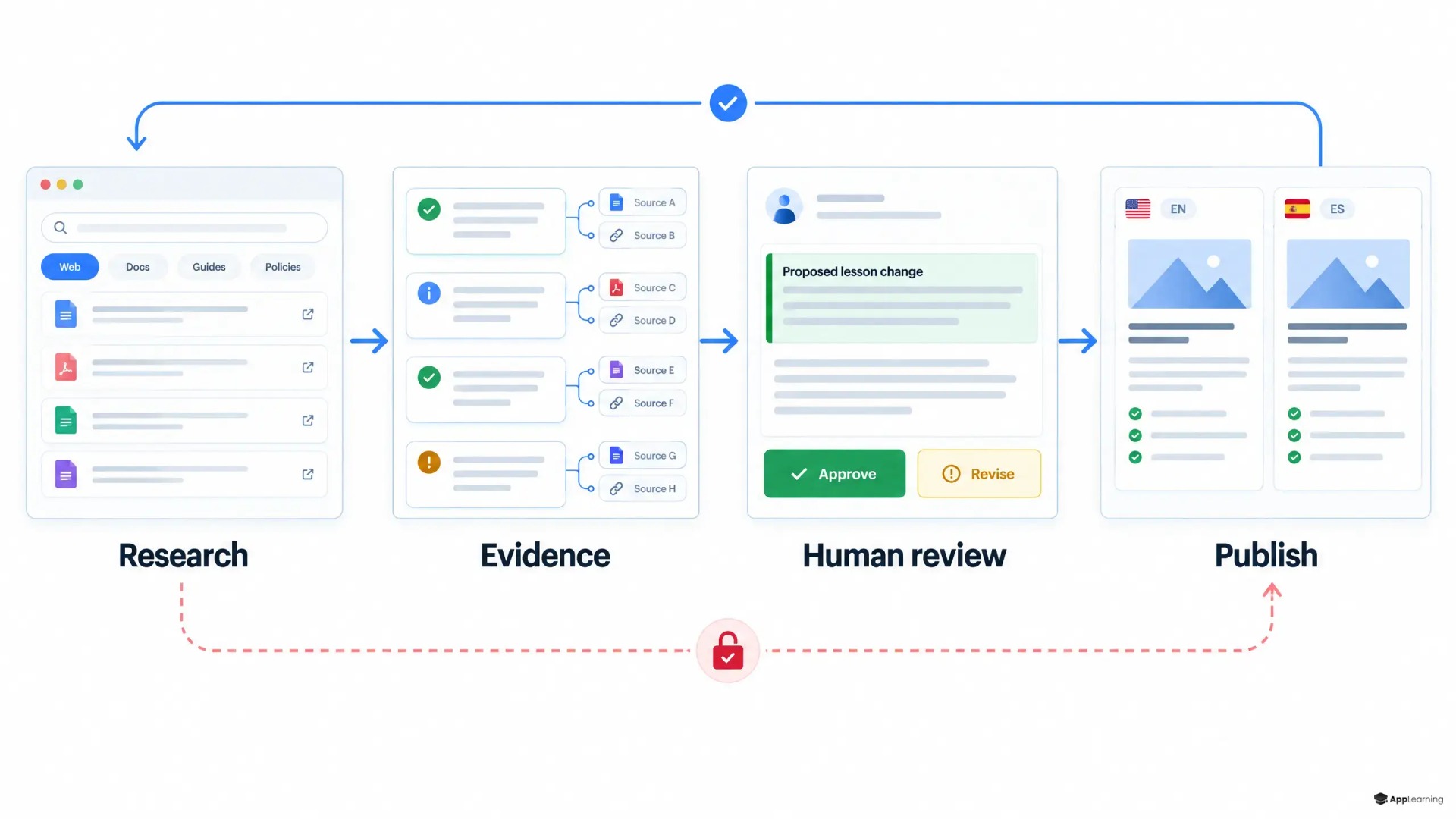
A practical workflow starts with a structured course inventory. Each lesson block needs an identifier, locale, subject, content type, last-reviewed date, and risk level. That structure lets an agent work through a large academy in batches and gives editors a clear path from a finding back to the learner-facing copy.
- Extract atomic claims from lesson text, examples, downloadable resources, and quiz rationales.
- Search only approved source classes for the topic, such as regulators, standards bodies, primary research, or internal policy owners.
- Create a proposed change record with the current wording, suggested wording, evidence, reason for change, source date, and confidence.
- Route high-risk, ambiguous, or conflicting findings to a subject-matter reviewer rather than an editor alone.
- Send only approved changes to a staging environment for CMS and localization work.
This model makes AI fact checking LMS content operational. The agent can review broad coverage and preserve a useful trail of evidence. The editor remains responsible for instructional meaning, learner relevance, tone, and the decision to change published material.
Approval is the control point
A good review screen should show the lesson context beside the proposed revision and evidence. Editors need three actions: approve, reject, or escalate. Rejection should capture a short reason, such as weak source quality, unsupported inference, or an unnecessary change. Those decisions become training data for the workflow itself, even if they never become model-training data.
Do not let approval happen in a comment thread detached from the proposed edit. Store the claim, evidence, reviewer decision, reviewer identity, and final copy in the same change record. When a learner, customer, or compliance owner asks why a course changed, the team should be able to answer without reconstructing the decision from chat messages.
Good to know
Can an AI agent update a course automatically?
It can prepare structured patches, but publication should remain behind a human approval gate. High-risk topics, policy changes, assessments, and localized content need explicit review.
What evidence should accompany a proposed course change?
Include the original claim, suggested revision, source URL, source date, relevant supporting material, rationale, confidence level, and any conflicts found during research.
Which course elements need review beyond lesson text?
Review quiz questions, correct answers, explanations, examples, links, downloads, screenshots, metadata, and every affected language version.
How should a small team begin?
Start with one high-change course area, define approved source types, run proposals in a review queue, and measure approval quality before connecting the workflow to the CMS.
The CMS should receive patches, not opinions
After approval, the system can create a structured patch for the CMS. It should update a staging version, never overwrite the live lesson directly. The patch must preserve the source record, approval state, locale, and content version so a release can be reviewed as a coherent package.
For teams using Strapi, Review Workflows can require an entry to reach a defined stage before publication. Its Audit Logs can also record CMS actions originating through an MCP server, which gives teams a way to distinguish an agent-mediated update from a human action. These controls do not make content correct, but they make the publishing path inspectable.
Localization belongs in the same release path. A translated lesson can preserve the words yet lose the qualification, terminology, or practical meaning of the source lesson. Run translation checks after the approved source-language update, then check quiz questions, correct answers, explanations, links, screenshots, and local regulatory references before publishing each locale.
Build an evidence-first course review system with App-Learning.
TalkMetrics that expose quality
Avoid measuring prompts run, pages browsed, or suggestions generated. Those figures describe agent activity, not learning quality. Measure the share of targeted lessons scanned, the percentage of proposals with complete evidence, editor approval and rejection rates, median time to approval, repeat corrections, and the rate of quiz or localization defects found before release.
For founders, these measures also answer the investment question. A useful system reduces the time senior people spend hunting for outdated material while keeping their judgment where it matters. It turns institutional knowledge into a maintainable operating asset, which supports faster onboarding without creating another opaque process.
Long-running browser agents make continuous course review feasible at a new scale. The durable advantage will not come from letting an agent publish more quickly. It will come from building a learning system where every material change carries its evidence, every approval has an owner, and every learner-facing release can be traced back to a defensible decision.