
Key takeaways
- Separate open-ended reasoning from controlled execution.
- Use agents for sequencing, selection, and exception handling.
- Keep CMS writes, publishing, and notifications inside bounded workflows.
- Treat existing workflows as reusable tools, not obsolete automation.
- Test, audit, and roll back each operational workflow independently.
All-agent design hides the operating model
An agent can turn a course brief into a plausible plan, choose between sources, ask for clarification, and spot an exception. That flexibility is useful. It also becomes hard to govern when the same agent can transform content, write directly to a CMS, trigger translations, publish a lesson, and notify an audience. A prompt is not a reliable operating boundary for actions that affect learners, brand, budget, or production data.
The problem is not that the agent may make an imperfect judgement. The problem is that its judgement and execution sit in one opaque loop. When something goes wrong, the team must reconstruct both the decision and every downstream state change. For a growing startup, that creates process debt just when onboarding and internal learning need to become more consistent.
n8n makes workflow tools first class
On September 25, 2026, n8n introduced its new Agents type with access to MCP servers, built-in integrations, and complete workflows as tools. That is the useful architectural signal. The agent can own the open-ended goal, while an existing workflow retains its ordered steps, input contract, credentials, validations, and failure handling.
Sometimes you want the agent in charge, with workflows as tools.
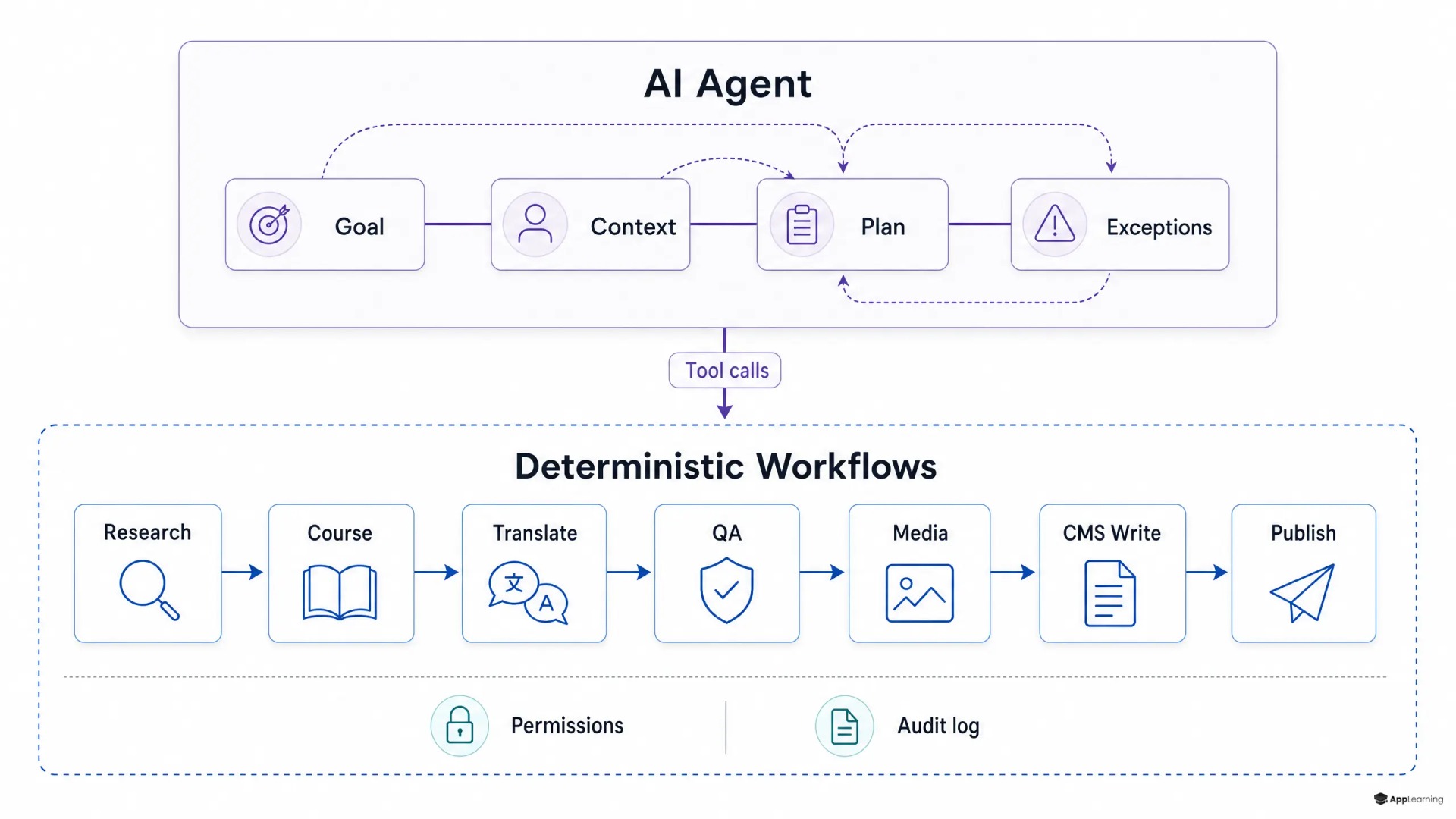
This is agent orchestration without handing the agent unrestricted control. The agent decides that a translation job is needed. It does not improvise the translation pipeline, select production credentials, or invent the publishing path. It calls a named tool with defined inputs. The workflow then runs the operation that engineering and content owners have already approved.
A course pipeline needs two control planes
At App-Learning, the pattern maps cleanly to AI content automation architecture. One control plane handles judgement. The other handles execution. The agent receives a brief such as “build onboarding for new account executives,” identifies missing inputs, selects the next job, and routes unusual cases to a human. Deterministic AI workflows perform the repeatable work.
- Ingest approved source material and capture provenance metadata.
- Generate structured lesson drafts against a defined content schema.
- Create locale-specific translation jobs with glossary and terminology checks.
- Validate learning objectives, assessment coverage, accessibility fields, and required metadata.
- Process media against fixed size, format, and rights checks.
- Create or update a CMS draft, then publish only after the required approval.
The phrase deterministic AI workflows does not mean every generated sentence is identical. A model can still produce variable output inside a generation step. It means the operational path is bounded: the inputs are known, allowed actions are narrow, validators are explicit, and each state change has a record. That distinction lets teams gain model flexibility without making production operations unpredictable.
State changes need hard edges
Treat CMS writes, publishing, learner notifications, permissions changes, and external spend as transactions with hard edges. Give each workflow a narrow service identity. Require a content ID and expected status before an update. Use idempotency keys so retries do not create duplicate lessons. Add dry-run or preview modes, approval checkpoints, and a compensating action where rollback is possible. The agent may request these actions, but it should not decide its own permissions at runtime.
CMS platforms are moving toward more visible agent activity. For example, Strapi now records MCP actions in audit logs, alongside admin activity, and can scope external AI clients to selected tools. That is a useful control pattern, but the stronger design is to expose only the workflow-sized actions an agent actually needs.
Good to know
Where should an agent stop in a course-production system?
The agent should stop at the tool boundary. It can decide that a draft, translation, validation, or publish request is needed, but a scoped workflow should perform the action with fixed permissions, inputs, and checkpoints.
Can a deterministic workflow still use an AI model?
Yes. Deterministic describes the operating path, not the exact wording of model output. Keep the model inside a workflow with a defined schema, validation rules, retry policy, and explicit rules for any CMS or publishing action.
Why keep existing workflows when adding agents?
Existing workflows hold operational knowledge such as mappings, credentials, checks, and recovery logic. Exposing them as tools preserves that investment while giving an agent a flexible way to select and sequence the right operation.
Workflows become production units
A reusable workflow should be testable without the agent that calls it. Run fixture briefs through source intake. Test structured outputs against schemas. Verify that a failed media upload does not create a publishable lesson. Check that a translation retry updates the intended locale only. Track workflow version, run ID, input hash, actor identity, approval state, and resulting CMS record. These controls make governed agentic workflows easier to debug, audit, and refactor.
Design a governed content system that helps your team scale learning without chaos.
Design itGovernance becomes part of the content system
The strongest system does not ask one model to be planner, writer, operator, and compliance layer at once. It gives the agent room to reason where ambiguity is real, then hands work to small operational units that can be inspected and trusted. For learning teams, that turns course automation from a clever demo into a durable production system that can scale with the company rather than depend on a few people remembering how it works.