

Key takeaways
- Choose models per task, not as a permanent product-wide default.
- Routine transformations and high-risk synthesis require different cost structures.
- Track cost per verified output rather than token price alone.
- Escalate on evidence from evals, risk signals, and correction data.
- Provider abstraction protects margins when models, prices, and availability change.
AI course production has become a routing problem. A single provider and a single default model may simplify the first prototype. It becomes expensive once a learning platform processes thousands of source documents, updates modules, translates lessons, creates practice items, and checks outputs at scale. The right unit of decision is not the product. It is the task.
The widening spread in model economics
The market now makes the trade-off visible. OpenAI lists GPT-6 Astra at $10 per million input tokens and $50 per million output tokens, positioning it for difficult end-to-end work. In its September 2, 2026 launch announcement, Google listed Gemini 3.8 Flash at $0.75 input and $3.75 output per million tokens. That is a headline price gap of more than thirteen times at both ends.
This is not a claim that the two models deliver identical results. They do not need to. It is a signal that using a frontier model for every formatting pass, metadata tag, or translation draft is a poor default. Caching, batch processing, latency tiers, tool calls, and output length will change the final bill. But the direction is clear: model choice now affects course-operation margins.
A course pipeline contains distinct jobs
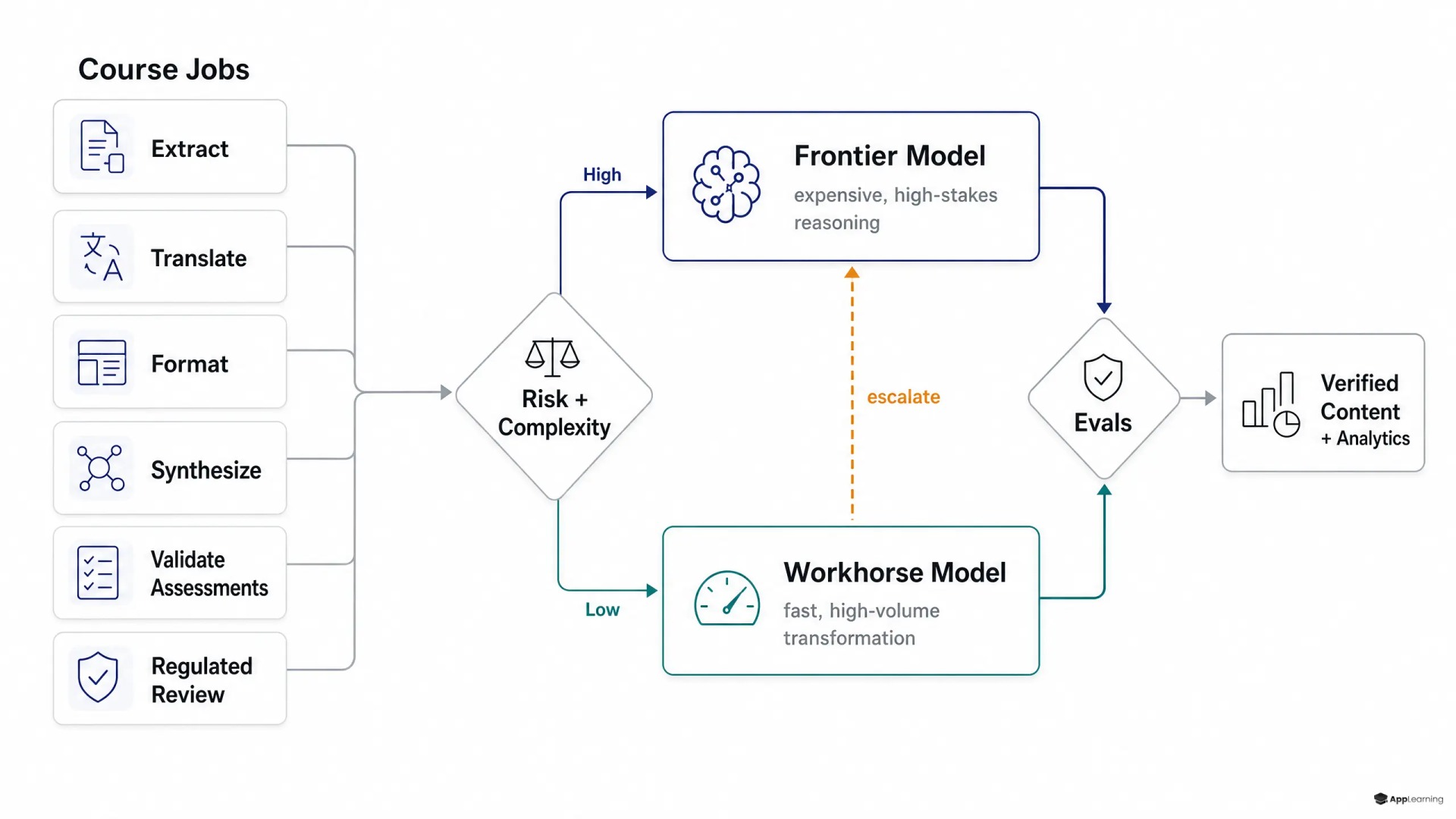
An AI course creation pipeline should be decomposed before it is automated. Most content work falls into a small number of task classes with different failure modes and different business value.
- Extraction and normalization of source files into a usable content structure
- Tagging, chunking, formatting, taxonomy mapping, and routine quality checks
- Translation drafts, tone adaptation, and conversion into templates or learning cards
- Synthesis across conflicting sources, learning-objective design, and scenario creation
- Assessment generation, answer validation, and content with legal, safety, or regulatory consequences
The first three classes often reward throughput, structured output, and low unit cost. The last two reward stronger reasoning, source discipline, and review. This is where AI model routing earns its place: route simple, bounded transformations to a workhorse model and reserve premium reasoning for decisions where a silent error creates real rework, learner harm, or compliance exposure.
Error cost should set the route
Token price is an input to the decision, not the decision itself. A cheap model that creates ambiguous quiz questions, invents a policy requirement, or misstates a safety procedure is expensive after review and correction. Equally, a premium model that cleans a spreadsheet column is wasteful even when its output is flawless.
Set routing rules around the cost of being wrong. Start with a lower-cost model when the task is deterministic, the source is structured, and output can be tested automatically. Escalate when the job requires multi-document synthesis, carries a high consequence if wrong, or fails defined checks. As OpenAI’s guidance on token pricing notes, lower cost per million tokens does not automatically mean lower cost to complete a task; total token use and task performance matter.
Escalation needs operational gates
A usable LLM routing system does not rely on a model describing its own confidence. It uses observable gates. Define them per task type, then retain the inputs, model version, output, evaluation result, and final route. That creates an audit trail and makes future model changes manageable.
- Escalate when required fields are missing, malformed, or internally inconsistent.
- Escalate when a source-grounded check finds unsupported claims or unresolved conflicts.
- Escalate when an assessment has more than one plausible correct answer or does not map to its learning objective.
- Require human approval for regulated, safety-critical, legal, or policy content regardless of model score.
- Send a controlled sample of passed work to human review to detect failures that automated checks miss.
For assessments, the premium model should not be treated as the final authority. Use it to improve generation or resolve hard cases, then validate answer keys, objective alignment, ambiguity, and source support with separate checks. In high-risk content, the route should end with accountable human review.
Good to know
Should a learning platform use the cheapest model for all routine content work?
No. Use the lowest-cost model that meets defined quality, latency, and verification thresholds for that task. A low token rate is irrelevant if correction work removes the saving.
Which tasks should move to a premium reasoning model?
Route complex synthesis, ambiguous source reconciliation, assessment validation, and high-risk regulated or safety content to stronger models. Keep a human approval step where accountability cannot be automated.
How can a startup begin AI model routing without building a complex platform?
Start with three routes: routine transformation, complex content work, and human review. Log results, create a small evaluation set from real company content, then refine routes using correction and escalation data.
How does provider portability reduce risk?
A provider-neutral task layer makes it easier to change models when prices, availability, data-processing requirements, or performance shift. It also reduces the cost of outages and migration.
Verified output is the measure that matters
Track cost per verified output: total model, retrieval, tooling, review, and rework cost divided by the number of outputs that pass the required checks. Add median latency, correction rate, escalation rate, and the severity of defects found after publication. These metrics reveal whether an inexpensive model is truly economical and whether a stronger model reduces enough rework to justify its price.
Build representative eval sets from real learning jobs, not generic benchmarks. Include messy onboarding documents, stale policies, multilingual terminology, role-specific scenarios, and difficult assessment items. Run candidate models against the same set whenever prompts, models, or providers change. Provider capability claims are useful inputs. Your own evaluation data should determine production routes.
Build onboarding systems that optimise verified learning output rather than model spend alone.
Talk to usPortability protects learning-platform margins
A multi-model learning platform needs a provider-neutral orchestration layer. Keep task prompts, schemas, evaluation logic, model versions, and route decisions separate from any one API. Use a canonical content format so a model can be replaced without rewriting the course pipeline. Add fallbacks for provider outages, rate limits, regional processing requirements, and sudden price changes.
For a growing startup, this discipline avoids a false choice between expensive quality and cheap automation. App-Learning can treat model selection as an operational layer behind onboarding and internal training: routine work stays fast and cost-aware, while content that shapes employee decisions receives stronger controls. The durable advantage is not loyalty to one model. It is a system that produces verified learning output at a cost the business can sustain.