
Key takeaways
- Time-to-first-draft hides the cost of downstream review and rework.
- Make verification gates visible, owned and measurable across the workflow.
- Track stage cycle time, reviewer touch time, rework and escaped publish defects.
- Automate source handling, handoffs and validation alongside content generation.
- Optimize the slowest trustworthy path rather than the fastest demo.
The Speed Trap in AI Course Creation
“Create a course in minutes” is a useful product demo. It is a weak operating promise. A draft generated in minutes can still wait days for a subject-matter expert, return with unsupported claims, contain weak questions, or miss the latest policy change. The visible authoring step gets faster while the real bottleneck moves into review, correction and approval.
For a founder building onboarding without a dedicated L&D function, that distinction matters. A fast but unreliable course adds work to managers and spreads inconsistent knowledge at greater scale. AI content automation should reduce the total effort needed to publish trustworthy learning, not merely reduce typing.
Time-to-Verified-Course Sets the Right Boundary
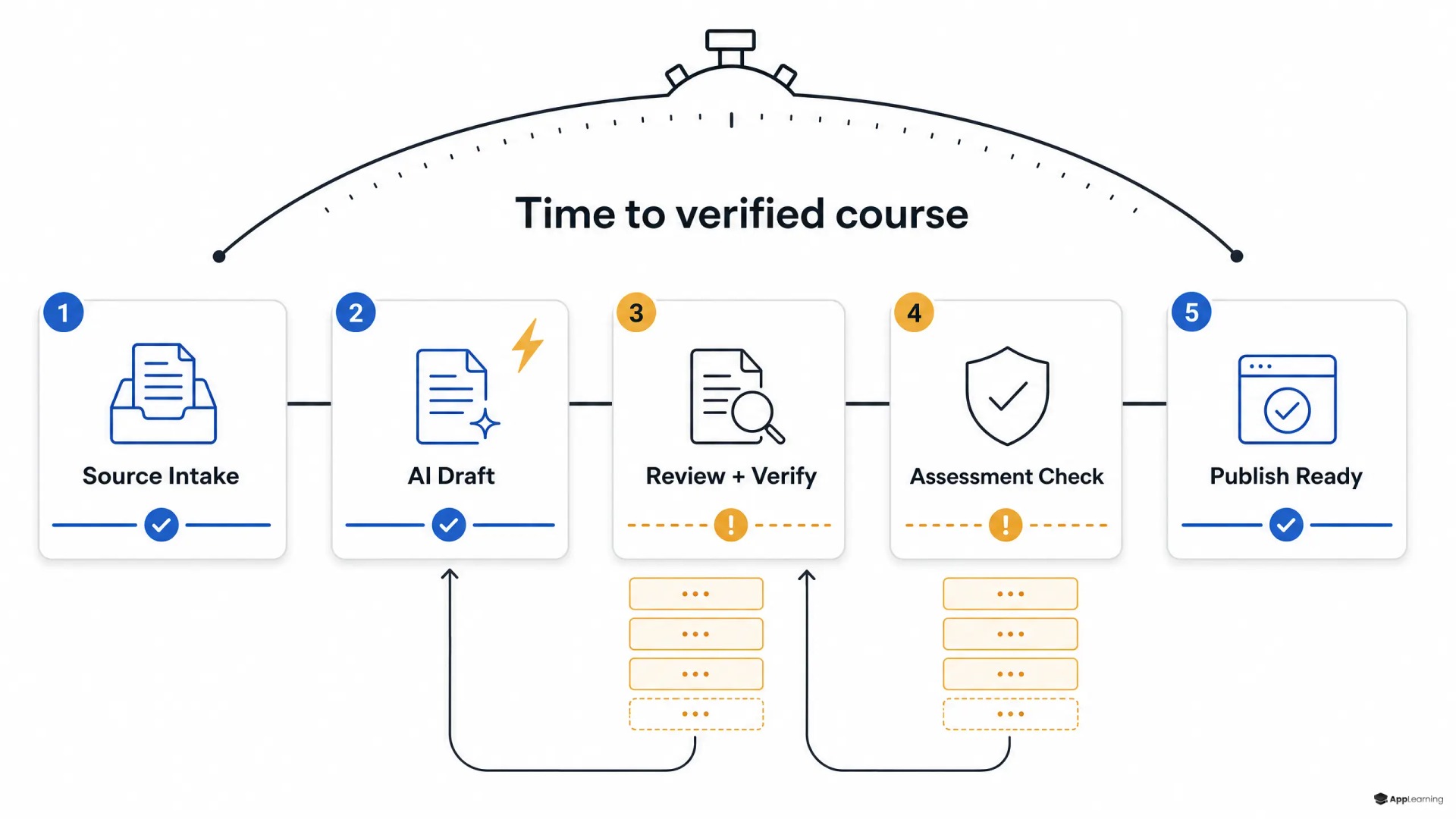
Time-to-verified-course is the elapsed time from approved source intake to a learning asset that is accurate, instructionally usable, assessment-checked, approved by the right owner and ready to publish in the LMS. It measures the complete AI course creation workflow, not one generation event.
This boundary reflects the work that must actually happen. The recent end-to-end upskilling framework treats knowledge acquisition, content development, review and verification, teaching, and assessment as connected stages. That is the more useful model for content operations LMS teams. A course is only fast when every required stage can move safely.
A Publishing Pipeline Rather Than a Prompt Box
A dependable workflow turns source material into a controlled production system with clear artifacts and handoffs:
- Source intake — collect policies, process documents, product updates and expert input; assign a source owner, version and expiry date.
- Knowledge preparation — extract approved claims, resolve conflicts and separate stable principles from time-sensitive rules.
- Generation — produce a structured lesson, examples, interactions and a draft assessment from the approved knowledge base.
- Learning content QA — check factual grounding, audience fit, clarity, accessibility, required disclosures and links back to source evidence.
- Assessment validation — test whether questions assess the intended decision or behavior, not recall of plausible wording.
- Approval and publish — record the accountable reviewer, publish the correct version and trigger the right assignment or learning path.
Not every course needs the same level of control. A short onboarding explainer may need a manager review. A fintech policy module may require compliance sign-off, a documented evidence trail and a release date. The point is to make the gates explicit before automation makes output volume harder to govern.
Review Debt Slows the Whole System
First-draft speed creates review debt when the system cannot show where a statement came from, what changed from the source, who must approve it or which questions need validation. Reviewers then inspect everything manually. They become the queue, and automation has only transferred effort from authors to scarce experts.
Assign ownership to each gate. A knowledge owner confirms source truth. A learning owner checks structure and learner fit. A compliance or functional owner approves high-risk claims. A platform owner controls publishing, audience assignment and version history. One person can hold several roles in a startup, but the decision rights should remain distinct.
Good to know
What is time-to-verified-course?
It is the total elapsed time from approved source intake to a course that has passed content review, assessment validation, ownership approval and publishing checks.
Why is time-to-first-draft a weak metric?
It measures only generation speed. It ignores waiting time, reviewer effort, correction cycles, assessment quality and defects found after publication.
Which learning content QA checks matter most for a startup?
Start with source accuracy, clear role relevance, a named approver, valid knowledge checks, correct audience assignment and a visible version date.
Can small teams use verification gates without creating bureaucracy?
Yes. Keep gates proportional to risk, reuse templates and automate routing, but always record the source, accountable owner and final approval for important content.
Metrics That Expose the Real Constraint
Measure the path as a system. The dashboard does not need to be elaborate, but it must reveal where trustworthy throughput stops.
- Stage cycle time from intake to approval, including queue time between stages.
- Reviewer touch time, separated from time spent waiting for a reviewer.
- Rework rate and the reason for each return, such as unsupported claim, unclear explanation or invalid question.
- Assessment failure rate during validation, including ambiguous or miskeyed items.
- Publish defects that escape the process, such as outdated policy content, broken links or incorrect learner assignment.
- Source freshness coverage for courses tied to changing policies, products or procedures.
The key comparison is not draft A versus draft B. It is the median time to publish a course that passes its required checks, plus the variation around that number. High variation often signals unclear ownership or inconsistent source quality rather than a weak generation model.
Fintech Shows Why Evidence Must Travel With Content
Consider a growing fintech updating its customer-data handling process. AI can turn the new policy into a concise role-based module quickly. But the real work is confirming that each operational instruction matches the approved policy, that the German and English versions carry the same meaning, that the quiz tests the correct escalation decision, and that staff receive the new version before using the process.
A course published before those checks is not early. It is an unmanaged risk. In regulated learning, the fastest defensible path is usually the one with source traceability, fixed approval gates and a clear record of what learners saw.
Make your learning pipeline measurable from source to publish.
DiscussThe Content Control Plane
An App-Learning content control plane should connect the full chain: source material, generated learning objects, review tasks, evidence links, assessment checks, approvals, versions and publish status. That gives a lean team one operational view of time to publish learning content without forcing it to build a large L&D operation.
The goal is not to add process for its own sake. It is to remove avoidable handoffs, route the right reviewer automatically, reuse approved knowledge safely and detect stale learning before it reaches new hires. When automation is measured from trusted input to verified output, it becomes a capability-building system rather than a faster text generator.