

Key takeaways
- The canonical course record and its exported views serve different purposes.
- Review packets need explicit coverage indicators for elements a document cannot represent.
- Consolidated copy removes the need to reconstruct lessons from separate change files.
- Action prompts, navigation and quiz behavior need review in the actual renderer.
- Approval belongs to a specific version, not a familiar filename.
The Review PDF and the Live Lesson Can Disagree
A financial-education content review exposed a narrow but important gap. Exported chapters contained educational copy and updates, while in-app action elements were absent from the PDF. Reviewers also needed one consolidated text after receiving separate changes and earlier files. The problem was not simply whether the CMS held the latest copy. It was whether the review packet represented the lesson.
Text approval leaves interaction unresolved
For accessibility evaluation, WCAG-EM includes complete processes and interaction, including feedback and behavior under different settings. (w3.org) The editorial implication is similar, though separate from accessibility conformance. An interactive course PDF export can support close reading without proving that a button appears at the right moment or leads to the intended destination.
Separate change files fragment the decision
When approval depends on combining an earlier chapter with later amendments, reviewers must reconstruct the intended lesson. That should not be their job. A course approval workflow should provide one complete, versioned review packet. A change summary helps reviewers find edits; it should not replace the consolidated copy.
One course object supports two review views
The OASIS DITA specification describes reuse through references to content fragments. (docs.oasis-open.org) The useful principle here is separation between source content and its representations, not a requirement to adopt DITA. For an academy CMS, the proposed canonical object includes chapter copy, prompts, navigation labels, questions, feedback, conditions and asset references.
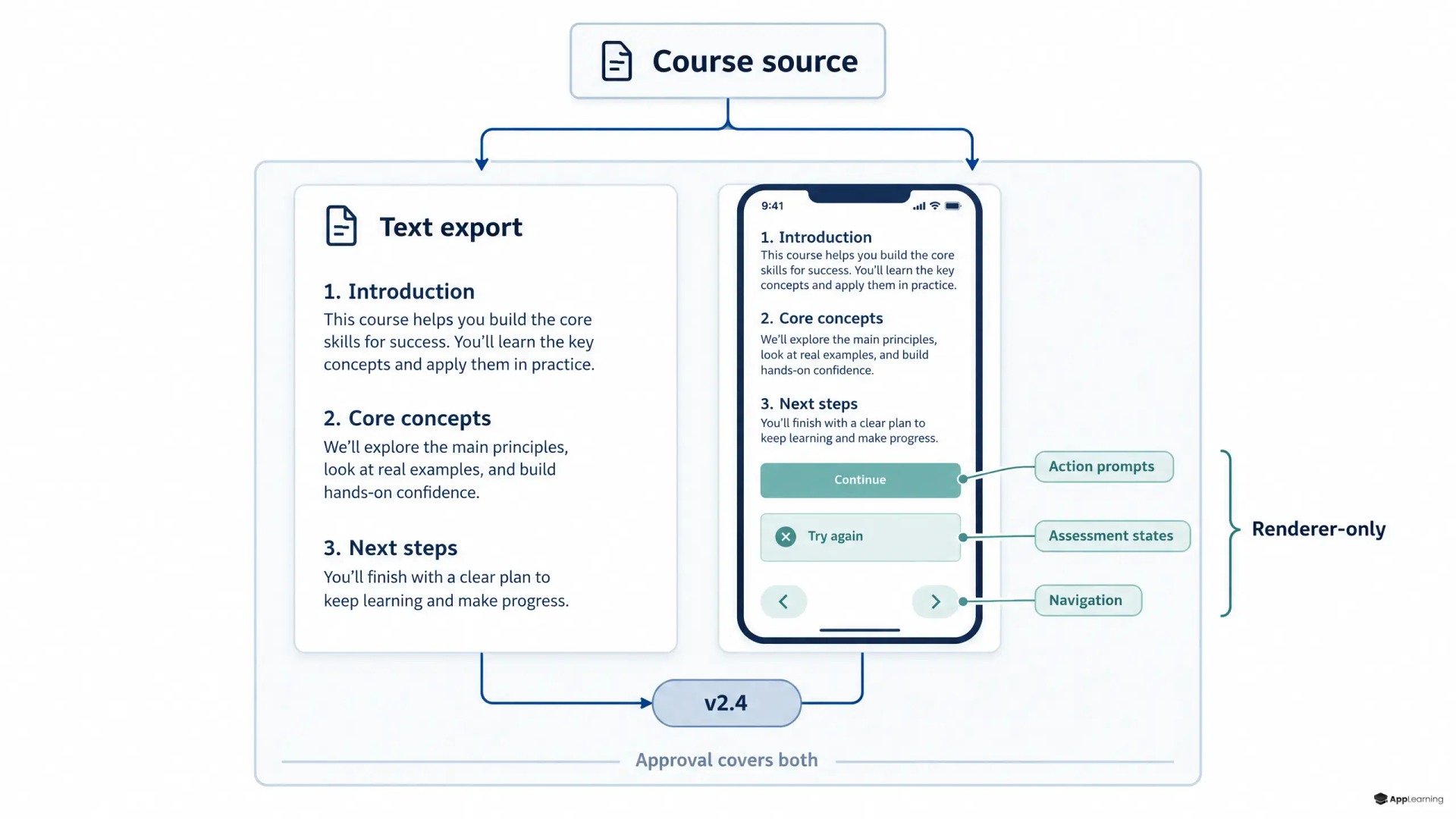
App-Learning can structure this around two synchronized views generated from one frozen revision: readable chapter copy for subject experts and a preview for interaction review. Content version parity means both views identify that same revision, language and relevant configuration.
The export declares its own limits
The proposed export includes every authorable learner-facing string, including answer feedback and conditional prompts, with conditions labelled. An omission manifest then distinguishes missing text from behavior that a document cannot reproduce. Each entry records the component identifier, export coverage, preview location and review status.
- Included as text, such as chapter copy and button labels.
- Represented with conditions, such as feedback shown after an incorrect answer.
- Preview required, such as navigation, unlocking and destination behavior.
Preview review follows learner states
Moodle’s quiz settings distinguish navigation rules, question behavior and feedback visibility. (docs.moodle.org) These are useful categories for LMS content review. The review protocol should use the production renderer in preview, with learner permissions and documented starting states, rather than relying on an editor’s unrestricted view.
- Follow action prompts and verify their destinations.
- Test correct answers, incorrect answers, retries and completion.
- Check navigation and conditional states on the intended mobile and web surfaces.
Publication stays bound to the reviewed revision
Drupal’s moderation model separates a published version from a working copy under review. (drupal.org) For the academy workflow, approval should record reviewer, scope, revision, language and renderer build. Publication should release that reviewed combination. Later content or behavior changes should trigger an impact check and renewed approval where needed, not inherit sign-off from a filename.
Build a version-matched review workflow with App-Learning.
DiscussRework becomes a traceable workflow signal
A useful measurement plan records issues found after text approval, separating export omissions, version mismatches and renderer defects. Review rounds and reconciliation time provide additional signals. These measures would establish whether the workflow improves; the review case alone does not demonstrate a measured benefit.
The PDF does not need to become the lesson. It needs to state its coverage honestly and point to a version-matched experience for everything else. Approval is complete only when the reviewed copy and the reviewed learner experience belong to the same release.