

Key takeaways
- Learning placement is a product decision, not a frontend detail.
- External academies suit partner distribution; embedded learning can reduce product-to-lesson handoffs.
- Consented attribution needs minimal identity mapping, not unrestricted access to financial data.
- Completions, confidence and verified financial behaviour belong in separate measurement layers.
- Cross-channel continuity depends on shared progress and reliable return paths.
The hard choice is not whether to add quizzes. It is where learning belongs and who owns the journey back to the product. Two October announcements show how similar gamified capabilities can serve different distribution strategies.
BMO puts learning in a separate consumer app
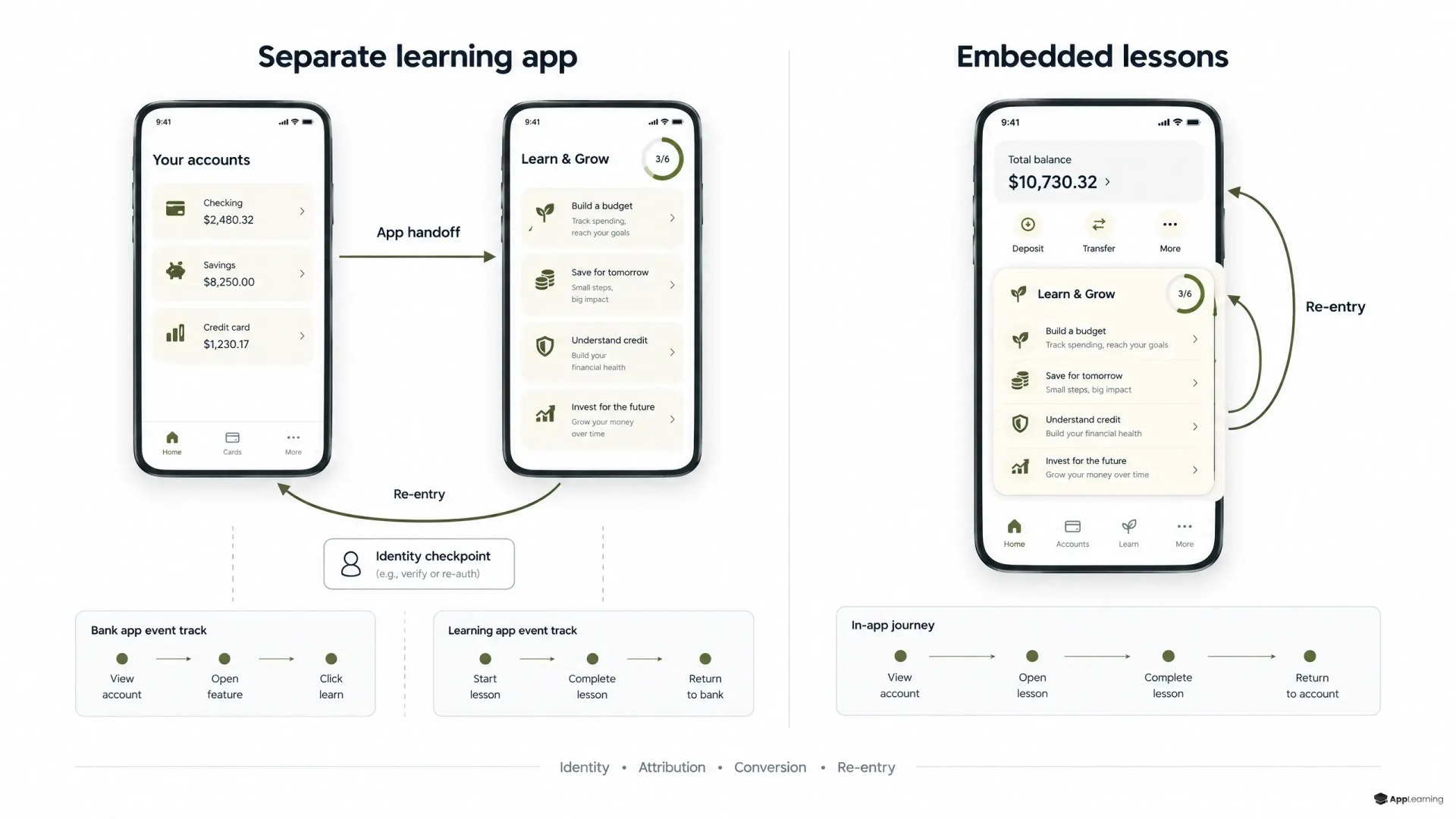
On October 8, 2026, BMO announced a Zogo experience in Canada for eligible students aged 18–24, delivered through the Zogo mobile app. Lessons and quizzes cover budgeting, saving and credit, with points redeemable for rewards. (newsroom.bmo.com) The important boundary is between this learning destination and BMO’s banking interface.
Our reading is that a ready-made destination can suit partnership distribution without requiring an academy inside the banking product. The trade-off is a handoff. Acquisition attribution, account linking and the learner’s return to banking need explicit design rather than assumptions.
Sezzle keeps the learning journey inside its app
On October 6, 2026, Sezzle reported more than two million completed Money IQ modules among over 338,000 users. Its release identifies Zogo as the provider and describes learning inside Sezzle’s app, with points redeemable for Sezzle Spend or gift cards. The confidence findings come from a user survey. (my.sezzle.com) These establish reported participation and perceptions, not causal evidence of improved financial wellbeing.
Embedded financial education offers a place to connect explanations with product decisions. That is an opportunity, not proof that Sezzle uses contextual triggers or that learning causes conversion. Rewards also deserve separate scrutiny when their redemption leads back to spending.
The integration contract matters more than the container
Zogo publicly documents lesson deep-linking and compatibility with websites and mobile apps. (zogo.com) That verifies available pathways, not either customer’s implementation. Neither announcement establishes its SSO design, shared identifiers or event-export contract.
- Identity — specify SSO or account linking, logout behaviour and consented learner-to-product attribution.
- Context — define which product moments should open which lessons and where learners return.
- Data boundaries — minimise shared fields and agree access, retention and deletion responsibilities.
- Rewards — define eligibility, redemption costs and duplicate-claim prevention separately from comprehension.
- Continuity — require progress to survive device changes and later re-entry.
The CFPB’s financial-wellbeing framework centres financial security and freedom of choice rather than course activity. (consumerfinance.gov) A useful measurement plan therefore separates lesson starts, completion, comprehension, self-reported confidence and verified behaviours such as on-time payments. Product conversion belongs alongside these measures, not above them; causal claims need a credible comparison design.
The buying choice follows the learner’s starting point
- External academy — favoured when partner reach and pre-customer education outweigh immediate product action, especially with an existing destination.
- In-app academy — favoured when authenticated users need understanding before a specific feature or decision.
- Hybrid model — favoured when discovery starts externally but progress must continue inside the product.
App-Learning documents web and mobile academies, embeds, deep links and SSO. (app-learning.com) For a fintech education platform, these are deployment choices. White-label financial literacy concerns brand control; it does not, by itself, establish integration depth or data ownership.
Map your learning integration with App-Learning.
DiscussA pilot needs an end-to-end acceptance test
- Select one knowledge gap and define a safe product outcome.
- Test entry, authentication, lesson completion, exit and later resumption.
- Validate consent boundaries, event deduplication and reward handling.
- Assign content review, localisation and update ownership before expanding.
The stronger system is not automatically the one inside the app. It is the one that fits the distribution job, preserves learner continuity and produces evidence the team can trust. Placement earns its value when understanding survives the journey from lesson to decision.