

Key takeaways
- A learn and earn campaign gains value when it becomes a planned sequence.
- Monthly releases create clear reasons for learners to return.
- Certificates can convert completed learning into visible social proof.
- Rewards should reinforce progress rather than become the product.
- Measure repeat learning alongside knowledge and downstream product behaviour.
The familiar learn and earn campaign has a structural weakness. It often creates one burst of attention, one completion event and one reason to leave. For a Bitcoin or fintech product, that is rarely enough. Users need time to move from basic literacy to practical confidence around custody, recurring buys, security and the trade-offs behind each choice. A recurring product education model can create that time without turning education into a permanent promotion.
One-off campaigns hit a hard ceiling
A single course can remove one onboarding barrier. It cannot establish a learning habit or reveal whether a learner can apply the material later. It also produces a thin measurement signal: a completion rate tells you who finished, not who returned, understood or used the relevant product feature. The result is often a campaign metric rather than a customer education lifecycle.
Binance’s recently announced South Asia programme makes the alternative visible. It pairs a different monthly course with certificates and prize draws over six months; its first edition began on September 23, 2026, and closes on October 5, 2026, before a second edition on AI agents and skills. The public announcement describes the mechanics, not causal retention or revenue results. That distinction matters. The campaign is a useful operating pattern, not proof that incentives improve long-term knowledge or customer behaviour.
A calendar gives education a product rhythm
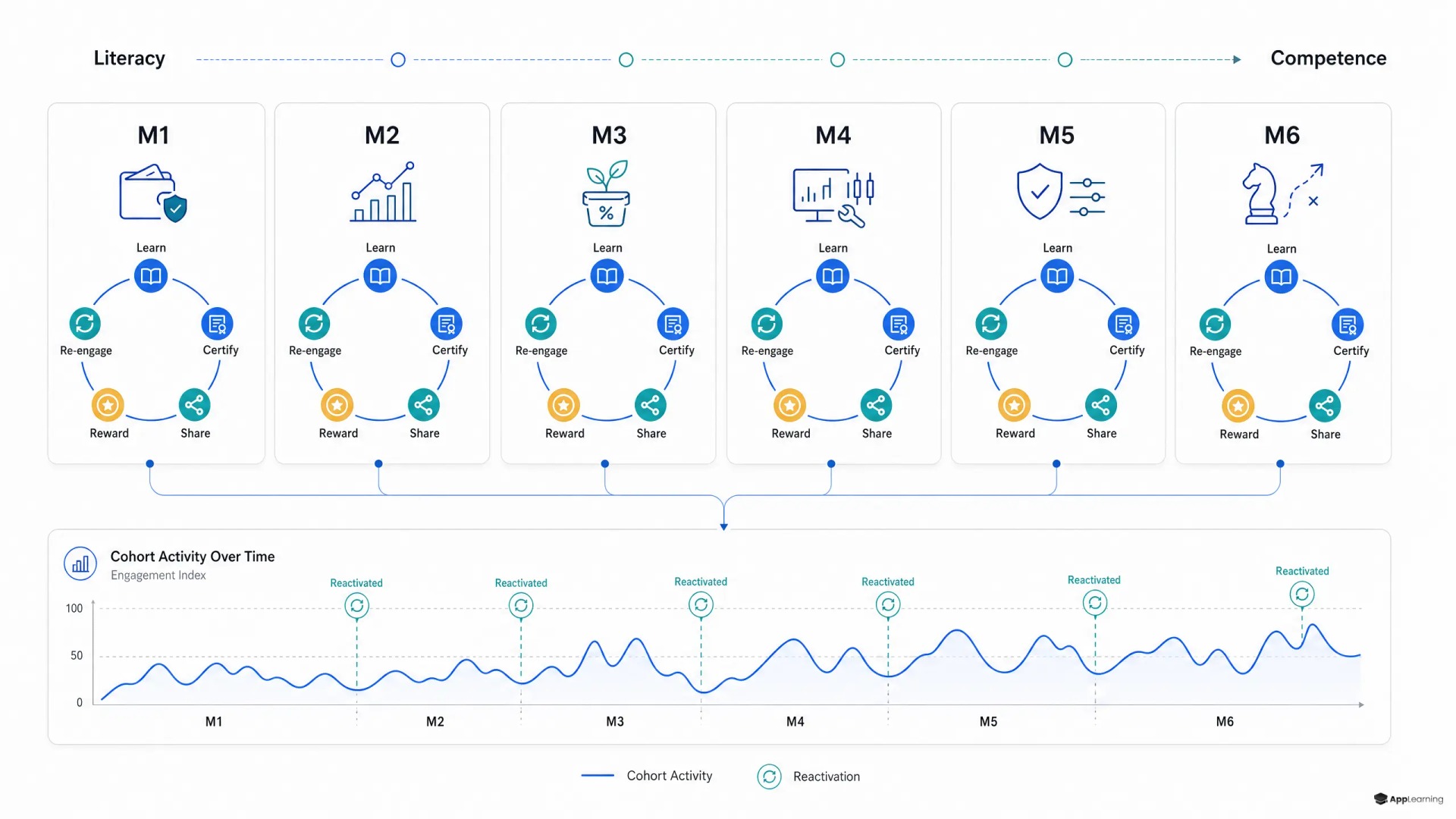
Treat the campaign as a curriculum calendar. Each month should answer one product-relevant question and prepare the learner for the next one. For a Bitcoin company, the sequence might move from Bitcoin basics and price risk to wallet security, first purchase, recurring buys, saving behaviour and self-custody readiness. Do not release six unrelated lessons. Build a capability path.
- Month one establishes shared vocabulary and risk awareness.
- Months two and three support first meaningful product actions.
- Months four and five develop safer repeat behaviour and feature confidence.
- Month six checks application, identifies gaps and offers the next pathway.
This turns recurring product education into an operating cadence. Product, compliance, content and CRM teams know what is shipping, which behaviour it supports and which cohort should see it. Localisation also becomes manageable because teams adapt a stable sequence rather than rebuild a separate campaign every month.
Re-entry points need a reason to return
Each release should work as a clean re-entry point. Notify learners about the new module, resume unfinished learning in one tap and deep-link them to the relevant feature after a short knowledge check. A user who completed Bitcoin basics last month should not restart at the home screen. They should return to the next appropriate action with their progress intact.
The first Academania edition requires participants to complete a beginner course, share evidence of completion and submit their details by October 5. Binance South Asia’s published participation flow shows why the deadline matters operationally: it creates a time-bound return moment. A stronger fintech learning campaign adds a second return moment after the deadline, when the next lesson and next product task become available.
Certificates make progress visible
Certificates are not proof of mastery. They are a progress artefact. Used well, they mark completion, give the learner a shareable signal and create a lightweight social proof loop. The share flow must remain optional and frictionless. It should never gate access to essential education, and it should not push customers to make claims about financial expertise they cannot support.
Incentives belong behind the learning design. Tie eligibility to meaningful completion, a short assessment and any necessary compliance checks. Keep reward value modest enough that the lesson remains the reason to participate. If users can gain more from gaming the task than from understanding the content, the programme will optimise for the wrong behaviour.
Good to know
What makes a learn and earn campaign more than a promotion?
A planned sequence of connected modules, return moments and product-relevant actions turns a single incentive into an ongoing learning lifecycle.
Which metrics matter most in a recurring education campaign?
Track starts, completions, knowledge checks, return rates, sequence completion and the downstream product behaviour each module was designed to support.
Should rewards be tied to course completion?
They can be, but eligibility should require meaningful learning activity and appropriate safeguards. Rewards should remain secondary to the educational value.
How can Bitcoin education support product activation?
Place short, contextual lessons before moments of hesitation such as a first purchase, security setup, recurring buy or self-custody decision, then connect learning directly to the next safe action.
The dashboard must outlive the draw
The useful dashboard follows a cohort across the full customer education lifecycle. Track invitation-to-start activation, module completion, assessment performance, return rate in later months, repeat participation and time to relevant product behaviour. Then compare exposed and unexposed cohorts carefully, controlling for prior activity where possible. This will not create perfect causality, but it is far more useful than reporting entries and vouchers distributed.
- Learning activation and completion by language, market and user segment
- Knowledge checks before and after critical modules
- Monthly return rate and sequence completion rate
- Feature adoption after related learning modules
- Support contacts and recurring friction themes among learners
Build your next learning cycle with App-Learning.
TalkThe six-month academy needs a real operating stack
A six-month customer academy fails when it is assembled from monthly landing pages, manual exports and disconnected emails. It needs scheduled releases, modular multilingual content, in-app deep links, certificates, controlled reward eligibility and cohort analytics in one system. App-Learning can operationalise that layer while product teams retain ownership of the behaviours and trust outcomes the curriculum must support.
The prize may start the first session. A clear learning path, timely re-entry points and visible progress give users a reason to return. For Bitcoin companies, that is the durable objective: replace uncertainty with informed action, one relevant capability at a time.