

Key takeaways
- Agentic payments add software as a decision-making actor in the transaction journey.
- Delegated payment consent must make scope, limits, review and revocation easy to understand.
- Support teams need one transaction model that shows permission, action and outcome.
- Learning should appear at delegation and exception moments, not only during onboarding.
- Scenario assessments expose gaps in consent handling, disputes and escalation.
Delegation inserts a new actor into the journey
A payment journey used to be simple: a customer chose, approved and paid. Agentic systems split that chain. The customer sets an instruction, software interprets it, and the payment rail executes it. On September 10, Reuters reported that India’s National Payments Corporation was developing a registry to verify and monitor AI agents transacting through UPI, with small, frequent purchases expected first and liability for wrong or unauthorised payments still requiring regulatory work.
That shift changes the education task. Customers do not merely need to know where to tap or how to check a balance. They need a mental model for delegated authority: what their agent may decide, when it may spend, and how they regain control.
A registry is not a customer mental model
An agent registry can help establish identity and provide a basis for monitoring. It cannot, by itself, tell a customer whether an agent was allowed to buy a substitute item, retry a failed payment, combine purchases or act on an ambiguous instruction. Nor does it make a transaction history self-explanatory when intent, agent reasoning and payment execution sit in different systems.
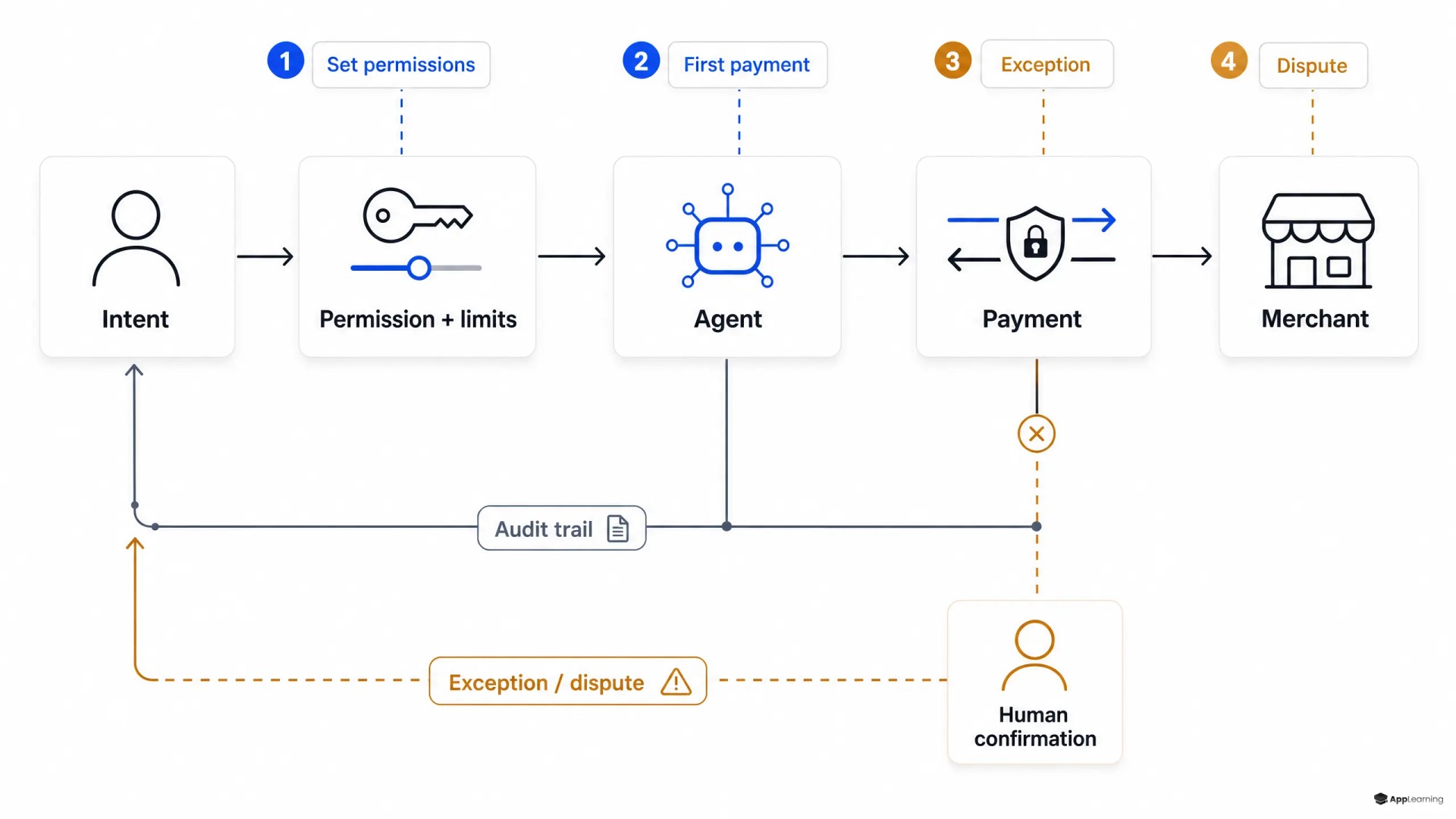
Product teams should treat this as a design requirement. Trust depends on a legible chain from instruction to authority to action to outcome. If any link is unclear, the product will create avoidable support demand precisely when money has moved.
Authority must be legible before money moves
Strong AI payment agent onboarding makes five concepts concrete before a customer delegates payment authority.
- Scope — which merchants, categories, accounts and tasks the agent may use.
- Limits — per-payment, daily, monthly and category caps, plus rules for retries and substitutions.
- Human confirmation — the actions that must pause for explicit approval.
- Records — a clear history of the instruction, the agent action, the payment and any exception.
- Revocation and recourse — how to pause, remove authority, dispute an action and reach a human.
The interface should show these rules as decisions, not legal prose. “Your agent may reorder household goods up to €50 per purchase” is testable. “You agree to automated payments” is not. Customers should be able to inspect the active mandate without hunting through settings.
Education must follow the risk
Agentic payments education should sit inside the journey. A short module at setup can establish the model. A second module should appear when a user broadens permissions, raises a spending limit or enables a new purchase type. A third should appear after a declined, disputed or unexpected transaction, when the customer has a real reason to learn.
This is where agentic commerce education differs from a static help centre. Use short, mobile-first scenarios: an agent finds an item above the cap; a merchant substitutes a product; the agent repeats a payment after a timeout; a customer revokes access mid-task. Each scenario should show the right action and the consequence of the wrong one.
One transaction model for frontline operations
Customers are not the only learners. Support, risk and partner teams need the same underlying model at greater depth. For every disputed event, they must reconstruct the original instruction, the permissions in force, the agent’s attempted action, the payment status and the available escalation path.
Fintech product education should therefore share a core curriculum across audiences, then vary the detail. Customers need confidence and control. Support teams need diagnostic steps. Operations teams need evidence standards and hand-offs. Partner teams need implementation rules. Scenario-based assessments can test whether a person distinguishes unclear consent from an authorised action that produced an unwanted result.
Good to know
What should customers learn before enabling an AI payment agent?
They should understand the agent’s scope, spending limits, confirmation rules, activity records, revocation controls and dispute path.
How is delegated payment consent different from a recurring-payment mandate?
A recurring mandate usually defines a known payee and schedule. Delegated authority may also require rules for choice, conditions, substitutions, retries and changing purchase contexts.
Which teams need agentic payments training?
Customers need clear controls, while support, risk, operations and partners need a shared model for investigating and escalating payment events.
Learning triggers belong at delegation and exception points
Do not reserve education for first-time onboarding. Trigger it when the user enables an agent, changes a limit, adds a payment method, sees the first autonomous transaction, receives a decline or opens a dispute. These are the moments when delegated payment consent becomes operational rather than theoretical.
The learning signal also matters. Completion rates show whether people finish a module. Scenario choices show whether they understand it. Repeated wrong answers can reveal a weak permission screen, unclear language or a feature that asks customers to accept more ambiguity than the product can safely explain.
Give customers a clear model before agents can spend.
DiscussThe education architecture for agentic finance
Build one modular content system around the transaction lifecycle: set authority, monitor activity, handle exceptions and revoke access. Reuse the same scenarios across web, mobile, support enablement and partner training, while adapting depth, language and assessment. This gives teams a practical way to scale AI payment agent onboarding without turning every market launch or product change into a content-production project.
App-Learning can provide that embedded layer: short journeys, role-specific paths and measurable scenario learning within the product experience. In agentic finance, education is not an explanatory add-on after launch. It is part of the control system that lets customers delegate with informed confidence and lets teams respond when delegation fails.