

Key takeaways
- A bank-sponsored academy can build employability value without promoting banking products.
- Open access broadens reach and makes the learning offer feel credible.
- External experts can supply content and credentials while the bank owns distribution.
- Short lessons and deeper pathways serve both curiosity and career intent.
- Measure audience growth and repeat learning before product conversion.
A seat is a distribution unit
A hundred thousand free course seats are not simply a corporate-responsibility expense. They create a large, permissioned audience around a useful need: career mobility. On 3 September 2026, Santander and Coursera added 50,000 places to bring the programme to 100,000 seats, offering adults in 12 countries a year of access to 80 courses without requiring either a Santander account or a university degree.
That is the commercial logic. The bank is buying relevance, reach and repeated contact around a problem people already want solved. It is not claiming that every learner will become a banking customer. Nor should it. A bank academy strategy works best when the immediate exchange is clear: the learner receives credible career value, while the sponsor earns attention and trust over time.
Skills infrastructure is not product education
Product education helps someone use a current account, investment tool or lending product. A bank employability program solves a wider problem that exists before any product choice. The distinction matters because the learner's intent is different. One person wants to understand a feature. The other wants to improve a job prospect, move into data work or gain confidence with AI.
For a fintech growth leader, this opens a different acquisition surface. Instead of paying to interrupt people who may not understand a complex product, build useful learning assets that attract people through a high-intent skills need. Product education can follow later, where it genuinely helps. It should not contaminate the first learning experience with a disguised sales agenda.
Open access changes the trust equation
Requiring an account would make the academy feel like an onboarding gate. Keeping it open to non-customers changes the signal. The sponsor is willing to fund value before it can identify a direct transaction. That does not remove commercial intent. It makes the intent more credible because the learner can benefit without buying anything.
This is also a useful distinction from bank-owned financial education. UBS launched YUMO on 9 September 2026 as a free Swiss platform with short chapters, quizzes and videos on personal finance and economics, available in four languages. It is a different content proposition, but it shows the same distribution principle: a bank can operate an education destination that is useful before a product conversation begins.
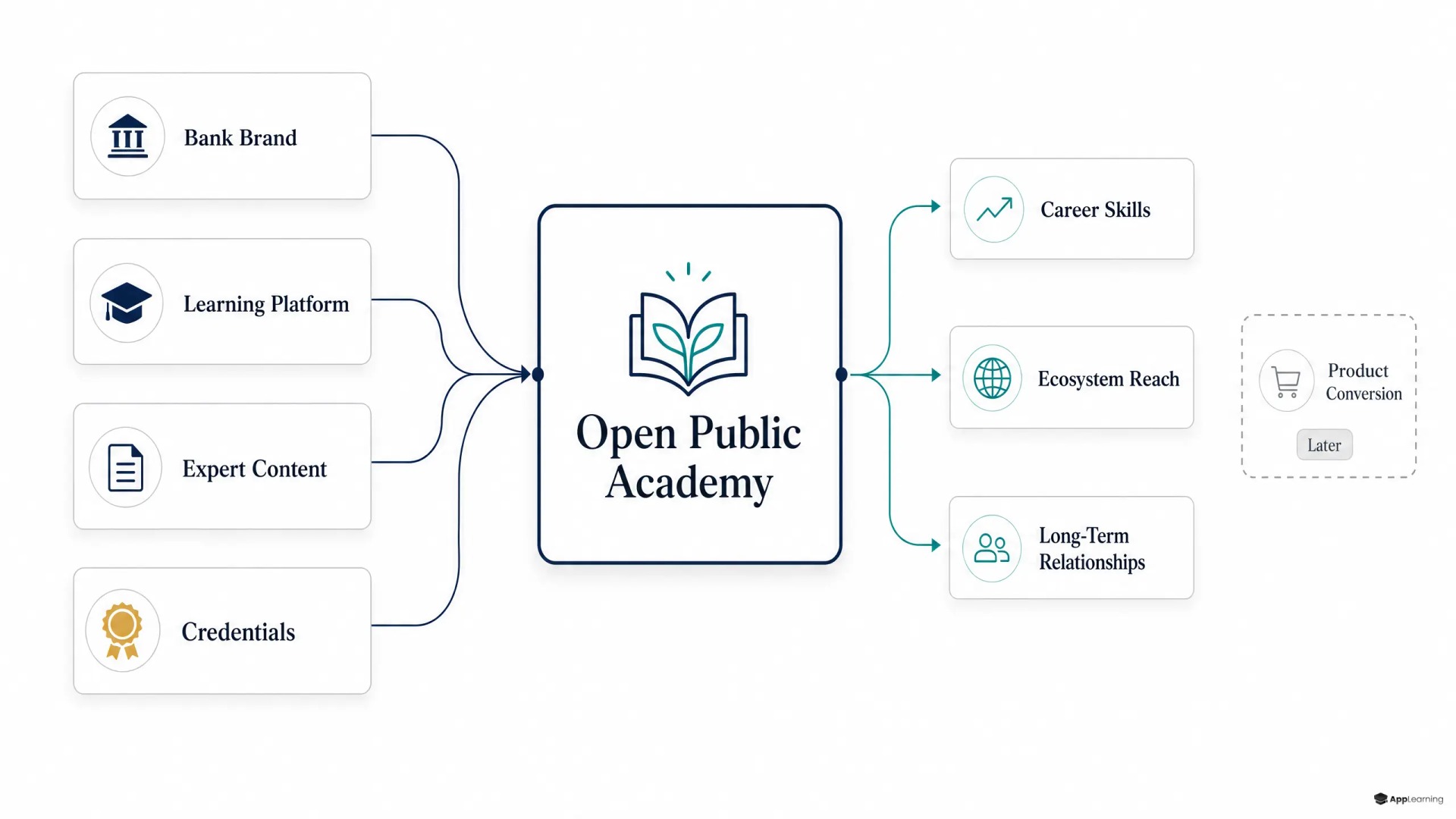
The academy stack has four owners
A sponsored learning platform does not require a bank to build every layer. Santander's model separates sponsorship and audience reach from Coursera's course catalogue and certificates. That split lets the bank own the destination, campaign calendar, learner relationship and brand experience while a specialist partner carries much of the subject-matter depth and credentialing.
- The bank or fintech owns the audience promise, funding and distribution.
- The learning platform runs identity, pathways, progress, notifications and analytics.
- External experts supply subject expertise, assessments and content production.
- A credential partner provides completion signals that learners can use beyond the academy.
An education partnership bank model becomes stronger when these roles are explicit. It avoids the common failure mode of launching a content library with no clear owner for acquisition, learner activation or ongoing programme operations. App-Learning can support this structure with a branded skills academy that combines external content, co-produced modules, cohort campaigns, certificates, referrals and multilingual delivery.
Good to know
Should a bank academy require a customer account?
Usually not at the entry point. Open access expands the reachable audience and keeps the value exchange clear. Account creation can remain optional when it supports a relevant next step.
Which content should a fintech create itself?
Own the modules where your product expertise is genuinely distinctive. Use specialist partners for broad career, leadership, data or credential content that requires external authority and ongoing maintenance.
When should product education enter the learner journey?
Introduce it after the learner has received clear value and only where it helps solve the next problem. Keep sponsored skills learning and product onboarding as separate pathways with different success metrics.
The learning ladder starts small
Large programmes need more than a large catalogue. They need a ladder. Santander combines short one- to two-hour courses with longer programmes, which recognises that learners arrive with different levels of time, certainty and ambition. The same design applies to a fintech academy.
- Use a ten-minute diagnostic, quiz or practical lesson as the entry point.
- Offer short skill modules that create an early completion moment.
- Group modules into role-based or goal-based pathways.
- Invite committed learners into cohorts, projects, mentoring or recognised credentials.
The short format is not a watered-down version of the programme. It is the activation mechanism. Deeper pathways then give learners a reason to return, share progress and build a durable relationship with the academy.
Audience value needs its own scorecard
Immediate account openings are the wrong primary KPI for this model. They create pressure to insert product messages where they do not belong, weakening the learning objective and the brand signal that made the programme valuable.
Measure the system in layers: qualified registrations, first-lesson activation, completion, certificate attainment, repeat participation, referrals, cohort retention and cost per engaged learner. Then connect consented learner segments to later brand consideration, product discovery and relationship value. This preserves a clean learning experience while still making the investment accountable.
Turn useful learning into a durable growth channel.
Plan itPartnerships become growth infrastructure
The lesson from these programmes is not that every financial institution needs to give away 100,000 courses. It is that a branded learning destination can become a distribution asset when it solves a real capability problem at scale. Start with one audience, one credible skills promise and one partner model that can deliver proof of progress.
The strongest academy will not be the one with the most content. It will be the one that makes the learner better off before it asks for anything in return. That is how education becomes a defensible growth system rather than another content campaign.