

Key takeaways
- Education belongs in the partnership architecture, not beside it.
- Different audiences need different learning stages and operational outcomes.
- Blockchain certification should unlock implementation readiness, not just signal course completion.
- The strongest academy KPI is progression into pilots, projects or active ecosystem participation.
Awareness is a weak partnership outcome
Many blockchain education partnerships stop after an event, a course launch or a content handover. Participants gain vocabulary, but no operating route connects that knowledge to a business decision, a technical design or a funded proof of concept. The partnership can report attendance while institutional behaviour remains unchanged.
A content library is necessary, but it is not a learn to pilot system. It does not tell a developer which capability to build next, an executive which decision to make, or an operations team how to test a use case safely. For a Bitcoin or Web3 product team, the same gap appears when onboarding education explains concepts but never helps users take the next confident product action.
The ladder turns learning into implementation
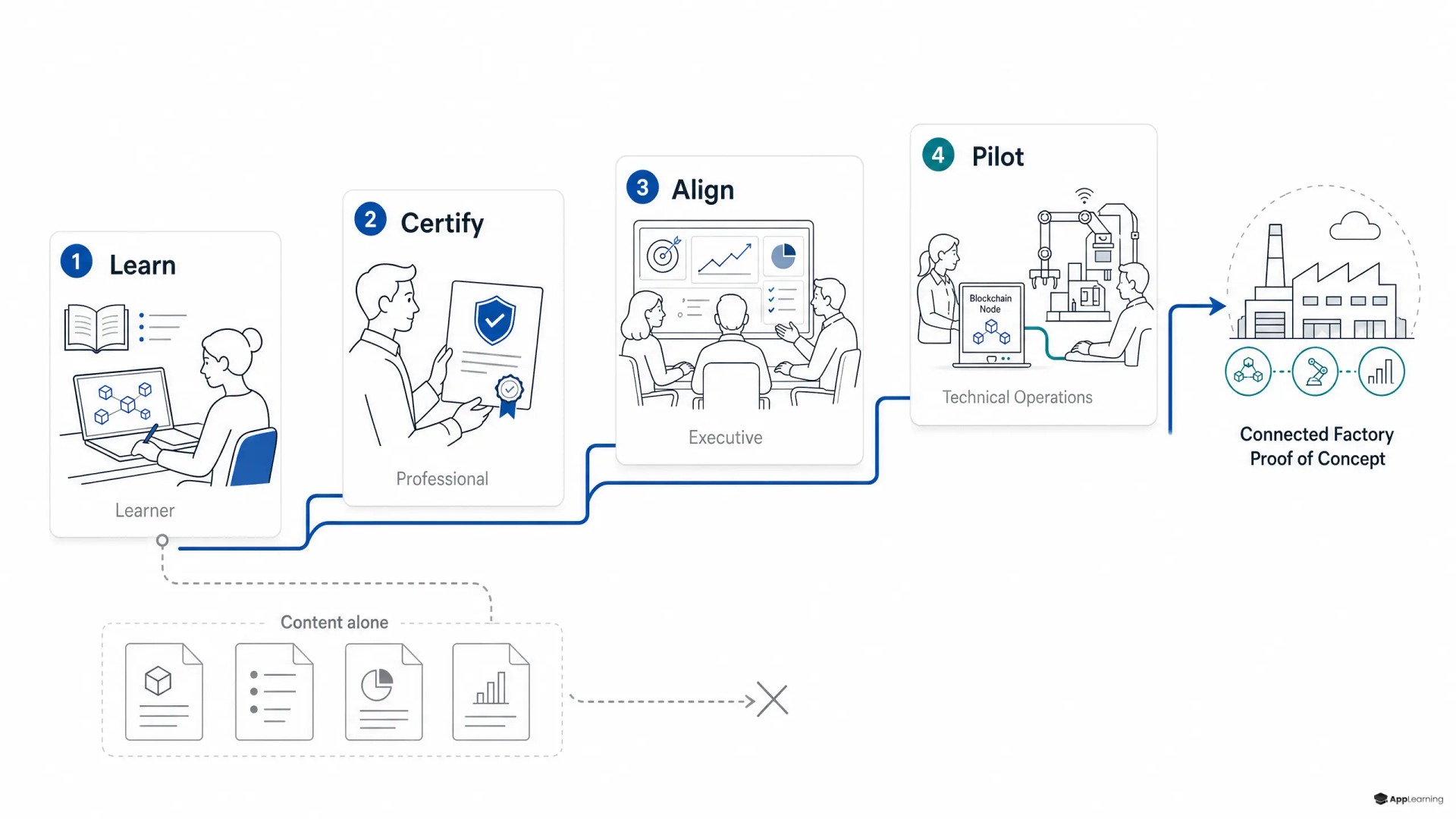
The Cardano Foundation and SENAI São Paulo provide a useful structure. Their June 2026 partnership announcement combines technical immersion, certification, executive training, masterclasses and industrial proof-of-concept work. The value is not any one element. It is the intended progression between them.
It is important to separate delivery from roadmap. The initial workshops took place, while the two-year programme describes planned certification, executive education, innovation tracks and pilots. In its August update, SENAI-SP described the first phase as training 130 education and research professionals and outlined further capability building and practical innovation work over the following two years.
- Learn — Give each audience a shared foundation in the technology, its limits, relevant use cases and the organisation’s strategic context.
- Certify — Test applied understanding and award a credential that qualifies people for the next stage rather than merely marking completion.
- Align — Bring leaders together around selected problems, risk boundaries, ownership and investment decisions.
- Pilot — Convert an approved opportunity into a scoped proof of concept with a sponsor, users, data, success measures and a decision date.
This sequence makes blockchain certification useful. It becomes a gate into workshops, partner access or pilot teams. Without that hand-off, certificates often become a reporting metric with no operational consequence.
Each role needs a different route
A single Web3 academy course cannot serve technical specialists, educators, executives and operating teams equally. They require a common language, but they need different evidence of readiness.
- Technical teams need architecture, standards, security constraints, integration patterns and hands-on use-case design.
- Educators need train-the-trainer content, facilitation guidance and reusable assessments that let them scale the programme internally.
- Executives need decision briefs, risk scenarios, economics and workshops that produce an explicit mandate or a clear no-go decision.
- Operational teams need workflow mapping, data ownership, partner dependencies and a practical pilot plan.
A well-designed enterprise blockchain training programme routes learners on the basis of role, assessment result and declared intent. A technical learner who passes a fundamentals assessment moves into solution design. A business leader who completes an executive module moves into an alignment workshop. A pilot team moves into project support. That routing prevents the academy from becoming a crowded catalogue with no next action.
Progression metrics reveal adoption potential
Completion rate is useful for content operations, but it is not the north-star metric for a blockchain education partnership. The programme should measure the conversion chain from access to action.
- Activation from invitation to first completed module
- Assessment performance by role and topic
- Certification earned and renewed
- Progression from certification into workshops or masterclasses
- Pilot candidates submitted, qualified and approved
- Proofs of concept launched, completed and advanced into production or active ecosystem participation
These measures need a shared data model. A learner record should connect academy activity with workshop attendance, partner account, pilot application and project outcome. Otherwise, a partnership team sees learning data in one system and adoption data in another, then cannot establish whether education changed the pipeline.
Good to know
What makes a blockchain education partnership operational rather than promotional?
It assigns every learning stage a next action, owner and evidence of readiness. Learners move from knowledge to certification, alignment and a defined pilot route instead of ending at content completion.
When should blockchain certification be introduced?
Introduce it after a foundation stage and before higher-cost activities such as workshops, solution design or pilot access. The credential should test the capabilities required for that next stage.
Which academy metric matters most?
Track progression into meaningful action. Depending on the partnership, that may mean a workshop, a pilot application, a proof of concept, a product activation or sustained ecosystem participation.
The academy becomes partnership infrastructure
A multi-year partnership needs more than a learning management system. It needs modular content that can be updated as the technology and use cases change, role-based pathways, assessments, credentials, localisation, workshop materials and progress analytics. It also needs a practical connection to the teams that own partner development and pilots.
For product leaders in Bitcoin fintech, the same infrastructure can sit inside mobile and web journeys. Foundational lessons can support onboarding; short assessments can surface confidence gaps; contextual modules can explain wallets, recurring buys or security choices at the moment they matter. The point is not to turn every user into a technical expert. It is to give each person enough understanding to take the right next step.
Turn partner learning into a route toward measurable implementation.
ConnectA learn-to-pilot system needs a clear owner
App-Learning can provide the academy layer for this model: mobile-first modules, assessments, credentials, role-based pathways and progress analytics. That gives partnership teams a consistent way to connect onboarding with workshops, executive education and proof-of-concept programmes without forcing internal product or ecosystem teams to become content production departments.
The real test of a blockchain education partnership is not how many people enter the academy. It is whether the partnership can show who became ready, what they were ready to do, and which pilots or product actions followed. Build education as a ladder with accountable hand-offs, and learning becomes part of the adoption system rather than a polished side programme.