

Key takeaways
- Online academies serve different goals across customers, employees, partners, and paid learners.
- Course platforms are not always enough for business training or product education.
- Brand, analytics, and content operations determine platform fit.
- App-Learning fits businesses building a branded academy around practical launch support.
The Best Online Academy Platforms Are Not One Category
An online academy platform for business is not a single software category. It is a system for giving a defined audience the knowledge needed to take action. That action may be completing a first transaction, using a product feature safely, passing compliance training, selling through a partner channel, or buying an advanced course. The best online academy platforms differ because those jobs differ.
- Customer education that improves onboarding, product understanding, trust, and retention.
- Employee training that supports onboarding, capability building, policies, and compliance.
- Partner enablement that standardizes product knowledge, certification, and sales readiness.
- Paid academies that turn expertise, certification, or continuing education into revenue.
Three Platform Types Create Different Jobs
The labels overlap, but the operating model should lead the selection. A business academy platform that works for a paid creator programme can be the wrong choice for regulated employee training or a fintech activation journey.
- Course platforms suit paid education, memberships, and fast commercial launches. Teachable and Kajabi combine course delivery with sales, payments, and learner-progress reporting. (teachable.com)
- Enterprise LMS tools suit structured internal training, complex administration, certification, and audit trails. Docebo, for example, supports automated enrolment, tracking, recertification, and compliance reporting. (docebo.com)
- Customer education platforms suit external learners who need smooth access, tailored paths, integrations, and business-facing analytics. Skilljar and Thinkific Plus position these capabilities around onboarding, adoption, and customer learning at scale. (skilljar.com)
- Branded academy systems suit companies that need education to feel like part of the product and brand experience. LearnWorlds and App-Learning support white-labelled or branded academies, segmented access, and learning analytics. (learnworlds.com)
Fintech Education Must Connect to Product Behavior
For a fintech or crypto team, education is rarely a content-library problem. Users may need to understand risk, security, wallets, transfers, investment concepts, or product mechanics before they can experience value. The academy therefore needs to sit inside onboarding and lifecycle journeys, not beside them. A lesson should lead to a clear next product action, such as setting up security, completing a first deposit, or using a feature with confidence.
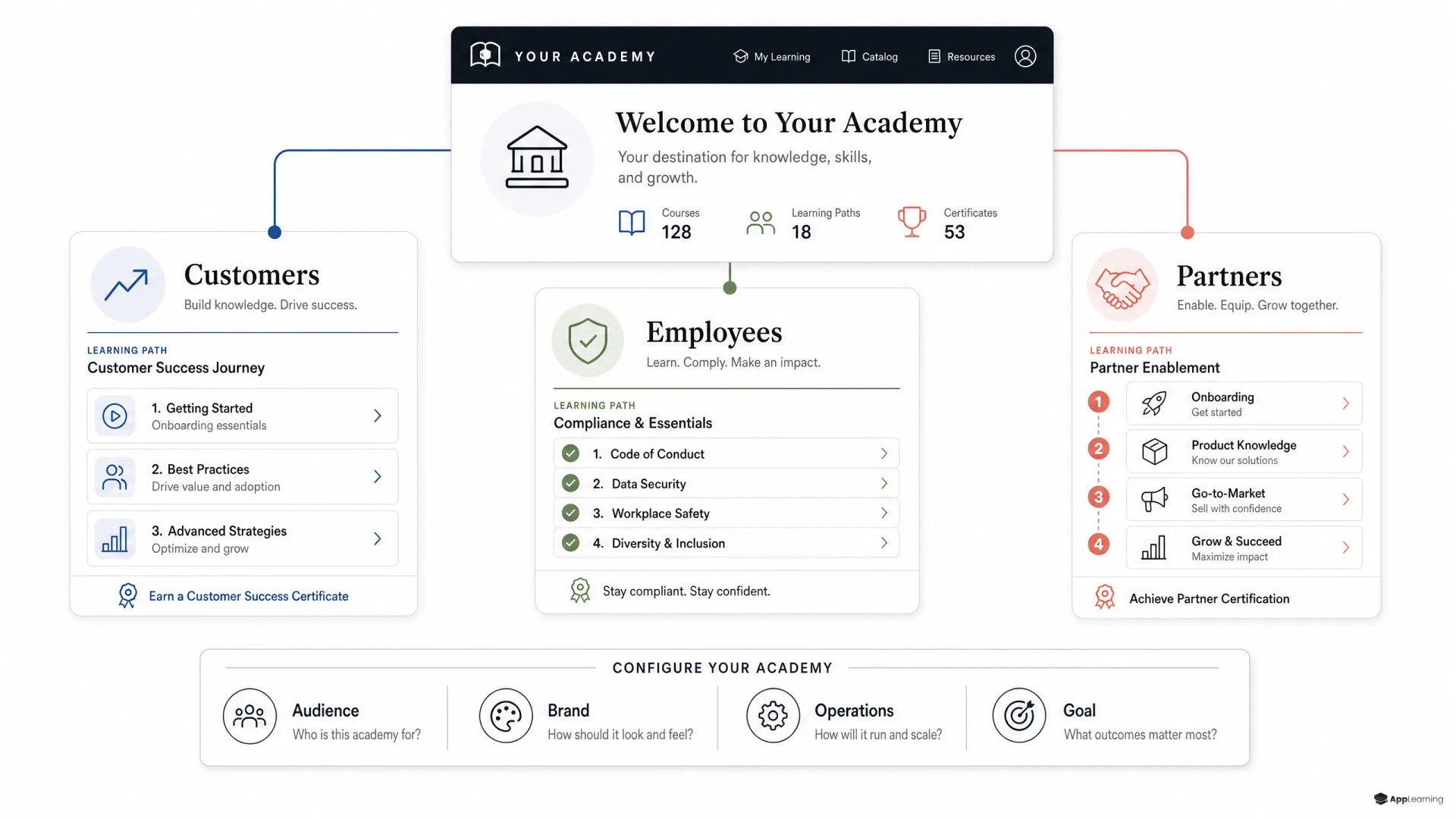
This is where App-Learning fits a specific operating need. Its academy platform supports branded microlearning, role-based paths, quizzes, analytics, and deep links from a product interface to a relevant learning module. That makes it practical to turn complex product education into short, measurable learning flows for customers, employees, or partners. (app-learning.com)
The Operating Model Decides Platform Fit
Feature checklists alone create expensive rework. Assess the system that must run after launch, especially when product releases, policy changes, and audience segments create a constant demand for updates.
- Brand surface coverage across domain, login, emails, certificates, notifications, and mobile.
- Audience separation for customers, employees, partners, regions, product tiers, and roles.
- Content operations that let subject-matter experts review and update lessons without a production bottleneck.
- Learning formats that simplify difficult topics through short lessons, scenarios, quizzes, and reinforcement.
- Analytics that connect learning progress with activation, support demand, certification, retention, or revenue.
- Integration readiness for SSO, CRM, lifecycle messaging, product analytics, and data exports.
Good to know
Which platform type is best for customer education?
Choose a customer education or branded academy platform when learners are external, voluntary, and closely tied to product adoption. Prioritize frictionless access, audience segmentation, integrations, and analytics beyond course completion.
Can one academy support customers and employees?
Yes, if the platform separates roles, permissions, learning paths, and reporting. Start with one audience first, then add the second only after the content workflow and measurement model work.
What should a fintech team measure beyond completion rates?
Measure the next product behavior after learning. Useful signals include security setup, first deposit, feature adoption, fewer avoidable support contacts, and retention by learner cohort.
Business Model Narrows the Shortlist
Platform fit becomes clearer when the business model is explicit.
- Choose a course platform when education is a standalone product with checkout and subscriptions.
- Choose an enterprise LMS when compliance, employee administration, and recertification drive the programme.
- Choose a customer education platform when adoption, account health, and external learner access matter most.
- Choose a branded academy system when education must support several audiences while remaining close to the product experience.
See how a branded academy can support your next product education release.
ExploreA Focused First Release Beats a Big Catalog
Start with one high-value audience and one measurable journey. Define the product or business action learners should take, build the smallest learning path that prepares them for it, and agree on the event data needed to judge the result. Assign one owner for content accuracy, one for learner experience, and one for measurement before adding more courses.
The strongest academy is not the one with the longest catalogue. It is the one that stays current, feels credible in the brand, and helps people make better decisions at the moment those decisions matter. When that system is in place, education becomes a durable lever for growth, enablement, and compliance rather than a collection of videos.