

Key takeaways
- Interactive training has behavior that can break after changes.
- A fixed issue must be retested in the learner-facing flow.
- Assessment logic needs the same release discipline as application logic.
- Regression testing matters when completion serves as readiness or compliance evidence.
A policy sentence, video or PDF primarily carries information. Interactive compliance training does more. It stores response state, unlocks steps, grades answers, branches scenarios and writes completion evidence. Once a module works this way, compliance training QA cannot stop at proofreading. It must verify behaviour in the same learner-facing flow used for onboarding, recertification and evidence of completion.
A compliance module becomes a stateful system
A learning module is not software in every respect, but its interactive parts have software-like behaviour. A change to one answer option can affect scoring. A revised scenario can alter the route a learner takes. A design adjustment can hide feedback or make the next step available too early. The ISTQB definition of regression testing describes it as change-related testing that detects defects introduced or uncovered in unchanged areas. That is the right operating model for assessment testing after a content or configuration change.
This matters most when an academy is more than a communications channel. In finance, banking and crypto environments, a pass result may signal that someone has completed a required learning path or demonstrated knowledge of a control. If the learning flow produces the wrong outcome, accurate copy does not protect the integrity of that record.
Small changes can alter the evidence
The risk is usually not dramatic. It is a small mismatch between intended and actual behaviour. But small mismatches can change what the learner sees, selects or receives as a final result.
- A retry keeps a previous answer selected when the learner should start fresh.
- Correct feedback appears, but the score still treats the answer as incorrect.
- A branching scenario sends a learner to the wrong consequence or explanation.
- Navigation permits learners to bypass a required interaction.
- A completion badge is issued before all mandatory assessment steps are complete.
- A mobile layout hides a response option, hint or submit control.
These are not editorial defects. They are failures in state, logic, navigation or presentation. Training quality assurance must therefore cover both the content and the path through that content.
A CMS review cannot prove a learner path
The authoring view can show the correct question, answer key and completion setting while the academy still behaves incorrectly. Editors inspect configuration. Learners encounter rendered screens, session state, responsive layouts and platform logic. Those are different layers of the system.
We saw the practical importance of this during a recent live demonstration of a compliance-oriented academy. A problem was corrected, then independently replayed in the learner-facing experience before it was considered resolved. The fix was not accepted because the CMS record looked right. It was accepted because the expected learner journey worked again.
This discipline also aligns with the wider logic of managed security learning. NIST guidance requires security literacy training content to be updated at defined intervals and after defined events, while its assessment procedures examine training materials, records and the mechanisms used to manage training. For high-stakes learning, evidence needs to cover more than whether a module was published.
Good to know
What is regression testing in compliance training?
It is a repeatable check that confirms a content or configuration change has not broken question logic, scenarios, navigation, scoring or completion behaviour that previously worked.
Which changes need a regression check?
Prioritise changes to assessments, answer keys, pass thresholds, branching scenarios, mandatory steps, completion rules, responsive design and platform integrations. Use a lighter check for simple text-only corrections.
Can editorial review replace learner-flow testing?
No. Editorial review can confirm that content is accurate in the CMS. It cannot confirm what a learner can see, select, submit, retry or receive as a completion result.
Regression testing becomes release discipline
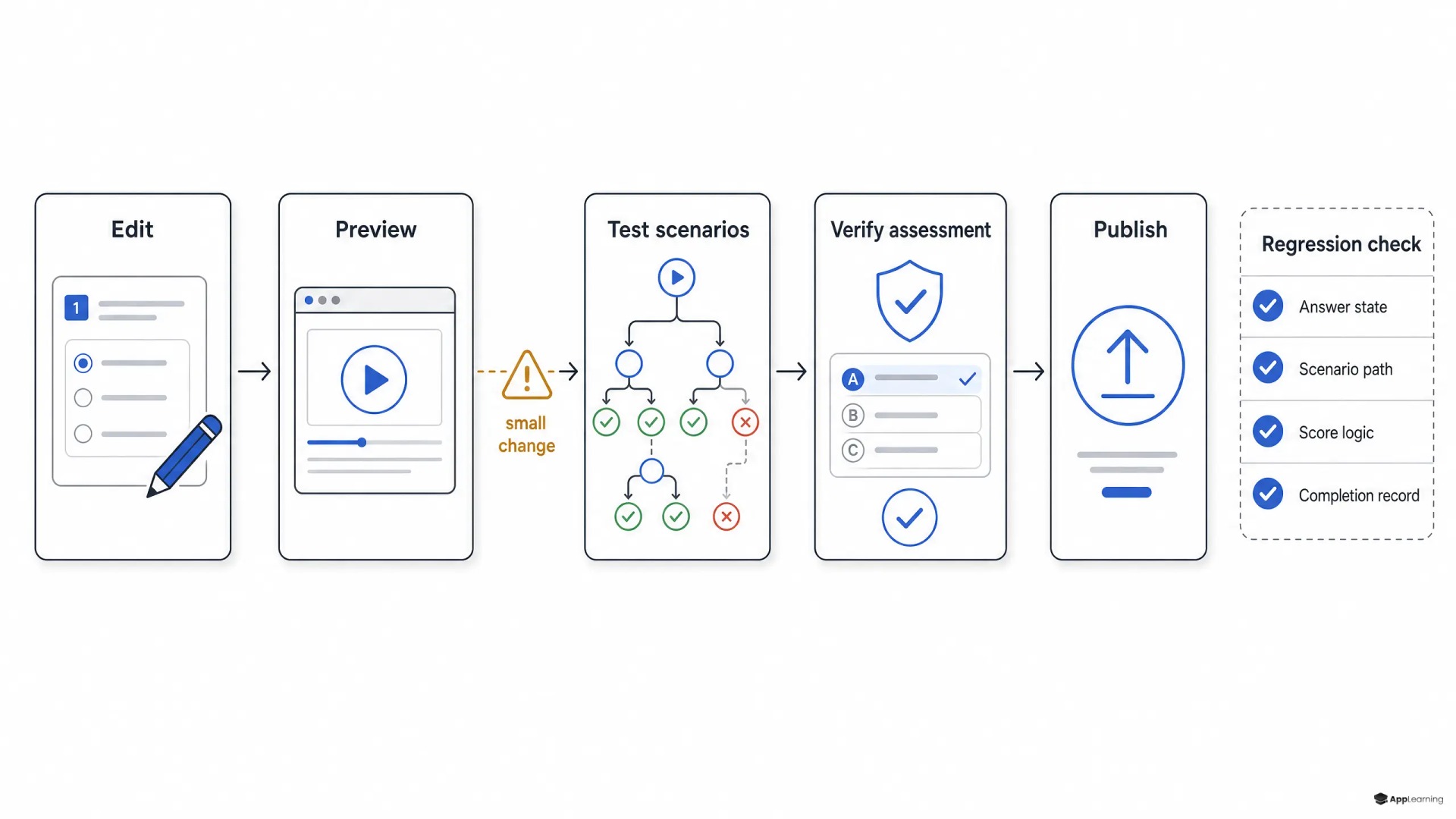
LMS regression testing does not need to mean a large QA team or a fully automated test suite. Start with a small, repeatable checklist for every meaningful update. The list should describe the critical learner journeys that must continue to work after a change.
- Open the module as a learner on desktop and mobile.
- Complete each changed question with correct, incorrect and retry paths.
- Confirm feedback, scoring and answer-state behaviour.
- Run the main scenario branches and check the intended consequence screens.
- Test mandatory navigation and any blocked or unlocked steps.
- Verify pass thresholds, completion status, certificates and reporting events.
- Record the release version, test date and reviewer for higher-risk modules.
The scope should follow risk. A minor wording correction may need a focused check. A new assessment, changed passing score, revised scenario logic or platform release deserves a fuller regression pass. The goal is not to test every possible click. It is to protect the outcomes that matter.
Build compliance learning that stays correct after every release.
DiscussVerification must sit inside learning operations
At App-Learning, content QA and product-level verification belong in the same operating model. A content owner checks accuracy, clarity and policy alignment. A learner-flow check confirms that questions, scenarios, navigation and completion rules behave as designed in the academy itself. This gives HR and L&D teams a cleaner handover between compliance, content and platform operations.
It also makes analytics more useful. Completion, pass and attempt data can only support decisions when the underlying assessment logic is reliable. Treating interactive learning as testable product behaviour protects that foundation while allowing teams to update content quickly.
The central discipline is simple: every meaningful change creates a new version of learner behaviour. When a module carries compliance, readiness or control evidence, that behaviour deserves to be checked before the release is trusted.