

Key takeaways
- Query permissions govern access at the source, not every downstream copy.
- Each learner data export needs defined recipients, purpose and retention.
- Agents and scheduled automations need explicit identities and governed destinations.
- Permission testing must cover denied reads, downloads and onward sharing.
- Vendor claims require deployment-specific evidence, not assumptions about certification.
When Learner Data Leaves the Governed Dashboard
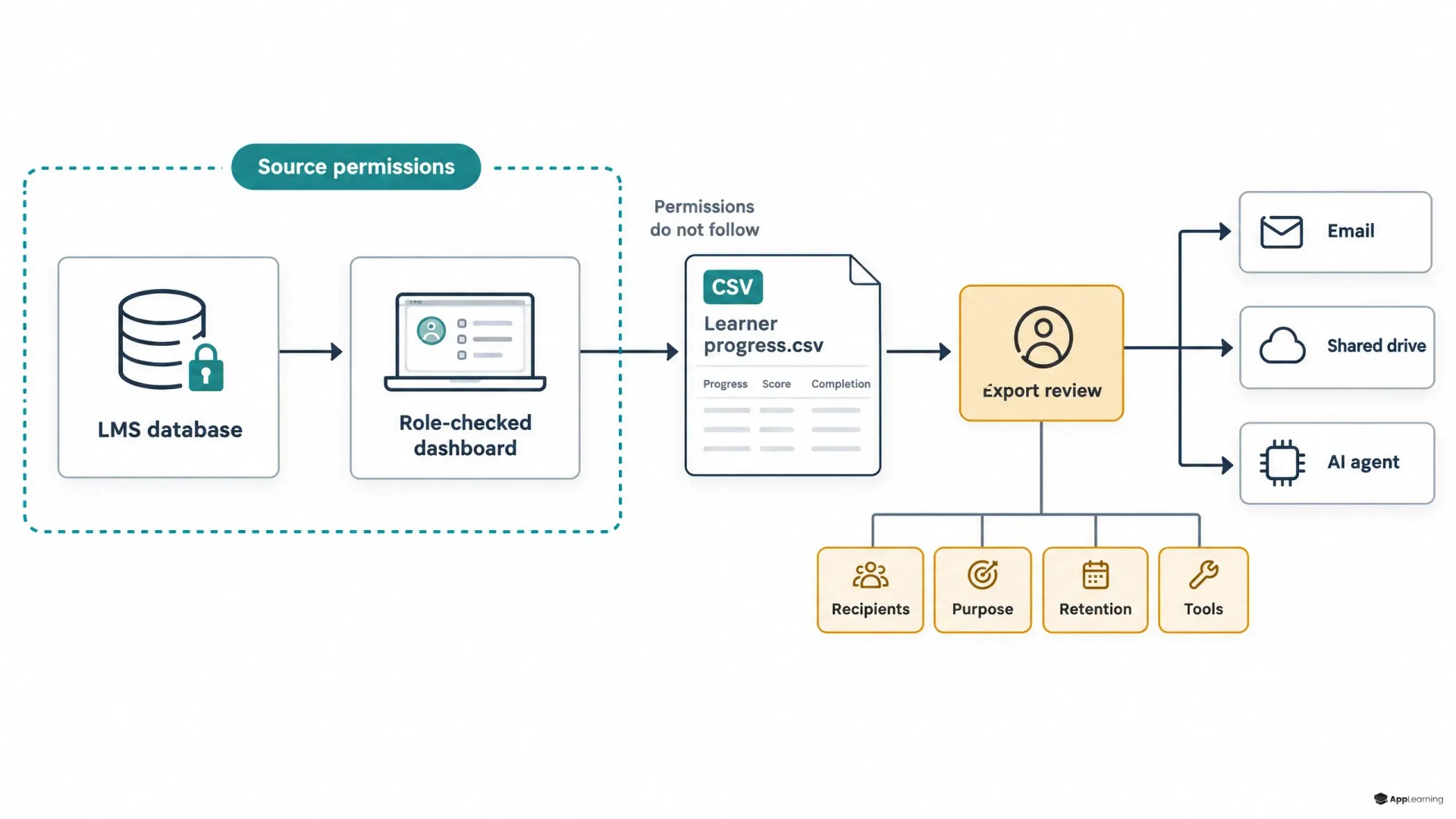
Consider a bank’s AI academy. A manager can view only their team’s progress, scores and completion status. The SQL query respects that restriction. The manager downloads a CSV, emails it to a project group and uploads it to an analysis agent. The query was permitted. The recipients and downstream processing were never assessed.
That learner data export creates a second governance boundary. Permission to view records is not permission to distribute them wherever analysis becomes convenient.
Retool separates query enforcement from copy governance
Retool’s November 9, 2026 explainer (retool.com) explicitly states that original source permissions do not accompany data copied, cached or passed through another service. It also describes centralized governance and query-level audit logs, while identifying PostgreSQL Data Access Enforcement as public beta at publication.
Retool’s configuration documentation (docs.retool.com) limits access policies to PostgreSQL resources and requires enforcement to be enabled and policies activated. This is not universal coverage across databases, exports or downstream tools. Query enforcement and copy governance solve different problems.
The trust boundary follows the learning-data path
A review map might run from Firebase or another LMS datastore through analytics, a dashboard, an export, shared storage, email and an agent. Each transition needs a named owner and an explicit processing purpose.
For App-Learning, the enterprise LMS trust model should be assessed across this whole path, not reduced to tenant isolation. This is a proposed review framework, not a claim that particular product controls already exist.
GDPR obligations extend beyond the download button
For processing within GDPR scope, Articles 5 and 32 (eur-lex.europa.eu) require purpose limitation, data minimization, storage limitation and security appropriate to risk. A GDPR LMS review therefore needs to examine the exported records, not just database access.
The European Commission’s explanation of processing roles (commission.europa.eu) distinguishes organizations determining purposes and means from processors acting on their behalf. The bank, LMS provider and analysis services need assessment against their actual activities; an export does not automatically create a new controller.
A practical learning analytics governance checklist should cover these decisions.
- Roles and approval — Separate permission to query, download, approve exports and access shared reports.
- Minimization — Match fields and cohorts to the purpose; prefer aggregate readiness reports where individual records are unnecessary.
- Recipients — Record approved people, storage locations and downstream tools before release.
- Retention — Define expiry and deletion responsibilities separately for exports, analysis outputs and required completion evidence.
- Revocation and DLP — Test managed-link withdrawal and data loss prevention rules; distinguish these from recalling downloaded files.
- Audit — Correlate requester, approver, query, export identifier, destination and deletion events without duplicating learner records in logs.
Agents need permission tests beyond the prompt
NIST’s Generative AI Profile (nvlpubs.nist.gov) identifies privacy risks and indirect prompt injection through retrieved data. For learner analysis, the test plan should include excessive tool permissions, retained prompts, generated files and recurring jobs with outdated recipients.
- Unauthorized user — Attempt another team’s records through dashboard and export endpoints; expect denial and an audit event.
- View-only manager — Attempt download and onward sharing through managed reporting; verify the configured restrictions.
- Scheduled agent — Remove its authorization and retry delivery to an unapproved destination; verify blocking and traceable failure.
Review your academy’s learner-data flow with App-Learning.
DiscussProcurement needs evidence from the proposed deployment
For enterprise academy compliance, procurement should request a data-flow diagram, permission-test results, retention settings and a sample export-to-agent audit trace. Evidence should identify the product version, plan, hosting model and enabled configuration. Marketing descriptions should remain separate from independent assurance reports and their scope.
A bank needs credible evidence of workforce readiness without uncontrolled employee-level copies. The strongest LMS security review follows a learner record beyond the dashboard and establishes who may receive it, why it remains necessary and where accountability ends.