

Key takeaways
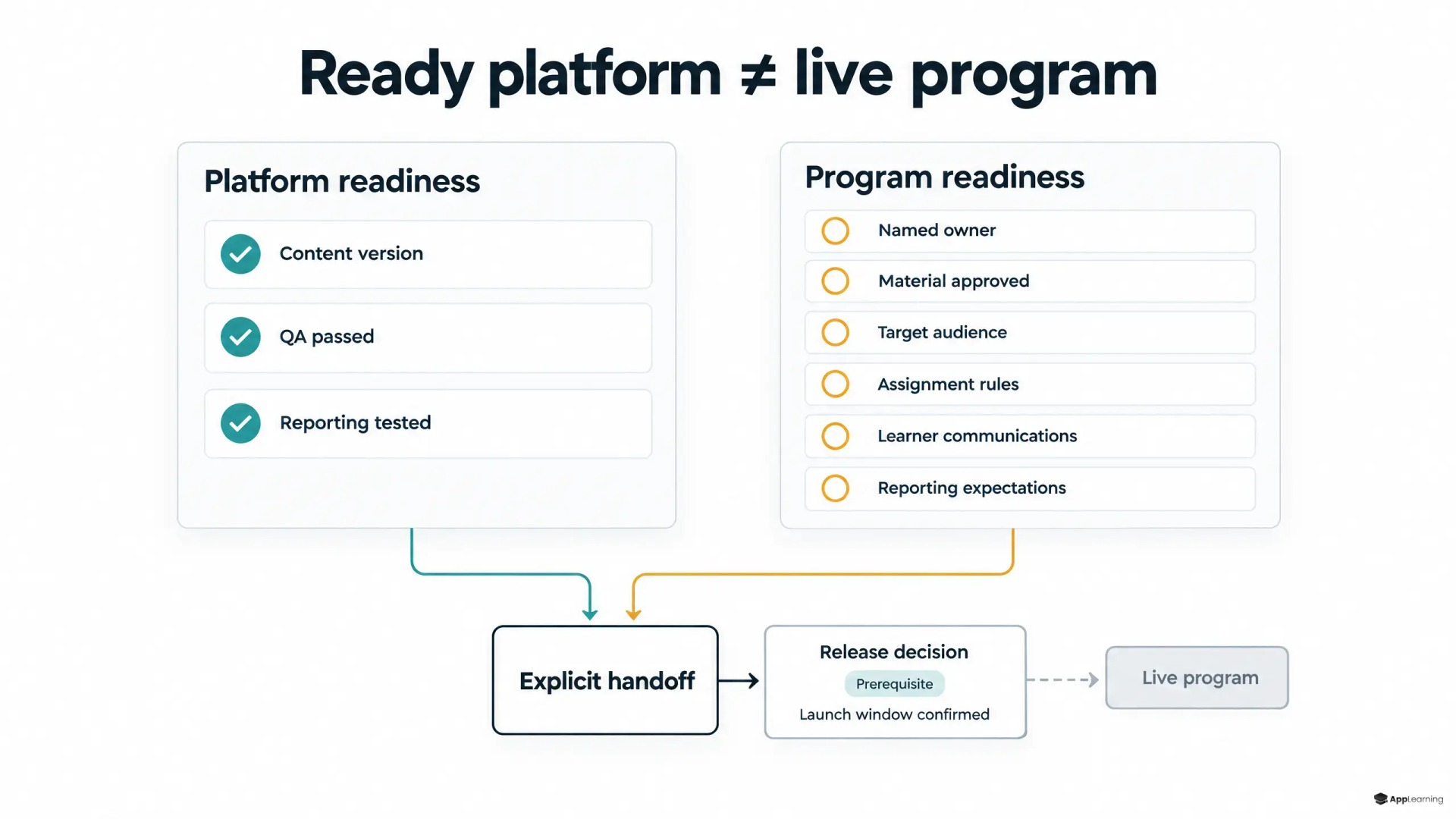
- Content readiness, platform readiness and rollout approval are separate decisions.
- One named program owner should hold accountability for the go-live decision.
- Audience rules, deadlines and learner messages belong in launch approval.
- Reporting expectations need agreement before assignments begin.
- Early rollout checks and maintenance ownership complete the handoff.
A risk-training module can complete technical review while its launch window remains unconfirmed. The course exists, but nobody has authorised assignments or told employees what happens next. Another content edit will not resolve that gap. The missing piece is a business decision.
Readiness has three distinct meanings
A useful compliance training launch checklist separates three states rather than treating “ready” as a single status.
- Content ready means the designated policy owner has approved the material, assessment and version.
- Platform ready means access, navigation, assessment behaviour, completion tracking and reporting have passed agreed tests.
- Rollout approved means the program owner has confirmed the audience, assignment rules, communications, reporting expectations and launch window.
Technical acceptance should not silently become rollout approval. A course can be available in an academy without being assigned to its intended population.
One owner authorises the launch
LMS go-live ownership should sit with one named internal program owner who has authority to approve or defer release. HR or L&D may coordinate the work without owning the underlying policy decision. The launch owner brings the required approvals together rather than replacing them.
- Compliance or the policy owner approves substance and required coverage, with legal review where needed.
- L&D accepts the learning journey and assessment.
- The academy operator confirms the tested configuration and known limitations.
- The program owner approves organisational timing and release.
Audience rules turn approval into assignments
Audience definition is more than an upload task. For covered financial entities, DORA Article 13(6) requires compulsory ICT-awareness and digital operational resilience training for employees and senior management, with complexity matched to their functions. (eur-lex.europa.eu) That specific requirement illustrates why a platform operator should not infer training scope from an employee directory.
Before enabling assignments, the owner should confirm included roles and entities, approved exclusions, joiner rules, deadlines, reminders and escalation routes. Learner communications should explain the requirement, due date, access route and support contact. A test account should receive the same assignment and message as the intended learner.
Reporting is part of release acceptance
NIST’s training-records control calls for documenting and monitoring security and privacy training and retaining individual records for an organisation-defined period. (nvlpubs.nist.gov) It offers a useful design reference, not a universal retention rule for every compliance course.
For the compliance academy rollout, the proposed reporting specification should identify learner IDs, assigned course versions, due dates, completion timestamps and assessment results where required. It should also name report recipients, access permissions and the applicable retention decision. A sample export belongs in acceptance testing.
A short decision log closes the handoff
Training launch governance needs a durable record, not a long meeting. The go-live entry should capture the approver, decision date, course version, audience-rule reference, launch window, acceptance evidence and unresolved blockers. Approval, deferral and rejection should be explicit.
App-Learning can package this into two linked checklists covering course readiness and organisational rollout readiness. The managed academy supplies delivery evidence and executes the approved configuration. The organisation retains its policy decisions.
Clarify your academy’s launch handoff with App-Learning.
DiscussThe first days test delivery, not compliance
The U.S. Department of Justice’s compliance-program guidance asks how training effectiveness, learning and behavioural impact are evaluated. (justice.gov) Early enrollment and completion data answer a narrower question about whether delivery is working.
A scheduled post-launch check should reconcile expected and actual assignments, inspect notification failures and test completion records. The handover should also name owners for policy changes, content reviews, audience updates and platform support.
Publishing ends the build, not the program. A dependable launch connects approved material to an authorised audience, a clear message and usable evidence—with a named owner responsible for what happens next.