

Key takeaways
- An evidence pack makes financial education quality inspectable.
- Define measurable objectives before content production begins.
- Keep source records, versions, and review decisions auditable.
- Tie assessments and product metrics to stated learning objectives.
- Treat disclosures and conflict safeguards as operating controls.
Publication Is Not Proof
A polished learning hub can still be hard to defend. When a partner, compliance team, or regulator asks what a program intended to change, which claims it makes, and who approved them, scattered slide decks and legal copy do not form an answer. On 23 July 2026, the European Commission launched two financial-literacy initiatives that make this direction clear: successful initiatives can be submitted until 30 October 2026 for analysis against three criteria, while a voluntary code is being developed around transparent objectives, accurate and unbiased content, and conflict-of-interest safeguards, with adoption expected in the first quarter of 2027.
This does not create a new legal duty today. It does show where financial literacy governance is moving. For a fintech, the practical response is not a one-off compliance file. It is a financial education evidence pack that is maintained as the program changes.
Objectives Define the Evidence
Start before authoring. State the target audience, its relevant decision or product moment, the knowledge or capability gap, and the intended outcome. “Improve confidence” is too vague. “Help first-time investors distinguish diversification from performance prediction before selecting an investment feature” can be assessed and reviewed.
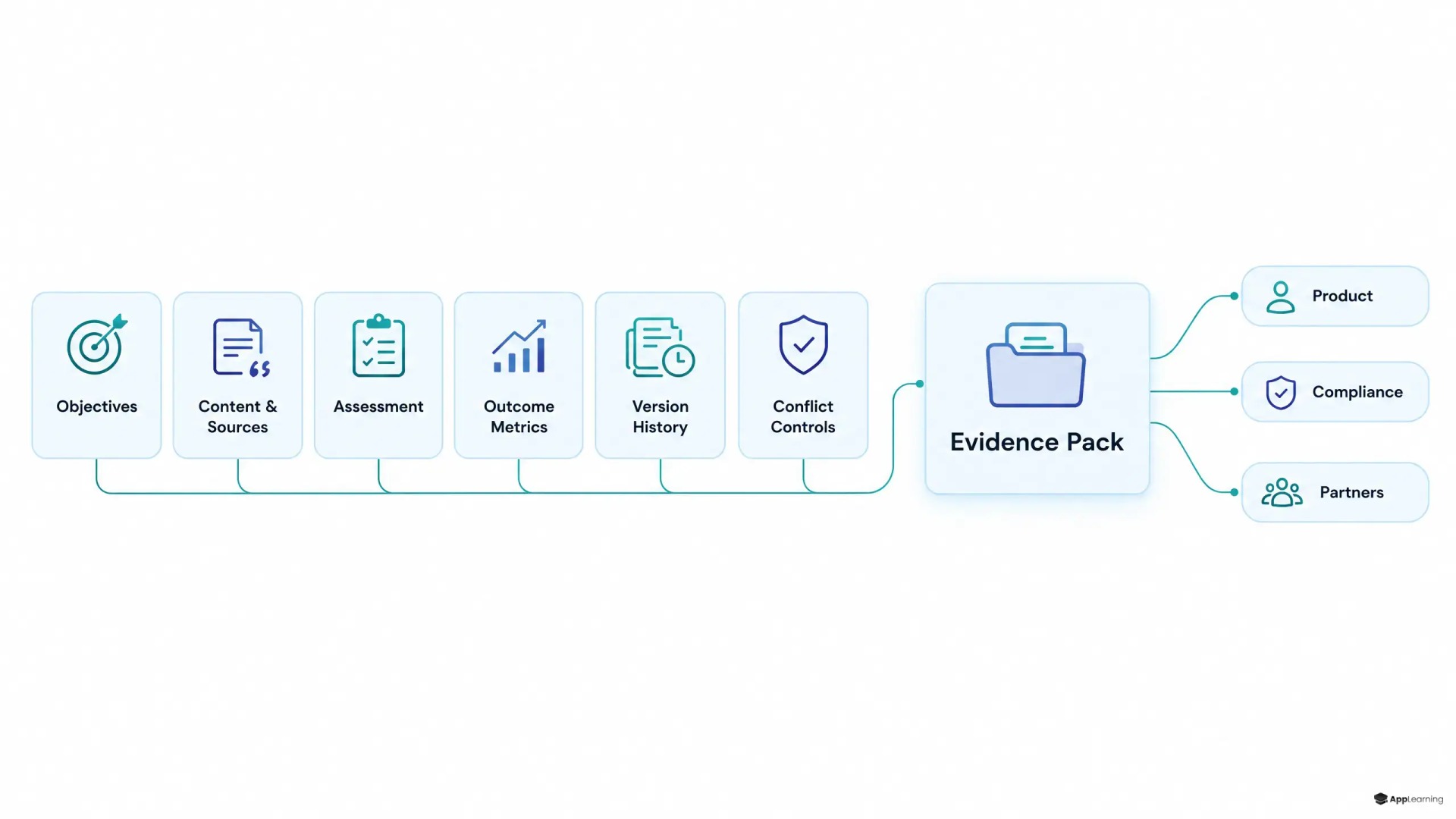
- Audience and market scope
- Learning objective and observable behavior
- Content modules that support the objective
- Assessment items and pass criteria
- Product, support, or follow-up metrics that indicate progress
This structure prevents a common failure in financial literacy program measurement: reporting completion as success when the program never defined what users should understand or do differently. Completion matters, but it is an activity signal, not proof of learning or appropriate product use.
Provenance Makes Content Defensible
Every material claim needs an owner and a source record. Store the source, publication date, market relevance, internal reviewer, approval date, and the module version that used it. When guidance, pricing, product flows, or risk disclosures change, teams can identify affected lessons instead of relying on memory and keyword searches.
Version history also protects the operating team. It distinguishes content that was correct when published from content that was never reviewed, and it gives local-market teams a controlled route to adapt examples without changing the underlying learning objective.
Assessment Must Follow the Objective
Assessments should test the decision skill the lesson claims to build. A quiz after a risk module should not reward recall of definitions alone. It should reveal whether a user can identify a trade-off, recognise uncertainty, or choose the next safe action inside the product.
Connect these results to outcome metrics with care. Look for patterns across knowledge checks, onboarding completion, feature activation, repeat support contacts, and later behavior. Do not claim causation from a dashboard alone. Use the data to locate friction, improve learning paths, and decide which content needs review.
Governance Sits Inside the Product
Financial education can become promotional when commercial goals shape what is taught, omitted, or measured. The evidence pack should therefore record conflicts, sponsorships, product relationships, mandatory disclosures, reviewers, and escalation ownership. Put these controls beside the lesson and workflow, not only in a legal repository that product teams never open.
That is the core of fintech education compliance: make quality controls executable. A clear owner should be able to pause a module, route a material update for review, and document the decision without rebuilding the audit trail by hand.
Good to know
What is a financial education evidence pack?
It is a maintained record linking a program’s objectives, audience, content sources, versions, assessments, outcome metrics, disclosures, and review decisions.
Which metrics should a fintech include?
Use measures that match the stated objective, such as assessment performance, onboarding progression, activation of the relevant feature, recurring support themes, and safe follow-up behavior.
Is an evidence pack only for regulated financial institutions?
No. Any provider that teaches users about financial decisions can use one to improve quality control, partner due diligence, and internal accountability.
Due Diligence Needs a Usable Package
Partners and enterprise clients often ask the same questions: Who is this for? What is the educational purpose? Which sources support it? How is it reviewed? How do you know it works? A standard evidence pack answers these questions once and reduces repeated document hunts across sales, product, legal, and operations.
It should be concise enough to inspect: an objective map, curriculum inventory, source and version register, assessment design, metric definitions, disclosure record, and review log. This is not paperwork for its own sake. It is the operating record behind credible financial education quality.
Make every learning journey ready for scrutiny.
TalkThe Academy Becomes the System of Record
A managed academy can produce this record as part of normal delivery. Objective-to-content mapping, source and version fields, quiz evidence, completion and behavior signals, disclosures, and approvals become native program data rather than a manual project after launch. App-Learning applies this model to embedded, mobile-first learning journeys, so product teams can improve activation without losing control of educational quality.
The durable advantage is not simply having more lessons. It is being able to show, at any point, what the program is designed to achieve, why each lesson exists, how it is governed, and what evidence supports its performance. That turns financial education from published content into a credible product capability.