

Key takeaways
- AI signals should prioritise review, not determine instructor performance.
- Every quality flag needs a visible rubric, source evidence and correction route.
- Adaptive teaching must be assessed in context, not as transcript deviation.
- Keep developmental coaching separate from decisions that affect employment.
- Validate QA against learner performance and application, not script adherence.
Quality assurance crosses a line
Learning quality assurance becomes algorithmic management L&D when a model-generated score changes how an instructor is supervised, coached or judged. The distinction does not depend on whether a vendor calls the system “QA”. It depends on the operating consequence. If a risk label repeatedly directs manager attention, creates a record or affects an instructor’s prospects, it is part of performance management.
A continuous observation model
The September 28, 2026 Guardian report said Multiverse uses AI-scored transcripts, risk labels and confidence scores for manager review, while people retain performance decisions. (theguardian.com) This is the critical boundary. AI instructor monitoring can help a learning team find sessions worth reviewing. It becomes harder to defend when a continuous stream of signals behaves like a standing judgment on the instructor.
The problem is not that managers receive more evidence. The problem is when the signal becomes the evidence. A low-risk status can discourage useful scrutiny. A high-risk status can create a presumption of weak performance before anyone has reviewed the session, learner context or teaching choices.
Context is missing from the transcript
Transcript analysis can spot repeated filler words, long silences, unclear instructions and unaddressed disruption. Those are useful prompts. But a transcript has weak access to instructional context: a learner may need extra explanation, a difficult question may require a productive detour, and a quiet group may be concentrating rather than disengaged.
- A follow-up question can look like a digression.
- A self-correction can show care rather than lack of knowledge.
- A pause can support reflection rather than signal poor facilitation.
- A session plan can need to change when learner needs change.
This is where AI teaching evaluation often fails. It converts observable language patterns into assumptions about teaching quality. A good rubric should define what reviewers are looking for, but it must also state the contextual evidence that can overturn a model flag.
The model belongs in the triage queue
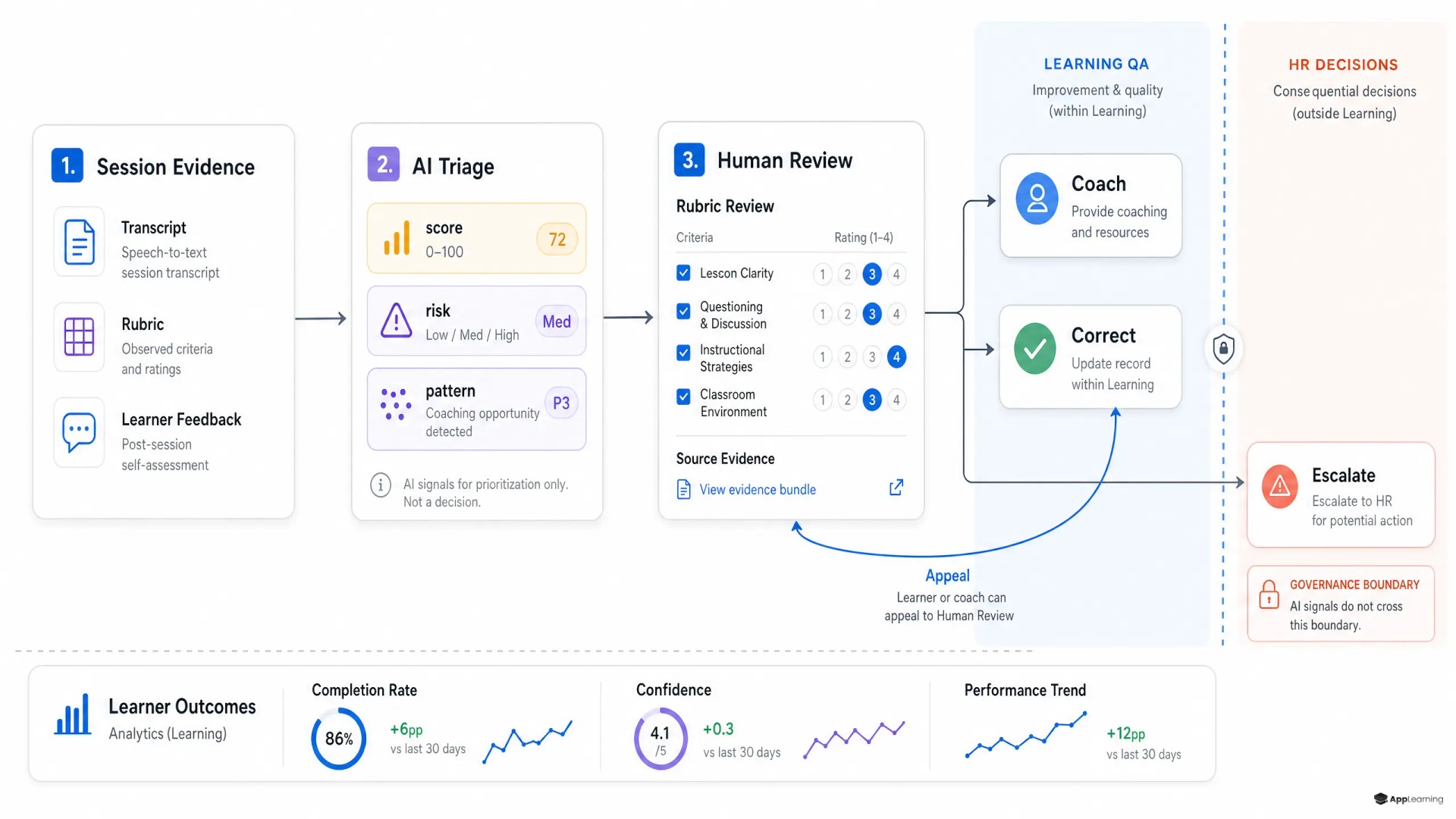
A defensible system treats model output as a triage layer. It creates a review queue, not a performance verdict. The UK Information Commissioner’s Office says worker monitoring needs a clear purpose and the least intrusive means that can achieve it, while warning that monitoring should not happen “just in case”. (ico.org.uk) The same discipline improves learning operations even where that guidance is not the governing legal standard.
- Label each signal as a prompt for review, not a finding.
- Show the rubric criterion, source excerpt and model confidence together.
- Use sampled sessions and calibrated reviewers rather than continuous score accumulation.
- Record the reviewer’s rationale separately from the model output.
- Set retention limits and restrict who can see instructor-level records.
Good to know
What makes AI-assisted QA different from instructor performance scoring?
QA identifies evidence for improving learning delivery. Performance scoring assigns a judgment to a person. The line is crossed when AI signals shape formal ratings, pay, progression, disciplinary action or sustained manager scrutiny without a separate human review process.
What should an instructor see when a session is flagged?
They should see the rubric criterion, the relevant session evidence, the model signal, the reviewer’s interpretation and the route to add context or request correction. A risk label without those elements is not actionable feedback.
Can AI-supported QA help with regulated learning?
Yes, when it helps teams sample delivery evidence, identify possible gaps and document human review. It should support assurance workflows without assuming that a transcript pattern proves an instructor or compliance failure.
Evidence and challenge create trust
Instructors should be able to see the observation rubric, the underlying session evidence, the reviewer’s conclusion and the status of any correction. They also need a usable challenge path. That does not mean every flag triggers a formal appeal. It means a teacher can correct missing context, contest an inaccurate transcript or explain an instructional decision before a label becomes part of their record.
For managed academies, App-Learning can frame this as a review workflow with explicit rubrics, sampled evidence, reviewer assignments, feedback history and correction states. That creates traceable academy quality management rather than a hidden score that follows an instructor from session to session.
Coaching and HR need separate rails
The same session can support development and employment action, but those workflows should not be casually merged. Coaching needs psychological safety, specific feedback and room to experiment. Consequential decisions need a higher evidence threshold, independent human judgment and clear decision rights. In regulated finance and crypto environments, keep assurance that mandatory learning was delivered separate from HR evidence about individual performance unless the use case, access and governance have been explicitly defined.
Make instructor QA rigorous without turning it into surveillance.
DiscussOutcomes are the only meaningful score
A quality signal earns its place only if it helps explain or improve learner outcomes. Connect QA observations to assessment performance, completion of required practice, confidence, manager-observed application and, where feasible, business or compliance indicators. Control for cohort difficulty, content changes and learner starting levels. Otherwise, the system will optimise for script adherence because that is what it can count most easily.
The durable design line is simple. Use AI to widen the evidence available to skilled reviewers, not to narrow teaching into whatever a transcript model can measure. Instructor quality is a professional judgment with consequences for people and learners, so it should never be reduced to an opaque score.