
Key takeaways
- Works councils need a different AI competency model than end users.
- Focus the curriculum on work design, monitoring, responsibility and decision rights.
- Scenario-based reflection turns technical claims into negotiable workplace consequences.
- Run parallel AI learning tracks for employees, leaders, technical owners and representatives.
- Treat co-determination readiness as a measurable rollout condition.
The learner group enterprise AI programs miss
Most enterprise AI governance training follows the rollout chart. Employees learn safe use. Managers learn adoption. Technical teams learn controls and architecture. Legal and risk teams review the policy. The works council often enters only when a specific use case reaches consultation. That sequence creates a predictable problem: employee representatives must judge effects on work without the shared concepts, evidence and scenario practice that the project team has built over months.
This is not a request to turn works council members into data scientists. It is a need for role-specific judgment. A German study of an adapted Implication Canvas found that a structured workshop format helped participants make assumptions, consequences and possible responses visible across technical, management and employee-representation perspectives. The small qualitative setting matters: it supports a practical training design, not a broad claim about training effectiveness.
Co-determination is a different job
A works council AI training track should not mirror employee prompt training. Its task is to interrogate the system around the work: what data enters it, what outputs shape decisions, who remains responsible, what skills move or erode, and whether the tool creates new forms of monitoring. Under Section 90 of Germany’s Works Constitution Act, employers must inform and consult the works council early on planned work procedures and workflows that include AI, including their effects on work and job requirements. Where a technical device is designed to monitor behaviour or performance, Section 87 creates a further co-determination issue.
For a bank, the questions become concrete fast. Does an AI meeting assistant create a new record of advisor performance? Does an operations copilot change who can override an exception? Does a knowledge assistant narrow the expertise expected from service teams? Does a model-supported workflow move accountability from a specialist to a line manager? These are organizational design questions, not feature questions.
The asymmetry that slows AI rollout
AI rollout discussions often begin with an uneven distribution of knowledge. Product owners know the target process. IT knows the integration. Vendors know the product language. The works council knows how work is actually done, where informal safeguards sit and which incentives a workflow will create. Without a common frame, technical assurance can sound conclusive while employee concerns remain broad and hard to translate into requirements.
German law recognizes part of this imbalance. When a works council must assess the introduction or use of AI, Section 80 of the Act treats the involvement of an expert as necessary. External expertise remains important. But it should support representative judgment, not substitute for it. A council that can ask precise questions will use expert input more effectively and move from general concern to testable conditions.
From literacy to socio-technical judgment
Employee representative AI literacy means being able to connect a technical system to its workplace consequences. This is broader than knowing how a large language model predicts text. It includes data flows, human oversight, error pathways, escalation rights, documentation, performance signals, deskilling risks and the allocation of final decisions. The EU AI Act’s AI literacy provision also makes context, technical knowledge and the people affected by AI use central to what sufficient literacy looks like. A dedicated council track is therefore a sensible part of enterprise AI governance training, even where it is not the same as a statutory compliance course.
Good to know
Is works council AI training a substitute for consultation or legal advice?
No. Training improves the quality of questions, evidence review and internal preparation. It does not replace the employer’s duty to inform and consult the works council early on relevant planned AI-supported work procedures under Section 90 of the Works Constitution Act), nor does it replace legal or technical expertise.
What should a Betriebsrat KI Schulung avoid?
Do not make prompt technique the centre of the curriculum. Avoid generic AI history, vendor-led feature tours and abstract ethics debates without a live workflow. The useful unit of learning is a concrete use case with identifiable people, decisions, data and consequences.
When should the co-determination learning track begin?
Start when a use case enters the intake or discovery stage, before configuration, procurement and employee communication make key choices hard to reopen. Repeat short scenario sessions as the workflow, data sources or affected roles change.
A parallel academy track for co-determination
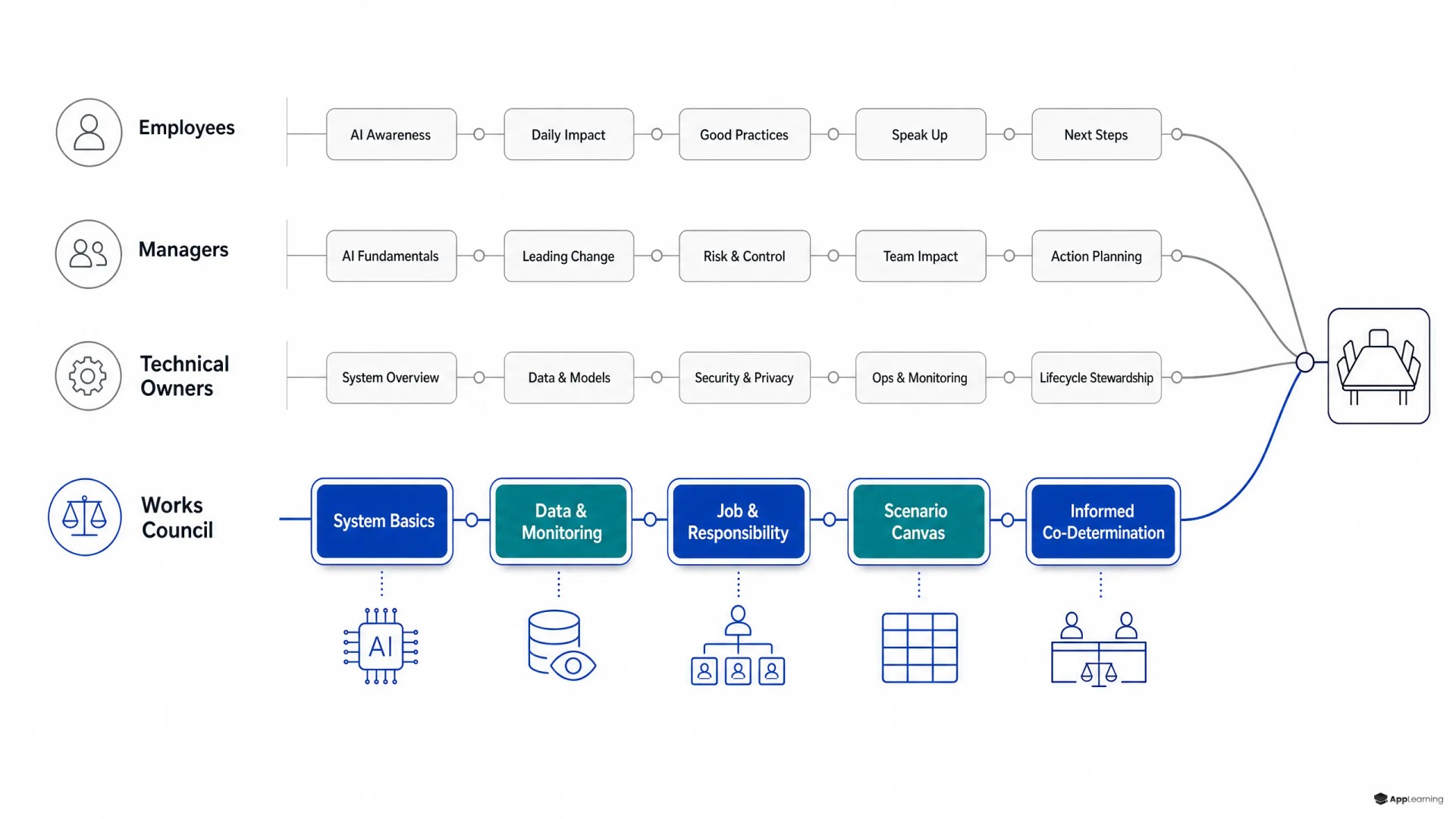
Build works council AI training as a parallel track alongside employee, manager and technical-owner journeys. Keep it short, case-led and tied to the bank’s live intake pipeline. A practical Betriebsrat KI Schulung can cover:
- System capabilities and limits without vendor theatre
- Data flows, access rights, retention and monitoring signals
- Human responsibility, overrides, escalation and decision rights
- Job design, workload, skill shifts and deskilling risks
- AI co-determination options and the evidence needed for consultation
This is not a separate awareness campaign. It is an operating mechanism. The learning journey should prepare representatives to participate before a solution is configured, not after a workflow and vendor contract have already set the practical boundaries.
Scenarios make consequences negotiable
The core exercise should be a real use case, not a hypothetical debate about AI. Take an internal knowledge assistant for relationship managers, an operations copilot for case summaries or a tool that drafts customer communications. Ask the group to map inputs, outputs, affected roles, error consequences, visible and hidden performance data, human checkpoints, fallback processes and the decision that remains with a person.
A structured canvas then turns the map into negotiation points: What must be true before launch? Which consequence is acceptable only with a safeguard? Which employee groups need different support? What evidence would show that the system is helping rather than quietly shifting risk? This gives employee representative AI literacy a usable output: requirements that product, risk, HR and operations can assess.
Build a works council learning track before your next AI use case reaches consultation.
Plan trackLearning evidence belongs in the rollout gate
Connect completion data to implementation milestones, but do not mistake completion for readiness. For each use case, record whether the relevant representatives have reviewed the workflow, completed the scenario session, documented open questions and received answers from technical and business owners. Use the same record to capture agreed safeguards, consultation status and the owners of follow-up actions.
That changes the role of learning. It becomes evidence that the organization has built the capacity to deliberate, not merely evidence that people clicked through a module. Banks that treat the works council as a learner persona can reduce avoidable friction without reducing scrutiny. The result is a stronger implementation process: faster where the case is clear, slower where the system still cannot explain how it will reshape work.