

Key takeaways
- Financial AI products are segmenting around professions, systems and work outputs.
- Shared fundamentals matter, but applied capability must differ by job family.
- Role packs should encode approved data, templates, controls and escalation routes.
- Assess the research note, model or client record employees actually produce.
- Modular learning architecture keeps role-specific content maintainable as vendor workflows change.
The end of generic financial AI literacy
A single finance AI course once looked efficient. Teach prompting, explain hallucinations, set a few data rules and issue a completion badge. That approach now breaks down in practice. An investment banker building a valuation model, an equity researcher drafting an earnings note and an adviser preparing for a client meeting may use a similar model. They do not use the same data, workflow, output or approval path.
The recent launches are product signals, not proof that one training method works better than another. Still, they show where the market is heading. Financial services AI training is splitting by job family. Banks need a shared baseline, but role-specific application must become the centre of the capability model.
A workflow stack for research and deal teams
OpenAI’s financial-services product announcement centres on research, financial modelling and client materials. It combines financial datasets with firm templates, while adding role-based access controls and exportable compliance logs. This is a workbench for teams whose outputs include valuation models, research notes and pitchbooks.
That changes the definition of investment banking AI skills. The relevant capability is not merely writing a good request. It is tracing figures to evidence, checking model logic, applying the firm’s formatting rules, separating draft from approved material and knowing when a senior reviewer must intervene.
An advisor layer built around the client record
Anthropic’s Claude for Financial Advisors release takes a different route. It packages connectors and skills for advisor work such as meeting preparation, portfolio analysis, documentation and compliance checks. Its integrations span the adviser stack, including custodians, portfolio platforms, CRMs, planning tools and meeting-capture systems.
Financial advisor AI training should therefore focus on client context, permissions, suitability, documentation quality and human judgment at the point of advice. A polished meeting brief is not enough. Employees must be able to identify missing client facts, avoid unsupported recommendations and route exceptions through the right review process.
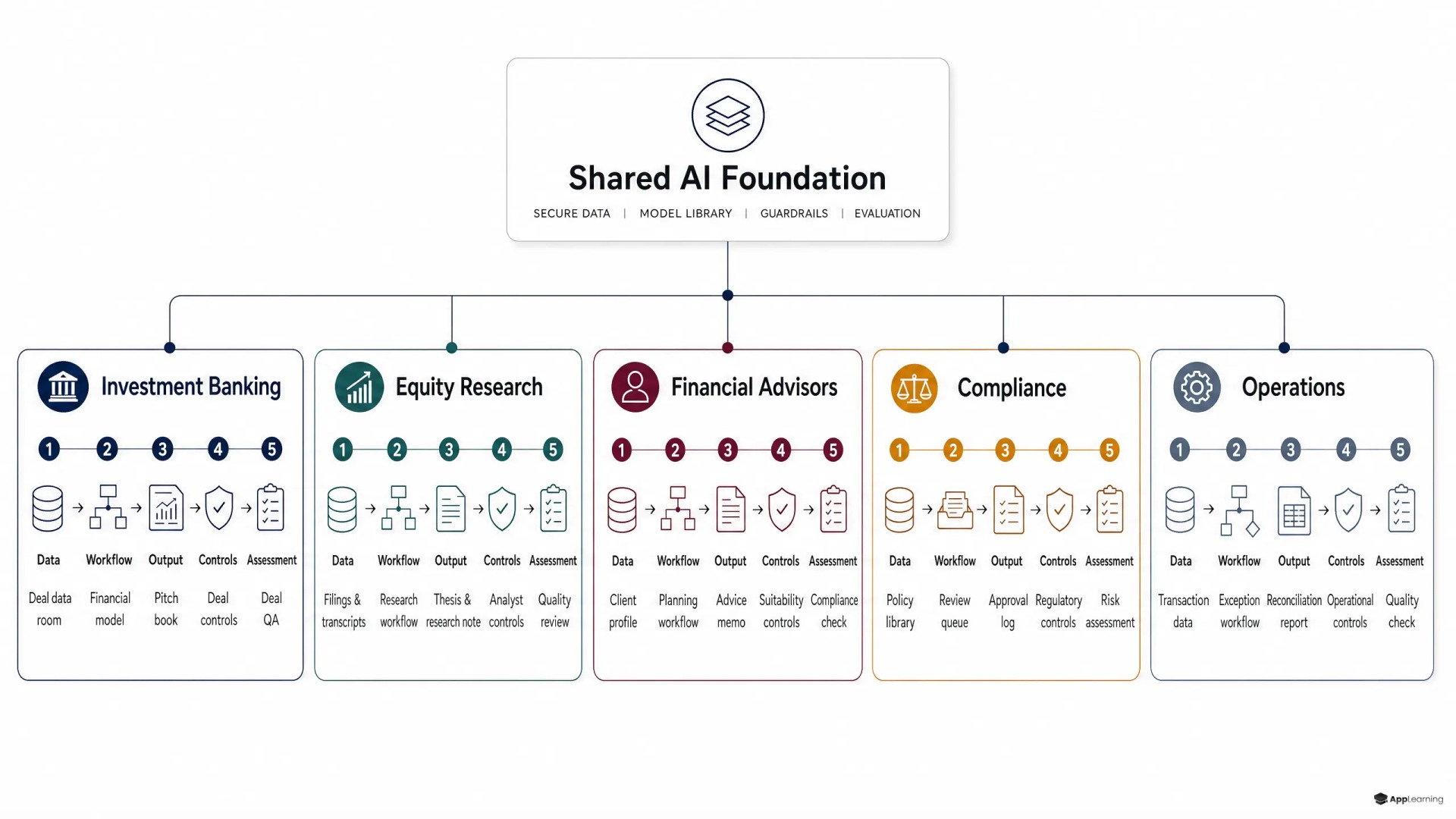
One foundation with evidence by role
A sound AI competency framework finance separates durable fundamentals from local execution. The foundation can be shared across the bank. It should cover model limits, confidential-data handling, source verification, prompt structure, recordkeeping and escalation. These are common operating disciplines, not a complete job capability.
The applied layer should differ by role. This is the core of role-based AI training banks can govern at scale: each job family learns how to use approved tools inside its real decision environment, rather than practising generic tasks in an isolated sandbox.
Good to know
Should every bank employee complete the same AI course?
Yes for the shared foundation. No for applied practice. Employees need common rules, but their workflow training and assessment should reflect their job family.
Which roles should receive the first AI role packs?
Start where AI use is active, outputs are repeatable and controls are clear. Investment banking, research, advisers, compliance and operations often provide distinct first use cases.
How can banks keep role-specific AI training current?
Use modular scenarios, templates and rubrics. When a vendor integration, policy or workflow changes, update the affected module instead of replacing the whole curriculum.
Role packs built from the work system
Each role pack should be designed around four elements that make the work distinct:
- Data sources that employees may access, plus the permissions and restrictions that apply.
- Tasks such as research synthesis, model review, meeting preparation, exception handling or document drafting.
- Outputs that the role must produce, including a research note, model, client follow-up, case record or control evidence.
- Controls that define review thresholds, disclosures, audit trails and escalation to compliance, risk or a manager.
This structure lets a bank retain one learning architecture while tailoring scenarios to investment banking, research, advisers, compliance and operations. In App-Learning, that can mean short simulations built around the firm’s approved templates, policies and systems, with a clear record of the decision or artifact a learner produced.
Assessment must test the artifact
Prompt recall is a weak proxy for readiness. A stronger assessment asks an analyst to correct a cited research draft, an associate to identify unsupported assumptions in a model, an adviser to prepare a compliant client note or an operations colleague to triage an exception. The learner should be assessed on the final artifact, the evidence used and the escalation decision.
That produces competence evidence leaders can use. It also exposes whether the problem is tool access, knowledge, judgment, workflow design or supervisory capacity. Completion data cannot make those distinctions.
Build AI capability around the work your bank needs done.
PlanCurriculum maintenance becomes a product discipline
Vendor workflows will change quickly. New connectors, templates, permissions and audit features can alter the safe way to perform a task without changing the underlying role. Banks should therefore version role packs as modular products. Update the affected scenario, policy reference, system walkthrough and assessment rubric rather than rebuilding the entire programme.
The strategic objective is not to chase every new AI feature. It is to make adoption reliable where the bank creates value and carries risk. Shared foundations create consistency. Job-specific practice creates credible capability. That combination turns AI learning from a generic awareness programme into an operating system for controlled change.