

Key takeaways
- Prompt literacy is not enough for governed financial agents.
- Data entitlement literacy must vary by role, source and permitted use.
- Citations, confidence signals and audit snapshots are user controls.
- Assessments should test source choice, interpretation and escalation decisions.
- Learning evidence can strengthen agent rollout governance.
Financial AI becomes a governed workflow layer
Financial AI changes character when an agent can work across licensed market data, confidential client files and internal systems. The critical unit is no longer the prompt. It is the governed workflow: which sources the agent can use, what it may produce, how its reasoning is evidenced and where it must hand work back to a person.
This makes employee capability a control issue. A bank can configure permissions and technical guardrails, yet still create risk if users cannot distinguish an authorised source from an appropriate source, or a cited output from a decision-ready conclusion.
Data entitlements become a learning problem
Data entitlements determine what an agent can retrieve for a given user, but they do not teach that user the meaning or limits of access. Data entitlement literacy means knowing which data is permitted for a task, how licensing or confidentiality constrains reuse, and what to do when an answer depends on a source outside the user’s mandate.
That is the gap in much financial AI training. Generic modules explain prompting, hallucinations and policy principles. They rarely teach the operational boundary between a research note supported by approved sources and an apparently credible answer that cannot be relied on, shared or acted upon.
Five user competencies around the agent
The competency model should mirror the agent workflow. NIST’s AI Risk Management Framework calls for defined human-AI roles, relevant risk-management training and documented proficiency for users and overseers. For financial research agent training, translate those expectations into five observable skills.
- Permission — identify the sources, data fields and outputs permitted for the user’s role.
- Provenance — read citations, distinguish primary records from derived content and check data currency.
- Confidence — treat a confidence signal as an invitation to verify, not permission to proceed.
- Auditability — preserve the method, source set, output and decision record required by the workflow.
- Escalation — recognise missing evidence, conflicting sources, sensitive-data exposure and decisions outside delegated authority.
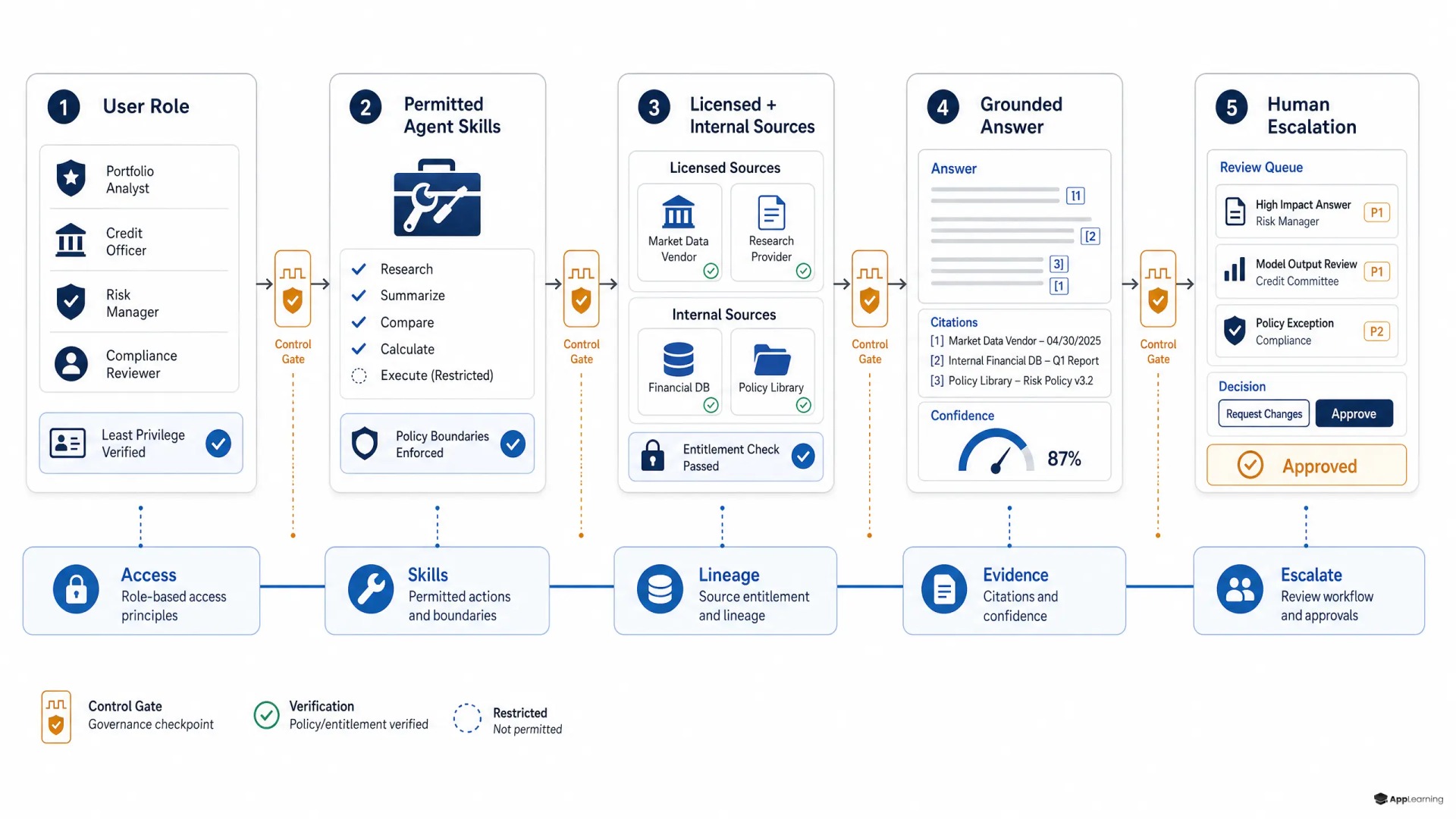
Roles, sources and permissions must align
Do not deploy one academy for every employee. Build a role-to-agent map. A relationship manager may need guided access to approved client context and product materials. A research analyst may need licensed market data, source comparison and methodology review. KYC and compliance teams may need corporate records, exception handling and evidence capture. Risk and control teams need to test whether the workflow is operating within its stated boundaries.
Each learning path should name the allowed sources, prohibited uses, output types, review triggers and escalation owner. The map does not grant access. Identity and access management, data owners and licensing controls remain authoritative. It makes the bank’s existing decisions usable at the moment of work.
Good to know
Does data entitlement literacy replace prompt training?
No. Prompting remains useful, but it sits inside permissions, source rules, evidence requirements and escalation boundaries.
Should training grant access to licensed financial data?
No. Training should explain permitted use through safe scenarios, while live access remains controlled by entitlement systems and data owners.
Who should define escalation rules for an AI agent?
Product, business, risk, compliance, legal and data owners should define them together, with clear ownership for each exception type.
Assessments need the pressure of real research
Completion quizzes cannot establish agentic AI compliance. Use short simulations built around realistic research requests. Give learners an ambiguous client question, a limited set of sources and a role profile. Ask them to select compliant evidence, explain what the citations establish, identify a confidence limitation and document whether escalation is required.
Score the decision trail, not only the final answer. A polished memo based on an unapproved source should fail. A learner who stops, identifies the missing entitlement and routes the case correctly has shown the behaviour the control framework needs.
Training evidence becomes rollout evidence
Learning records should connect to deployment governance. Track readiness by agent, role, workflow, release and entitlement class. Record scenario performance, recurring failure modes and completed remediation. For European financial entities, the DORA logging standards require documented logging procedures and protections for log information; they do not prescribe AI training, but they reinforce the value of traceable operating evidence.
Pass scores should never grant production access by themselves. They can, however, show whether a population is ready for a controlled pilot, where extra supervision is needed and which workflow changes require renewed training.
Build governed agent readiness before you widen access.
Talk to usA different mandate for bank AI academies
For chief innovation officers, the goal is not to turn every employee into a model expert. It is to create reliable human participants in governed AI workflows. App-Learning can structure that work as role-specific, mobile learning journeys tied to real agent tasks, permitted sources and decision points.
The bank that treats citations, confidence, permissions and escalation as part of everyday capability will scale financial AI with more discipline. It will also give innovation, risk, compliance and business teams a shared operating language before agent access spreads faster than judgment.